Just because people refer to it as ethical persuasion, does that make it ethical? Who decides that it’s ethical? What makes your attempts to persuade or convince other people ethical or not? Could you be crossing the line already when it comes to your communication and sales strategies? What could that be costing you? What could you be risking?
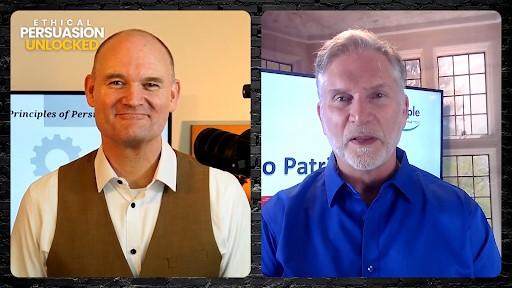
Ethics is not often talked about in sales, advertising or marketing training. But it should be central to our approach, because ethical persuasion helps us to achieve short and long-term results. And team members embrace and use it. Welcome to the first episode where we’re introducing a guest on the Ethical Persuasion Unlocked podcast. I’m joined by my friend and colleague Brian Ahearn, who is the Chief Influence Officer at Influence People and a faculty member of the Cialdini Institute.
He is an international speaker, coach and consultant, and Brian helps clients apply research-based approaches to influence to boost results. Brian is one of only a dozen Cialdini Method Certified Trainers in the world and was personally trained by Dr. Robert Cialdini, the most cited living social psychologist on the science of ethical influence. Brian has written four books on influence, including ‘Influence People’ which was named one of the 100 best influenced books of all time by book authority.
Okay, welcome everybody. We have a treat today. I’m joined today by Brian Ahearn, who’s one of the highly advanced trainers of the Cialdini Institute and also runs his own ⁓ business, of course. And today we’re gonna talk about ethics when it comes to ⁓ persuasion, because a lot of people when they hear the word persuasion, they think of manipulation. So Brian and I are gonna have bit of a discussion about that. We’re gonna touch on some questions which I’ll run you through in just a second. But first of all, ⁓ welcome to the podcast, Brian. Thanks for coming.
Brian Ahearn:
Hey, thank you for having me on, Patrick. It’s great to see you. It’s hard to believe it was already a year ago when Jane and I were in Australia and toured around with you in Hamizan and you guys made the trip extra special.
Patrick van der Burght:
Yeah, yeah, we had a great time together and it was great to also see you at work. All right, so we’re not really constrained about where we’re going to hear some of the questions that we might dive into in terms of ethics. So what exactly makes something ethical or not when it comes to our communication? Who decides that something is ethical or not?
What happens when staff are forced to be or asked to be unethical and what may be some of the costs that a business might experience when they conduct unethical communication or persuasion. I think it would also be good to touch on what makes it ethical or not to raise something that is urgent or use scarcity and yeah also interesting, what if your competitors are acting unethically?
How do we respond to that? All right, so Brian, is your experience or your connection to ethics when it comes to persuasion? I know you’ve got an interesting story that takes you way back. Would you mind sharing that?
Yeah, so if it weren’t for the word manipulation, you and I would not be having this conversation and we never would have met. When I was working for a large insurance company here in the United States, a coworker came down. She had been in our department and left, but she came down. She gave a video of Dr. Cialdini. She had seen it while she was studying for her master’s degree. And it was Dr. Cialdini at Stanford University presenting on the power of persuasion.
I watched the video with my boss and I was in the sales department and right away my thought was what he’s talking about is the underpinning of all selling.
It clearly explains why certain sales approaches work and why certain ones don’t. So it had relevance for me. The other thing I loved was it was all backed by research. I’m a very analytical guy and the fact that it wasn’t motivational hype or fluff really spoke to me that I could look at the hard data and see what a difference it made when you change your approach to influence. And the third thing that stood out was he was very clear about non-manipulative ways to move people to action.
So I began to use that video around the company. We would show it. We would talk about the concepts, how we might be able to apply them. During that time, I had signed up for Stanford’s marketing because his video is a great resource and they had a lot of other fantastic resources. But one day, one of his, one of the marketing flyers hits my desk and I’m paging through that and then boom, there’s Chaldini’s picture, big picture near the top of the page.
But at the very top, it said “Best seller”,and right underneath it, “call it influence, persuasion, or even manipulation”. And I just thought, I cannot believe they actually use that word to advertise his work, because he’s so clear about non-manipulative ways. So the only thing I can think is, I guess that moral part of me felt it needed to be addressed. So I sent an email to Stanford.
And I basically said, I don’t know anybody who wants to be manipulated and I don’t know anybody who’s looking to become a manipulator. That word cannot be helping your sales, but it’s probably really hurting.
Well, I never heard from Stanford, but sometime later my phone rang at work and it was a representative of Dr. Cialdini’s organisation, Influence at Work. And she introduced herself and she said, I’m calling to thank you on behalf of Dr. Cialdini. It came to our attention that you sent an email to Stanford and because of that, they’re changing the marketing of all of our materials. And I thought, wow, that is so cool to really have that kind of impact. Well, We had a nice conversation.
Before we hung up, she said, if your company is ever looking for a guest speaker, Dr. Cialdini travels around the world and speaks about this. Now here’s fate for you, Patrick. I said, well, I sit next to the woman who plans our events and books our speakers. Would you like to talk to her?
I transferred the call. They had a great conversation. Now this all took place in the year 2003. That was a long time ago. Summer of 2004, Bob is in Columbus, Ohio several times to address the insurance agents that represented our company. And it was during that time I went to Arizona, went through the two day workshop, loved it, began looking at how we could put these principles into practice. But I stayed on my boss for three years to allow me to go back to Arizona to get certified under Cialdini to teach his methodology and that happened in 2008.
I began to use it in everything I was doing, leadership training, coaching, sales training, all of it. And always had an eye on leaving the company at some point to do this full time. So that came in the end of 2018. I decided to leave and influence people became what I do full time and I have loved it. the thing I would want listeners to take away is how serious this whole ethical piece is for me. Because if it weren’t for the word manipulation, as I said, you and I would not be having this conversation.
I would not have met Dr. Cialdini, the entirety of my life would be different. I mean, my career is obviously fully focused on this, but he changed how I interact with everybody based on his principles. And so pretty wonderful thing to be able to look at somebody like Dr. Cialdini and say, you changed the course of my life.
Patrick van der Burght:
Yeah, absolutely and experience on this side of the water.
So the smart money is on using this ethical way and it also makes us, of course, feel better. I think most people don’t actually like to be unethical. So yes, it can be used unethically, but we really want to use it ethically. I think sometimes that the reason some people use some of these principles unethically is because they just don’t know enough about it of how powerful it is when it is used in an ethical way.
I mean, you can totally outperform an unethical approach with an ethical approach. So often people just don’t know how good it is and they don’t know the application skills or confidence to use it. So maybe this would be a good time to go into what would make something ethical or not and it’s probably a good idea for us to share what the Cialdini Institute has put together as sort of a three question filter to look at what it is we’re doing and does that pass these three questions. So when it comes to deciding if our approach is ethical or not, we propose three questions. So first of all, are you telling the truth?
Right, clearly if you’re lying, then, well, you’re obviously not doing the right thing and it’s unethical. Second question then is, is what you’re raising to the surface, is it naturally there in the situation? So, you might be able, and the classic example is you walk into a store, you want to buy something, and the salesperson says, it’s the last one we have in store.
And the person buys it, walks away, and comes back a few hours later and wow another one is on the shelf there it wasn’t the last one and then confronted with hey hang on I just bought this thing because you said it was the last one and the salesperson go well it was the last one we had in store but we have a stock room just down the road so I just got another one from there and brought that to the store.
So technically it might have been the last one in store but effectively it wasn’t so we don’t want to you know, import things, exaggerate things. And I know we want to talk about, you know, having sales on which are often, you know, imported in my opinion. And we don’t want to counterfeit anything. And then the last question is, is it wise to make this request of other people?
If they went along with it, if they took your recommendation, if they purchased your product and of course, you know, persuasion is not just about sales, it goes in a lot of other different areas. If they went along with it, basically would they be happy? Would they come back to you in the future to deal with you again? your take on those three questions?
Well, when I talk about this, I always let my students or the audience know that ethics is a big topic, right? Entire courses at universities are taught on ethics. Books are written on ethics, but we don’t have time to do all of that necessarily. And so we need a framework that we can defer to that will allow us to feel good about how we’re interacting with people. you know, as you said, the first question we ask is telling the truth.
Are we telling the truth? But I always like to take it a little further. We always tell the truth, but we never hide the truth. If there’s information that’s material to somebody’s decision making, and we know that and we don’t bring that into our conversation, then shame on us. Because if they were to find that out after the fact, and that might have made a difference in their decision making.
They will not be looking at us as an ethical influencer. And the example I’ve used often is we have a beautiful home. We have lived in our home actually for 35 years and we love it. If we were to ever sell our home, I have a gym in my basement and I’ve got a carpet down there so that it feels a little cosier when I’m down there every day. If you bought my house, Patrick, and moved that carpet and saw a crack in the basement floor, you and you turned to me and said, Hey, Brian, why didn’t you tell me about the crack for me to say, well, you didn’t ask. You’re not going to think I’m an ethical guy.
But as you know, and I know, we can talk about what are perceived shortcomings or weaknesses in our case and gain credibility. So if you and Hamizan were here and looking at the house and I could tell that you really like it, I might say, hey, Patrick, come here, I want to show you something. We go down to the basement, you see my gym. I talk about that I work out there every day. And I say, we’ve got this carpet here. And I move it and you see the crack.
And I say, I would never want you to buy this home and not have realised that this cracks here. We’ve lived here 35 years, never once has it leaked. But I want to make sure you know that you’re probably feeling pretty good about me at that point. So we tell the truth, we never hide the truth. The second question about we only use the principles that are natural to the situation.
If somebody found out we falsely used a sense of scarcity or we falsely use social proof to let them know that lots of people were doing something or people just like them. They may be very happy with the purchase that they made in a sales transaction, but they will still not feel good about you as an influencer if they recognise that this isn’t one of the best selling products or as you mentioned, there were lots back in the the storage off site.
So they’re not going to feel good and they’re not going to probably come back. You have hurt your credibility. And then that final one, you know, is it wise? We often talk about Stephen Covey defined a win-win situation. But I know in a sales transaction, you know, you’d always like to pay as little as possible. I’d like to sell my product or service for as much as possible. But if we find that place in the middle where you still feel like you’re getting a good value and I’m walking away and saying, I’m still making a fair profit on this.
In other words, we’re both better off, then we can still feel good about that. I like to put it this way, good for you, good for me, then we’re good to go. And I think if we can hit all three of these criteria, truthful, natural, and wise, we can look ourselves in the mirror and feel good about how we’re interacting with people.
What would you say are some of the most common situations where we see unethical use of persuasion? I’ve got one where, you know, if you buy, let’s say supplements or something online, for some reason with so many businesses, when you come to the page where you’re about to order, it’s always low on stock. There always tends to be a sale that runs out in two hours and 16 minutes.
Right? And then if you leave, you know, you forget to continue to complete the order. And a week later, the tab is still open, which happens to me all the time. I’ve got like a hundred tabs open at any one time. You come back to this tab and, wow, look, now it’s two hours and 20 minutes before the sale is coming to an end and it’s still low on stock. What are some of the things that you’ve seen that people should be aware of?
Brian Ahearn:
One of the classic ones here in the States, if you’re a homeowner, inevitably you get people knocking on your door. They want to sell you a new roof. They want to sell you new gutters, maybe siding or something like that. And it is so common to hear this, Patrick, if you sign today, I can save you 20%. But if I have to come back another day, I’m not going to be able to offer you that deal. And I call BS on that because the reality is that man or woman is probably knocking on every door in my neighbourhood.
And if they’re really good, maybe they get 20% sales, but it’s not too likely. So it’s not true that if I call them the next day, that rather than come and close the sale with me at 20% off, they would rather go knock on another 10 doors to hopefully make a sale.
There’s nothing scarce there. They’re trying to scare you into thinking you’re gonna miss out on the deal. Now it could be that it were truthful. If somebody were selling roofing and they might say, Patrick, this is what the price is today.
But I cannot guarantee that this would be the price if I were to come back. You know, there was a hurricane down in Florida earlier this year, which means a lot of building supplies are going to be going down there. That tends to raise prices. So I just want to alert you to the fact the price may be the same, but it might not be. That’s ethical because there’s something true that’s going on that could have an impact on the pricing that you would have wished you would have taken advantage of it today.
Patrick van der Burght:
And in the same token, even just the fact, mean, there’s currency exchanges that change all the time. If you’re dependent on supplies that comes from overseas, or maybe you’re limited in times in terms of how many appointments you can take on, right? It’s ethical to say, listen, the price that I’m giving you today, we’re happy to stand by that for two weeks.
But after that time we would have to reassess if perhaps any adjustments are necessary. I think that’s also perfectly fine.
Brian Ahearn:
Yeah, and something I do, you when I work with clients, I always put in my proposal, the price is good for 30 days things may change. I may get a better opportunity potentially down the road on the date that they might have wanted me and ⁓ therefore I will not be able to to honor that. I always adjust my pricing as I move into a new year. And so I would tell clients like, hey, this is what my price is this year. Prices will be going up next year.
If you sign the contract this year, even if it’s for six months down the road into the next year, I am totally happy to honor that pricing. That is ethical because as you know, our pricing does change. The economy is changing, expenses, all of those things that go into figuring, you know, what is a fair price for a client to bring me in to work with them.
Patrick van der Burght:
It seems like an appropriate time. Let’s touch on the concept of the sale. A lot of businesses have periodic sales. Some businesses jump on the, or a lot of businesses jump on the bandwagon of Black Friday. And I know for sure that, you know, there’s products, services that I buy.
Sometimes I like doing a bit of video editing and I’ve got one of the software programs where you can basically tell it how many seconds and minutes long you want a piece of music to be and it generates it for you. And I know that these things are always on sales on Black Friday. So, you know, if I want to buy a few more albums, I always just wait until Black Friday turns up. But a lot of businesses have periodic sales and there seems to be no rhyme or reason for having these sales.
And sometimes they’re so frequent that you really feel sort of ripped off when you bought when there was no sale on, or you bought it during a sale and it just repeats so quickly and so often that it really takes the joy out of the purchase that you’ve made. And I always seem to be picking on one industry, but over here, the mattress industry seems to have a big hand in that. You’ve got those big mattress stores on the side of the freeways, right? And so you drive past an awful lot and then…
It seems like every six weeks they’ve got a three week long 50% off sale, right? And first time, if you don’t pay attention, as in you don’t look for something that you’re not interested in and all of a sudden you’re interested in a new mattress. Now you notice this store, wow, there’s a sale on, you’re rushing, you might’ve bought something, happy in the moment.
But then the sale ends two weeks later and a week after that, the sale’s back on, you start recognising that this business always has a sale on. You don’t feel that good about your purchase anymore. You certainly don’t feel that good about the person you talk to or the store. And you probably wouldn’t recommend anybody to go there to take advantage of the sale. So I’d like to hear what your take is on, all right, when is it ethical to have a, you know, a time limited sale? And when isn’t it?
Here in the States, there are rules around that. You can’t advertise a sale price and have that be the price that it is all year long. What organisations do here in the States, sales are almost always tied to different holidays. They’re going to have the back to school sale for Labor Day. They’re going to have ⁓ the Christmas sales.
They’re going to have President’s Day sales. They have Easter sale. So I think smart shoppers start recognising, OK, there’s always going to be a sale. you know, there may be a bigger sale at certain times, but there’s always going to be a sale. The only time I want to pay full retail is if I absolutely need something now. And I don’t want to wait maybe five or six weeks for that next big sale to come up. And so I recognise I will have to pay more if I am constrained by time as opposed to being able to wait on those organisations.
Then we also know too, at least we see here in the States, the closer you get to Christmas, the bigger the sales get, but you do run the risk of maybe not being able to get the exact thing that you want. So as a consumer, you’re kind of in that constraint of when do I place the bet, so to speak, to feel like I’m still gonna get ultimately a good return.
But I think you’re right that people don’t necessarily feel like they’re getting a great deal anymore because we’ve been so conditioned to wait for the sales and then oh of course the big one too is after Christmas everything gets lashed and so if you’re willing to wait and willing to roll the dice that you know the size you want in the color you want might not be available you can sometimes get fantastic deals but there’s again there’s always a little bit of a gamble with that.
Patrick van der Burght:
What, I mean, the thing I struggle with in terms of sales is that if there’s, if there’s no genuine reason to have the sale other than what time of year it is, I mean, why, what’s the justification for offering that product at a lower price? Right. It just gives us the feeling that they’re bumping that price up to then take the discount off again.
So ethical reasons to have a sale is when, you know, a product might be ending or running out or the ⁓ materials that it’s made from is no longer available and so there’s a limited supply of that. What’s your take on that? in, when is it ethical to run a sale and when is it not?
Brian Ahearn:
Well, it’s so interesting. One of the big things is you have to understand your consumer base. So there was a retail company here in the United States called JCPenney. JCPenney was famous for having all kinds of sales.
When a man named Ron Johnson took over and he had been with Apple and Apple rarely has any kind of sales because they’re so good at what they do, people are willing to pay premium price. So he made some changes, they did away with sales, they talked about like an everyday low price, they rounded numbers, they weren’t $19.99, they were $20, they did away with sales and the retail sales for the organisation tanked.
And he was gone within one or two years, even though he was a guru, the customer base for Apple is entirely different than the customer base for JCPenney and what they’re expecting. So a big part of that is you have to understand your base.
Then you also have to understand your competitors because if your competitors are running sales and you don’t occasionally run sales, you’re gonna probably lose out because there’s gonna be a lot of people who are just concerned with going in at price and you might be able to reduce your price a little bit in a sale, still have a better quality product and actually do well. So there’s so many factors that go into that.
But what we don’t want to do is we never want to encourage somebody to just use the word sale or just use a percentage, 20, 30% off when the reality is that’s the price that they’re charging.
And again, here in the United States, ⁓ they have laws against that. And if consumer agencies find that organisations are basically running the sale all year long, they’re going to get fined because they’re not really running a sale. They’re just, they’re manipulating people to get them in the door.
Okay, let’s circle back to having an organisation in which, let’s say the boss is expecting the staff members to act unethically. I know Dr. Cialdini did some research on that because he wanted to sort of quantify for organisations that there was a cost associated to having a culture of unethical tactics.
So let’s touch on that real quick. So the three cancers as Dr. Cialdini calls them was one is stress on the person. Most of us don’t like acting unethically because there’s, doesn’t agree with something inside of us. We don’t like the idea that we can’t get ahead in life without having to lie or cheat other people.
And so most people don’t like acting unethically and it produces stress and that stress multiplied over so many employees increases things like sick leave so there’s a cost there. The second cancer you identified was that because people don’t want to unethically they don’t want to stay in those sorts of situations where they’re expected to do so and so staff turnover increases and of course it’s very costly to find new staff, train new staff, and of course we know about the war on talent. It’s very hard to find the right people.
So losing good people is also a significant cost to business. And then lastly, which is a bit of a funny one, as in the people that don’t mind being unethical, they’re a very different type of person.
They’re the unethical type of person. And so, whilst they might not mind dealing with customers in an unethical way, they also don’t mind being unethical towards their employer. So they might do deals by the side, walk out with your office furniture and those sorts of things. So there’s quite a few links to costs associated for businesses by promoting unethical behaviour.
Do you have anything to add to that, Brian?
Brian Ahearn:
I think when you’re feeling that kind of pressure from somebody above you, I don’t think most people want to work for someone like that. And so you may have a really good employee who says, the first chance I get, I’m out. Because I would rather work for somebody that I feel good about working with in just the same way that we’d want to feel good about dealing with a salesperson.
Who we know is ethical, somebody that we know, like, and trust. So those people, as you point out, they’re probably gonna be the first out the door. And then what are you left with? You’re either left with people who are underperformers and don’t really care, and other people who enjoy taking advantage. I do think that our conscience can be seared.
And you may not know how seared your conscience is until you get out from the situation. I think a good example, like if you go to the movies and you’re watching a really dramatic or scary movie, you ever have that feeling like you walk out of the theater and finally you exhale and you didn’t realise how stressed you were as you were watching that? I think that a lot of people who act unethically are very much like that.
They may think, that it has no cost on them because they haven’t experienced for so long something different. But if they got out from under that and kind of exhaled and relaxed, they’d realise, wow, there was actually a lot of stress there. And as you and I know, when you have stress and cortisol is shooting through the roof, you may not feel the effects of that until much later when all of a sudden you start having physical ailments and things like that.
So there’s a heavy toll to the individual who does it, there’s a heavy toll to the people who are around them who are observing it and don’t feel good about it. And there’s a toll for the organisation because if they’re filtering out the better, more honest people, then who knows where those people who are less than ethical are gonna drag them into and hurt those long-term relationships.
Patrick van der Burght:
Something I’ve also heard a lot of times in conversation I, mean, persuasion is not just about sales, but, know, often, you know, I teach in relation to sales teams and a lot of people report back, you know what? I’ve done all these different sort of sales training courses, but I don’t use any of them because I wouldn’t want to treat other people like that.
And so, you know, also that highlights that, you know, you could even be investing in training and when it has that unethical undertone, you know, for a lot of your staff members, it’s going to be a complete waste of money.
Go ahead.
Brian Ahearn:
Can I say something to that? I went to a conference once and there’s a guy who was up on stage. He’s a sales guy. I forget all the details of what he was talking about. But at some point he talked about a woman who had gone through a divorce and had these negative things that had happened and how they were able to get in there and get her house at such a great deal.
And it felt disgusting, because it felt like, okay, you know this person is in a really dire situation and you took advantage of that. And I wrote the that put the conference on and said that was really bad and I would not go back again if that’s the kind of people that you have. And they were very apologetic and said they would comp the next one and they’d had other complaints, wouldn’t have that person back.
But that’s the kind of thing where somebody is focused on what they can get out of it. How much can I, out of this rather than what is going to be the right thing for both of us where again we can both leave and feel good about the transaction.
Patrick van der Burght:
Yeah, absolutely. All right, so maybe a final thing to sort of round this off as we end.
What if other people, other businesses in your industry are acting unethically? How should that dictate or not dictate how we behave? I know you’ve got some great views on that. What would you say to our audience?
Well first thing is you never want to badmouth competition because that can come back to haunt you too. But you do want to, I think, point out that the grass isn’t always greener on the other side.
So I spent the entirety of my career in the insurance industry here in the States and I primarily work with insurance associations, insurance companies, insurance agencies. And the reality is, Patrick, you will always be able to find a lower price for your insurance for your home and auto.
You’ll always be able to find a lower price because obviously companies are changing their pricing structure all the time. But there are also people out there who will do things that are not in your best interest. They won’t sell you the right coverages. They won’t sell you the right limits. They may do something unethical to manipulate some of the rates, but like maybe misclassify you just to get a lower rate. You could be driving 60 miles a day to work and they say, well, we’re just going to put you down as pleasure driving three miles or less.
So you can always find somebody who’s going to probably give you a lower rate, either legitimately or probably illegitimately. And that’s really where that salesperson has to educate the individual. When it comes to something like insurance, I could say, wow, know, Patrick, I have not seen a rate that low for the kind of car that you drive in the area of town that you live in. Would you be OK sharing that policy with me so I can see and I will give you my professional opinion whether this is the right coverage and a good deal or not.
And to be able to then maybe look at that and ask you questions and say, well, you know, Patrick, they have you classified as driving less than three miles a day, but you and I said you drive more than 60 miles a day. That could result in your insurance being canceled. So I’m telling truthful things by pointing out what I know is the right thing to do. And I think that’s how we have to handle it.
There will be some people who say, you know, I don’t care because it’ll fall back on that insurance agent or that salesperson. I’m going to make them honor what they sold me. But that would also tell me too that I don’t know that that’s somebody I want to deal with. If I’ve clearly pointed out that something is off here and they’re okay with it just to get a lower price, not somebody that I would prefer to deal with over the long haul.
And if I do my job well and I’m dealing with people who are good customers where they’re getting the value and I getting value or both happy about that, those are probably the very people who will be happy to refer me to other people who are probably like them and I can grow my business in with that kind of clientele as opposed to somebody who’s very okay with skirting the system.
Yeah, absolutely. Okay, I think that rounds things off nicely for this discussion about persuasion and ethics. I want to thank you very much, Brian, for introducing this topic to my audience. Now, I know you’ve published a number of books. If people want to delve a little bit more into you, and of course, I’m gonna get you to come back later in the series to talk about other topics persuasion related probably will dive into sales but but if people want to dive a little deeper into your line of thinking when it comes to persuasion what are the books that you’ve that you’ve published and which one would you recommend people to perhaps start with?
Brian Ahearn:
Well, I’ve published four books now. I just had one come out a little over a week ago. My first book is called Influence People, Powerful Everyday Opportunities to Persuade that are Lasting and Ethical. And it just takes a look at Dr. Chaldini’s material and what is real world application in business and in personal life, social media, things like that. Then Then I wrote a book called Persuasive Selling for relationship driven insurance agents. So very specific to a market. But that looks at the sales cycle, starting with prospecting all the way through getting referrals and what’s the best psychology and why. And then I had The Influencer Secrets to Success and Happiness.
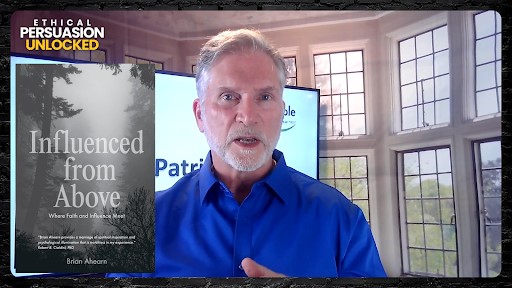
And that one I challenged myself, I write like a business parable, because some people will never read a sales book or a business psychology. And so this is actually a story format to teach Cialdini’s principles of influence as you follow the career of a young man named John Andrews, and he’s learning from mentors, coaches, and clients. And then the newest book is called Influence from Above, Where Faith and Influence Meet.
And since we’re talking about the topic of ethics, if people are really focused on the ethics, I think this would be the best book for them. My daughter asked me a question years ago. She said, Dad, what I want to know is where’s God in all this? All the psychology you teach, where does he fit in? We have this wonderful conversation and it spurred the thought of writing a book on this. And so the book, I think, takes ethics to an even deeper level because if I am looking to love God and love you, ethics is going to naturally take care of itself.
If I do this well, could have an internal impact for some people. Because I firmly believe, Patrick, if we do our jobs well, people will enjoy more success at the office, and that opens up so many doors for them. You know, maybe college for the kids, vacations, you know, dream home, all those things that are wonderful things. But it also, on a very personal level, can make life so much happier.
Right, if your spouse contends with you less, if your kids aren’t arguing about doing the chores and homework. And so this book really takes a look at that. But ⁓ what it looks at is how Dr. Cialdini’s principles really have their roots in spiritual truths. And so people who are interested in ethics might really find that one very interesting.
Patrick van der Burght:
Awesome. Yeah. And, yeah, I totally agree. I often tell people that just, just being a good person as in interested in someone else, trying to find out what’s important to another person, you know, trying to help and assist people, right? Then we’ve got the principle of liking or reciprocity already kicking in. And so that’s a great head start to, to being more, more persuasive. So thank you very much for, for being on with me today, Brian, of course we’re going to put links to your social media and the books you’ve got in the show notes. People can access those there. And yeah, thank you very much for joining me.
Brian Ahearn:
Hey, it was my pleasure Patrick. I will come back anytime you want to have a conversation.
Patrick van der Burght:
We’ll make sure to do that. Thanks, Brian.