
It’s like self-defense classes. By learning how to use these mechanisms, you have a greater chance of defending yourself when an unethical tactic is used on you.
Dr. Cialdini recommends that we ask ourselves a simple question when it comes to looking for things that we can use to activate the principle of reciprocity.
The feeling that we owe something to someone can linger for a long time.
As it turned out, even when people don’t like what they’ve been given, it doesn’t stop reciprocation.
With her question, it was like she disabled my legs. I just stopped walking.
From an early age we are taught that it is not polite to receive something and then not give in return. Our society has rather mean names for people who take without giving in return. Therefore, when someone makes a kind gesture towards us, we feel that there is a debt that needs to be repaid. As consumers, we often receive free samples. I remember as a child when we went with mum to the butcher and there would often be a dish of samples to try.
My parents had a retail shop selling paint and wallpaper in Rotterdam in the Netherlands. It’s a little harder to give people samples of paint, but they were quick to offer people cups of tea or coffee and had balloons and free coloring books available that they would give to the children in the family. While these are nice gestures of appreciation for visiting the business, they also produced benefits.
People did buy more, but only of other types of candy. As it turned out, even when people don’t like what they’ve been given, it doesn’t stop reciprocation. It’s the kind behaviour of giving that is reciprocated.
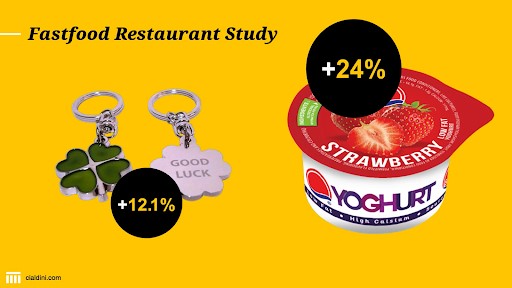
The sales figures of retail heavyweight Costco show that all sorts of products get significant boosts in sales when free samples are given away. Beer, frozen pizza, lipstick. When it comes to giving, what we give also has a big impact. Research conducted in fast food restaurants reveals some very interesting insights on this topic.
Some people were kindly greeted as they entered the store. Others were kindly greeted and given a small gift, a keyring. Others were kindly greeted and given a small cup of yogurt.
The people who were greeted and received the keyring spent on average 12% more on food than those who were only greeted. Compared to the group that was only greeted, the last group who were greeted and got some free yogurt spent 24% more. In a later episode, we’ll dive into how and why that works.
They think they are investing to produce reciprocity when they’re actually completely missing the boat.
Business coaches, financial planners, complementary health practitioners, architects, and other businesses that often need to provide proposals and do a fair bit of homework before they can do so, try to provide extra value to their potential client to impress them. They want to do more than other professionals in their space might provide.
They invest a lot more time than they expect other professionals to do and present the most elaborate proposals. And yet it doesn’t seem to increase their conversion rate. They tell me, I do all this extra work. I go deeper with my proposal than anyone would. I research, I share tips and insights, yet it doesn’t seem to help. Of course, a few other things could be going on.
To be fair, there are stages to success. We need to have a good relationship with our audience. If they don’t like you or like you more than your competition, then that doesn’t help. But if they somehow dislike you, they will go out of their way to avoid dealing with you.
Equally important, if they remain uncertain about what it is you’re offering in your proposal, it’s very difficult to move on. And when I say uncertain about what it is you’re offering, I don’t mean the facts and figures that you present. Your rational reasons why you are a good choice for them, that is mostly system 2 information that is hoping to appeal to the rational part of the brain. And as we covered in Episode 2 about
The Science of Human Decision-Making which you do really need to listen to if you’ve missed that one, our audience already has limited time to process that kind of information. And so you’ll end up creating more uncertainty in them. What you need to provide is system one information, the type of information that activates the principles of persuasion, which are decision triggers.
Lastly, they may lack the motivation to take action, even if you have a great relationship or if they’re certain that your product or service is right for them. As you might recall, for each of those stages, relationship building, reducing uncertainty and motivating into action, there are go-to principles. I go into a lot more detail about that during my courses, which takes
persuasion application skills to a whole new level. So in all fairness, when I speak to a professional who has these issues with their extra efforts, not seeming to produce more success, they are very likely to have little or no idea about all the other genuine ways that they are currently reducing the chances that they will hear yes.
That said, there are things we need to realise when it comes to giving to others. When we do go the extra mile in the hope it will activate reciprocity, the most common mistake is perhaps that our audience doesn’t realise that you put in extra effort.
If you just present all the good stuff in your proposal, or just give them all the insights in a conversation, they might think that this is what you do all the time. They might think: Maybe this is just what people in your industry do. If our audience doesn’t realise we put in extra effort, then it’s less likely they’ll feel that there is something that they should be grateful about and that should be reciprocated.
Another common mistake for businesses is to offer something extra to clients or potential clients and to do so in a way that makes it feel like an entitlement. In which case, once again, our efforts and investment does not actually produce the effects that we were hoping for. We’ll unpack that particular pitfall another time so you don’t have to waste all that investment and wonder why people aren’t more appreciative.
This happens when our goal comes not from genuinely wanting to help someone, but instead from creating something to exploit the principle of reciprocity as a mechanism to get our way.
This is another reason why it’s good you’re here. It’s like self-defense classes. By learning how to use these mechanisms, you have a greater chance of defending yourself when an unethical tactic is used on you.
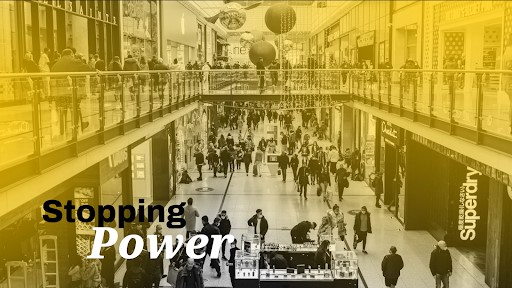
There’s always one example that always comes to mind, which I experienced in a busy shopping centre. It was around a busy time of year when I found myself walking at a fair pace through the shopping centre with my hands full of stuff. Ahead of me was one of those pop-up shops. You know, some tables and display cabinets were positioned in the middle of the walkway between the shops. They were selling something like beauty products or skincare or something like that.
I was in a bit of a hurry and I had no intention to start a conversation about skincare. But as I was just about to stride past the pop-up shop, a lady took a step forward to me, extended her arm, and in her hand she was holding a little satchel. And she said “Here, this is for you”.
As I was walking past her, I managed to extend a hand and take the satchel from her. And at the exact moment she said “Can I ask you a question?”
I’ll never forget it. It was like my legs buckled. I’m reasonably tall and when I’m in a hurry, Patrick has a little bit of speed to him. But With her question, it was like she disabled my legs. I just stopped walking.
As I stopped and immediately wondered how I went from being in a hurry to stopping, and because I knew the principles of persuasion, I immediately realised what had happened. The satchel, which probably cost two cents, was used as a tactic to stop people walking past. A technique that clearly worked and that they had learned in the past. I had a few options available to me.
I could have simply replied ‘No, sorry, I’m in a bit of a hurry, but thank you for the satchel.’ Especially when a tactic like this is used for the sake of aiming to produce a reciprocal response, I think it’s perfectly fair for the instigator of such tactics to lose their gift when the tactic doesn’t work. It would have been fine for me to keep the satchel and move on.
The option I chose at that moment was to say ‘No thank you, and you can keep this.’ And I gave her back satchel.
We should ask ourselves the question, how can I help this person, genuinely? It shouldn’t be important that there is an immediate profit to be made. We would rather be seen by our contacts as a genuine helpful individual or organisation that has their best interests at heart and that they can rely on now and in the future.
Nice try, but that ebook is not experienced as a gift. I’m not saying that as a lead generator it’s a bad idea. I’m just pointing out that if you’re under the belief that making an ebook available in this setting would produce reciprocity, then you’re making a costly mistake.
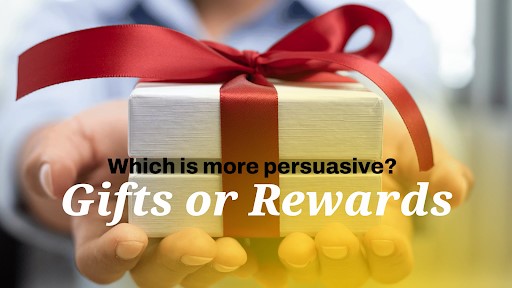
It’s probably helpful to define what a gift is. A gift is something that is given without a requirement having to be met. In the example of the ebook, it wasn’t a gift because we first had to surrender our name and our email address, and then we would get the download link, which makes it a reward, not a gift. If you attempt to motivate your sales team, with an item, a bonus or an experience for meeting certain sales targets, that would also not be a gift.
It could be a nice motivator, but it’s not something that would trigger the principle of reciprocity after they qualified and received the bonus. We’ll have a dedicated episode to help you understand that motivating people with money or gifts has many downsides. And that…
If you’re hoping to motivate people, there are costless ways of doing so very effectively, using specific principles of persuasion.
Another thing to be aware of is that items that you give to someone that have your company name and contact details on them are rarely experienced as a gift that needs to be reciprocated because they’re not a gift. They’re advertising. Again, I’m not saying that these are bad things to do. If it’s something useful, does remind people of your business and that can be quite valuable. It just doesn’t activate the principle of reciprocity as you hoped it might.
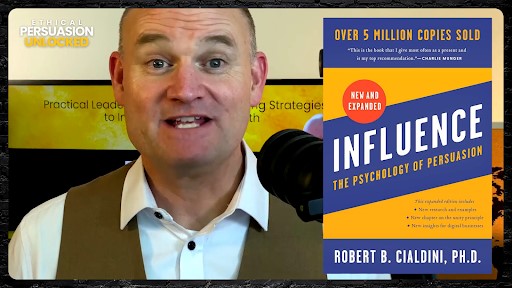
The book Influence mentions an insightful example of how long people can remember when others helped them. It involves the exchange of relief aid between Mexico and Ethiopia in 1985 during Ethiopia’s famine. While hundreds of thousands of people died in Ethiopia and the world rallied to send aid and money to Ethiopia, the officials of the Ethiopian Red Cross, had decided to send $5,000 to the victims of the earthquake in New Mexico.
When they were asked why they had decided to send money to Mexico, even though their own country was in such dire need of assistance, they explained that they had sent money because in 1935, when Italy was invading Ethiopia, Mexico had helped Ethiopia.
Despite a famine and 50 years having passed, the power of the principle of reciprocity remained active. There are other examples in history of similar situations, even ones that span longer than 50 years.
I think it’s very comforting to know that most people will remember the kind actions of others and will want to return the favour when the opportunity arises, even if it takes longer. So when you make an effort to assist another, individual, a company or even a country, know that those kind actions won’t be quickly forgotten. There is a good chance that those actions will flow back to you sooner or later.
I have something for you as well. And in a minute I will share one more study and insights into the dark side of reciprocity, which will shock you. But before I move on, let me tell you that we will go into more details about the principle of reciprocity in many future episodes, including in conversations with my guests.
I hope you’ve learned a few valuable things from this introduction. And if you have found value in what I’ve given you in this episode and other episodes, I would really appreciate it if you could be so kind as to leave a detailed review on this channel, highlighting what you found valuable and whether others should investigate this show. And remember, only share this show with people and young adults who you’d like to see more successful in business and life.
Some were sent the survey, which would take an hour to complete, and they were told that they would receive a $50 check after completing and sending in the survey. In this case, 23% of people complied. Others were asked to complete the survey and told that a $5 check had already been included. It was theirs regardless if they filled out the survey or not. Despite the fact that $5 is not a significant compensation for an hour of someone’s time, in this scenario 52% filled out the survey.
The punchline being that to get the same amount of filled out surveys, it would cost you 8 times more using the reward structure. Now, you may wonder what happened to the $5 checks of the people who were given it, but didn’t complete the survey. Surprisingly, few people cashed those checks. Likely because we’ve all been taught as children, it’s not polite to take without giving in return. My advice to you is this. If you have something to give to someone that is of low value, you are better off giving it as a gift upfront instead of as a reward.
Even here in Australia, the current Prime Minister, Anthony Albanese, landed in hot water when he was the Finance Minister. He even had a nickname, Freebie Albanese. He got business class upgrades from Qantas and Emirates, and then later made it more difficult for Qatar airlines to access Australia. Independents like Helen Haines and Allegra Spender relinquished their airline perks in protest and there was even calls for a senate inquiry. Perhaps this sort of behavior is why politicians are often seen as untrustworthy, but surely this would be different for our scientists.
Scientists are truth seekers, are they not? What I’m about to tell you may shock you. There’s a controversy regarding the safety of calcium channel blockers, which are a drug related to heart disease. One study had found that a 100% of the scientists who found and published results that were in support of the drug had received prior support from pharmaceutical companies in the shape of research funding, equipment, free trips and things like that. Of those who were critical of the drug, only 37% had received such gifts. Shocking, right?
We’ve created a portal, a community where you can access our episodes and keep track of what you’ve listened to and what you’ve missed. Also, the tools that our guests often make available are easily accessible there. It’s a true treasure trove of value. At this time, we’re still working out some of the plans for features, but we may have a dedicated app for this community down the line. And while there will be free access, it will likely also be a pathway to some paid options to provide additional lessons from me and guests, as well as access to exclusive live events. We will add details on how to access all this in the show notes.
There is a lot more to the principle of reciprocity. It has many hidden gems, dynamics and subtle nuances. One of which is likely much more impactful than the giving to others to activate reciprocity. This dynamic enables you to turn a no into a yes ethically, while increasing your audience’s loyalty to their decision and their willingness to work with you in the future.
It’s something that my students are justifiably so absolutely fascinated with. If you are responsible for the productivity of a team of people who use communication to reach their and the company’s goals, then ask yourself, is this type of powerful communication truths, the science of getting what you ask for, is that something your team should struggle without any longer? As you know, I’d be delighted to help you and your team develop the skills.