










But you are here now at the start of this journey, a journey filled with jawdropping research and case studies and potent eyeopening strategies that are typically costless to implement. And this podcast will deliver because what I will teach you, I am a trainer. I can’t help it, is based on scientific research. No Patrick gut feelings. What you hear from me is backed by science.
Welcome to Ethical Persuasion Unlocked, episode number one. I’m excited because I think it is painful to watch companies, business leaders, and professionals waste so much time and resources on inefficient communication and business practices. I see the world through the lens of ethical persuasion or social influence and I see so many seasoned professionals make avoidable mistakes that is costing them every single day.
Let me start by sharing some research that will blow you away. I will give you your first nugget of persuasion gold and it’ll hit home why you need to make this podcast a priority and share it with those you care about.
We’ll dive into all the principles of persuasion in time and revisit them with many different strategies and nuances. And this next example is connected to one of those principles and it teaches you an important lesson and strategy no matter what industry you’re in.
Okay, here we go. My first research-based lesson for you.
Research was done at the University of North Carolina where certain students were on probation. If they didn’t raise their academic scores by a full letter by the next semester, they would be expelled from the university. I think we can all agree that would have a dramatic impact on the trajectory of their lives. And so all involved were as motivated as they could be to not let this happen.
The researchers divided the students into three groups that will be exposed to different experimental conditions. One group was not asked to set any study goals. Another group was asked to set study goals, but to keep these goals private. The last group was asked to set study goals and to write them down, sign their name, and make copies to share with everyone in the class. It should be pointed out that other than that, they were treated the same and were afforded the same assistance and resources from staff to help them during this time.
The question is how did these groups perform? Did they improve their grades enough to stay in school? The first group who didn’t set any study goals didn’t do very well. In fact, only 14% raised their grades enough to stay in school. The second group did set study goals and kept them private. What do you think? Did they do any better? You’d like to think so, right? I mean, it sounds like good advice to encourage someone to set study goals. Well, they didn’t do any better. Also, 14% of them raised their grades enough to stay.
What happened to the last group then? The group that was asked to write down their study goals, sign their name, and make photocopies for everyone in the class. From this group, 86% raised their grades enough to stay in school. You heard that correctly. 86% versus 14% in both the other groups. That is a 514% increase in the amount of people that did what they initially all said they would do or wanted to do. Fascinating. Don’t you agree? The fact that their commitments were made public dramatically increased their compliance.
You could also let them know that you will inform all your team members about their commitment and how excited they will be to hear this news. Just like with the publicized study goals, you’ll have dramatically increased the chances that they will stay true to their initial commitment.
You’ll have fewer deals or agreements falling through. Now, what is the second important lesson here? For that, I need you to put yourself in the shoes of the students and their parents of the first two groups, the ones whom only 14% succeeded, the ones that had been randomly selected by researchers to be part of those two experimental groups. As an outsider, now you can objectively see that if they had been allocated to the third group, then 514% more would have still been in school.
Now imagine being the student or their parent and finding out that just because they were treated with slightly different instructions to not set goals or not being asked to set goals or even to set them but not asked to write them down and make them public, 514 % more of them, more as was necessary, now got asked to leave the school and their lives would forever be changed, most likely for the worst. Can you imagine the feeling student or parent? The devastation of having missed out, having lost, because they were not communicated to in an ethically more persuasive way? You can feel it, right?
Now, realise that when it comes to you conducting your business the way you do, or your team, without knowing how to be ethically more persuasive, or not using it consistently in the most effective way, you are. Your team is, right now. In group 1 and 2, you are in the 14 % group.
Perhaps you’ve heard of it. Perhaps you think you know it. But you don’t really know it. Or you don’t really use it. And it is costing you every single day. You are in the 14 % group. Unless you’re one of my students, of course. In which case these episodes are excellent to stay on topic and refresh and deepen our understanding and confidence.
But you are here now at the start of this journey, a journey filled with jaw dropping research and case studies and potent eye opening strategies that are typically costless to implement. Well done for being here. I appreciate professionals like you that invest some time to discover ways to do better, to lose less and to get to their goals faster.
And if you’re like me, if you want to get ahead, but you don’t want to lie or cheat your way forward either, then you and I are the same. And this podcast will deliver because what I will teach you, I am a trainer, can’t help it, is based on scientific research. No Patrick gut feelings. What you hear from me is backed by science.
And I love the science because human behavior is very entertaining, eye-opening, funny, sometimes terrifying, but always fascinating. As I’ve illustrated with the research story before, not using nearly a hundred years worth of scientific research in your communication efforts results in a similar outcome. As if an architect was to design a skyscraper without knowing the science. Except that when you fail to use the science, you likely have no idea how much success, profit, progress or competitive advantage that you could have had is slipping through your fingers. You are in agony, but you just don’t know it.
And this is where I have to warn you. In our journey together, you will learn simple strategies to reach your goals at the pace you were always able to. And you wouldn’t believe that some of this simple stuff can have such an impact if it wasn’t for the fact that I’ll typically demonstrate its validity with research and case studies.
You’ll think to yourself, is it this simple? And then you realise how much you’ve wasted not knowing this at the start of your career or business venture. Which is why I’m such an advocate for young adults being introduced to this important life defining soft skill in school and university instead of halfway in their lives.
So you’re in the right place. Investing your time in one of the most in-demand, high priority skills for business and life. A skill that can help you realise successes that are slipping through your fingers.
I look forward to explaining to you in coming episodes the science of human decision-making.
And it’s the most effective in the long term when used ethically. That’s the beauty of it. And that’s why I’ve been so passionate about this for decades now. There’s no need to lie or cheat. You’re not going to make anyone do what they don’t want to.
I’ll explain this in a lot more detail in the science of human decision making. But essentially, people are so overloaded with stimuli and decisions that they need to make every day that they need, they crave the type of information that affords them a shortcut to a quicker decision.
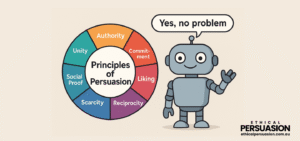
That is what Dr. Cialdini’s 7 universal principles of persuasion are. They are decision triggers.
When someone who doesn’t know the science thinks about how they’re going to convince someone, they will come up with information that may seem reasonable and rational, but it actually overloads their audience. And they put your proposal mentally in the too hard basket and they don’t agree or comply with your request. And you think that you got a no. But you didn’t. You got indecision. Which might have been disguised with things like, ‘No. Sorry, the time isn’t right for us,’ ‘I can’t commit to this right now,’ or ‘No, it’s too costly.’ It could have been a YES, if you had communicated what they wanted and needed to hear.
If we provide our audience information that qualifies as shortcuts, it’s easier for them to move along with their decision-making process.
Let me give you an example. I recently delivered a training at Westpac, which is one of the big banks here in Australia. We are diving into one of the principles and one particular strategy related to that principle. We’re busy workshopping this strategy so that team members can come up with their own application ideas and bounce those ideas off me so they know they understood the science correctly.
I’m talking to one of the lenders and he says how now he understands what has been happening to him lately. He explains that when he speaks to a doctor about the different loan structures available to them, he needs a decision on whether or not they will choose a variable or fixed rate for their home loan.
He explained to me that in the past he had often been spending a lot of time explaining the impact of both options.
He told me that when he speaks with them, he genuinely explains that now nine out of 10 other doctors that their department has written home loans for are choosing for the variable option. Upon hearing that news, many doctors go, good enough for me. I’ll go, I’ll do the same. Let’s move on. Right? Decision made.
I’ll explain another time what principle of persuasion was at work there. But it highlights beautifully the effect of providing genuine information that allowed for a quicker decision. Now that the lender at Westpac understood the scientific principle behind what he had stumbled across, he will be using it more confidently and consistently.
And not just when it comes to decisions for fixed or variable interest rates.
- It repairs, strengthens, and builds loyal relationships.
- It reduces uncertainty in your audience.
- It helps to motivate people into action.
If you agree that this is something you want to learn more about and you agree that listening to more future episodes will be valuable to you and perhaps people you know, then we can use the persuasion principle from my earlier example to set you up for success that is yours to have. Remember the 14% group of the students that saw most of them fail unnecessarily. Let’s get you out of that group.
Now, based on the insight that I’ve shared with you and the fact that world leading organisations are urging individuals and businesses to develop this skill and that millions of businesses already recognise they need this skill, I would hope that you also see the value and urgency for you to learn more.
If you agree that this is something you want to learn more about and you agree that listening to more future episodes will be valuable to you and perhaps people you know, then we can use the persuasion principle from my earlier example to set you up for success that is yours to have.
Remember the 14 % group of the students that saw most of them fail unnecessarily? Let’s get you out of that group.
If you have made the decision that what you learned here is of value to you and you are making the decision that you will or should listen to more of this in the future, then I challenge you to do this. Make a public statement that you found something valuable and that you are going to be learning more from this podcast.
Put a post on social media or call or send a note to your friends or colleagues and tell them. I found this podcast on the science of ethical persuasion. It was eye-opening and I’m following it and I’ll be listening to upcoming episodes. I think you should listen to the first episode too and share them the link to this episode or the show.
Now might think, yeah, yeah, clever way to get more exposure. Well, that’s true. But really, shouldn’t your friends and colleagues be introduced to this? Won’t they be missing out the longer they stay in the group that doesn’t know or use the science available to them? You’ll be doing them a favor, which is the principle of reciprocity, but we’ll talk about that another time.
I’m excited you’re here. If you’ve enjoyed this episode, leave us a review with some details about why you valued what you’ve learned and check out the show notes. If you like, I also have some complimentary resources available on our website, ethicalpersuasion.com.au, including an ebook for which you don’t even have to give your email address. Just right click and download.
If you want to learn this skill properly though, I’m sorry to have to say that a podcast alone will not help you to develop application skills and confidence, which will mean that you’re still missing out on success and waste time and resources. Some formal training is needed if you want to learn this properly and quickly.
Do our flagship training if you can, or start with an online workshop. It will be fun and so powerful. Of course, you can also connect with us and we can have a discussion on how to best train your team to use the science of persuasion ethically to put your business back on track on the trajectory that you should be on.
Till next time. I wish you an influential future in which you’ll hear YES more often.