He took three years off and with disguised identity and disguised intent, he enrolled in as many new employee training courses as he could possibly get access to. Our environment may change, but essentially the way people think and how we formulate our decisions has not changed.
As we will no doubt delve into, the principle of authority teaches us that human beings have a tendency to follow the leads of other people who have genuinely more knowledge and wisdom about a particular topic. While it is informative to tell you a little bit more about Dr Cialdini, and only polite for me to acknowledge the person who I admire so much and have learned so much from, this introduction will also trigger the principle of authority within you.
Well, you might think that getting to the research insights and tips on how to use persuasion science is the most important and valuable thing for you to listen to right now.
Your understanding of the lifetime achievements of Dr. Robert Cialdini and how we are so respected by the business as well as the academic community. That will help you subconsciously realise the value and importance of learning from these podcasts. Or, if you like, consider formal training for you and your team sooner rather than later. This introduction is a subconscious decision trigger for you that will help you to get clarity on the value available to you here and it will genuinely help you to tune in.
Dr. Robert Cialdini became a university professor at Arizona State University in the late 70s. He was fascinated by the request process. What makes someone say yes to another person’s request? And how can it be that if you ask for something one way, you get few yeses, and if you ask for practically the same thing, but in a different way, you get significantly more yeses.
At that time, when he became a university professor, Dr. Cialdini realised that there was approximately 50 years worth of research already on the subject, but it was mostly laboratory-based research.
Here, people are put a controlled environment and then, in a way, experimented on. Dr. Cialdini realised that if…
he was going to discover how persuasion science truly worked, then he was going to have to go into the real world where the battles of persuasion are fought every single day. Where business professionals like yourself make an effort every day to move towards personal and company goals by convincing others about what it is they were asking or proposing.
Now this could be related to sales, advertising, marketing, customer service, HR, PR, many other activities that help us to move towards our goals.
Dr. Cialdini did something that was not heard of very often at the time. He took three years off and with disguised identity and disguised intent, he enrolled in as many new employee training courses as he could possibly get access to. He sold portrait photography over the phone. He sold cars from a lot. He worked in restaurants.
He observed army recruiters attempting to persuade young individuals to sign four years of their life away. He looked at negotiators, politicians, lobbyists. He even spoke to law enforcement representatives about strategies that con artists use to manipulate people to give up their life savings.
Also, cult recruiters, he investigated, not to use the strategies that they would be using, but to uncover what the psychological triggers are, the engines are that we’re powering these strategies, because we must be able to use that in ethical ways as well.
They just knew that they worked just when trial and error. What was interesting was that people from different industries all thought that they were, what they doing in their strategies were so different than people in other industries or roles. People in advertising departments would say how different they were from people in sales and people in sales would say how different they were from people in marketing and so on.
Dr. Cialdini collected all the strategies that they were teaching their new employees and instead of looking for what made them different, he looked for what made them similar. What is it within those strategies that makes them work? What are the psychological drivers that work regardless of the industry or the department?
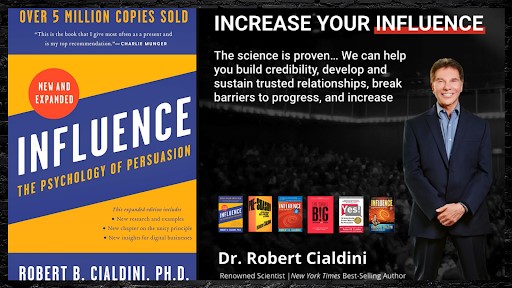
The answer to that is essentially what went into his book, Influence, The Psychology of Persuasion, which was first published in 1984. It had within it six principles of persuasion. And in 2015, an updated edition came out in which, after a lot of additional research, the Principle of Unity was introduced to us.
The book Influence has now sold over 7 million copies in 48 different languages. It is a timeless text because our environment may change, but essentially the way people think and how we formulate our decisions has not changed. For this reason, we still find Dr. Cialdini’s book Influence on the top of many recommended business books lists lists.
In publications like Forbes and many top CEOs consider it the best business book of all time. It should absolutely be in your library in your collection of audiobooks.
In my opinion, the book is very entertaining. It has countless fascinating references to research and explanations on how the principles of persuasion work. While I wouldn’t call it a training manual on how to use persuasion science in business, it certainly has self-defense tips to help readers protect themselves against people trying to use the persuasion principles on them unethically.
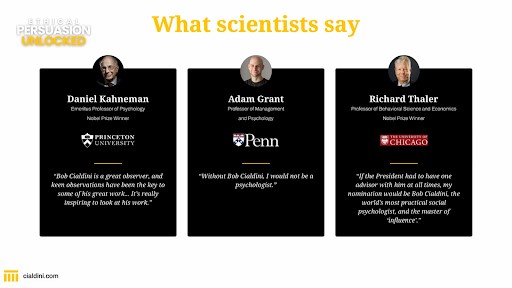
But also the academic community, sings Dr. Cialdini’s praises, which I think has a lot to say for his ethics. Daniel Kahneman, a Nobel Prize winner, said, Bob Cialdini is a great observer and keen observations have been the key to some of his great work. It’s really inspiring to look at his work. Another Nobel Prize winner, Richard Taylor, a professor of behavioral science economics, said if the president had to have one advisor with him at all time, my nomination would be Bob Cialdini, the world’s most practical social and the master of influence. As well as Adam Grant saying that without Bob Cialdini, he would not be a psychologist.
Besides this, the accumulation of knowledge doesn’t automatically turn knowledge into skill. In the end, we don’t want knowledge. After all, knowledge is easily accessible now with the internet. What we do want is application skill, the ability to use what we know.
But to develop application skills, you need formal training with someone who can guide you through that process. Someone who can introduce you to how others have successfully applied this knowledge so that you can then start imagining how you could use that in your challenges.
The involvement of a trainer who allows you to share your own interpretations of the knowledge can confirm that you understand the theory correctly, or they can give you a small course correction if you’re laboring under some misunderstandings. It is this feedback from a trainer that helps you develop application skill, and equally as important, confidence that you are using it correctly. This is difficult to achieve just by reading a book or listening to a podcast for that matter.
Should you be interested to become a Cialdini Institute Licensed Trainer yourself or to have someone trained within your organisation, then please follow the link in the show notes where we can help you with some more information on that topic.
If you look up on the internet anything related to influence or persuasion, chances are that the very first pages you are presented with contain references to Dr. Cialdini. When we see him on stage in front of thousands or in YouTube videos viewed by millions, you can’t help but think that he looks like a genuine and caring guy.
We’re all familiar with that saying that you shouldn’t meet your heroes. Well, I can assure you that Dr. Cialdini has never disappointed. He cares about helping people succeed and maintaining ethical standards in doing so. Every time we’ve spoken, I can’t help but appreciate this gentleman more. And every time we interact, I learn more.
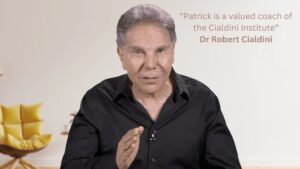
I was incredibly fortunate that he was willing to record a video recommendation for my services and I’ve always been very proud to be associated with him and the Cialdini Institute.