

After only four days, 67% of kids were happy enough to go into the playpen with the dog and stay there petting and scratching the dog while everyone else left the room.
Ethical Persuasion is a science that teaches us how, through the use of words and images, we can move more people in our direction.
It tripled results. To go from 25% increase in compliance to 75% increase is not a 50% increase. It’s a 200% increase.
Remember the rule, people follow the leads of others, especially when they are numerous, when they are similar to them, and when they are uncertain.
If you think that it is important for your business success, but you can’t easily tell me what other applications of social proof are, then you and your team members are wasting time, resources, success and competitive advantage not communicating other social proof information that is easily and ethically just as powerful as reviews or testimonials are.
So let’s change that today. This is not like doing a course with me, but let’s explain some of these other types of social proof and see you lose less success. Welcome and well done for being here. You are a proactive go-getter that doesn’t want to struggle unnecessarily when there is a simple science to be used.
Being Dutch, I was force-fed German in school, which I really didn’t appreciate at the time, but it has turned out pretty valuable in my life. I am at the Frankfurt Main Hauptbahnhof train station, which is a big train station, like Gare du Nord in Paris and Paddington train station in London, in that it has a big overarching roof above it.
We are standing there on the platform looking like obvious tourists because we had large suitcases with us. Hundreds of people are waiting on the platform because at this stage the train is already there but the doors are shut and the departure time had come and gone. In the meantime other tourists with suitcases sort of ended up waiting near us.
Being a larger train station with so many platforms, announcements were going continuously over the loudspeakers and in German, of course. It’s hard for me to figure out exactly what they’re saying, but I get the gist of the messages and I can certainly tell when it is about the train that I’m waiting for on our platform. I can’t remember why exactly, but the other tourists had worked out that I knew…
what was being said in the announcement. And I told them there was something wrong with this enormously long train, but that they were working on it. That was why the train was already there, but the doors were still shut. We were supposed to wait.
Announcement after announcement keeps being broadcast and eventually one comes that tells people on our platform to walk towards the far front of the train because the first section of the train will remain in Frankfurt and the other part, the front part, will take us on our journey. Immediately hundreds of passengers that clearly knew what the announcement was about started walking at a decent pace to the far end of the platform.
Now my question to you, what did the tourists do? Do you think they stayed put? Do you think they paused to ask me what the announcement had been about? Would you have stayed put? No they didn’t. Practically immediately they followed everyone else. Why? Because there must be value to what other people are doing.
They witnessed the behaviour of many others who were waiting on the train platform just like them and system one in the brain made a nearly immediate decision to follow them. So let’s give you a definition of the rule of social proof. People follow the leads of others, especially when they are uncertain and when the others are numerous and similar to them.
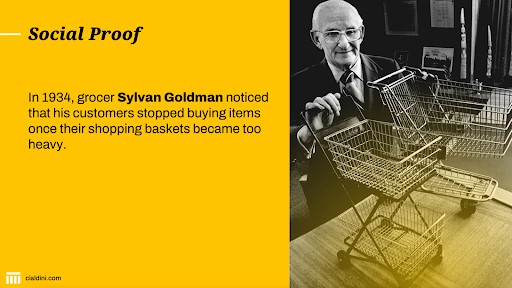
No one used them. He was about to give up on the idea, but he tried one more thing. He paid people to use the carts and wheel them through the store. When his true customers saw that, they quickly followed suit.
In 2020, we were confronted with the COVID-19 virus. In Japan, research was done to find out what reasons were why people decided to wear the recommended face masks, which was urged to be worn by the country’s health scientists.
They analysed multiple reasons why someone could decide to wear a mask, like the perceived severity of the disease, the likelihood that wearing the mask would protect the user, the likelihood that wearing it would protect others. Only one factor had a major impact on people deciding to wear the mask.
Seeing other people wearing the face masks.
Social proof also works on kids. One psychologist is well known for leading the way in this area, Albert Bandura. He used it to end undesirable behaviour. In one situation they used social proof to reduce fear of dogs in nursery school-aged children. They allowed frightened children to watch a little boy play happily with a dog for 20 minutes a day.
After only four days, 67% of kids were happy enough to go into the playpen with the dog and stay there petting and scratching the dog while everyone else left the room. A month later, they retested the kids’ fear levels and they had not become more fearful. It stuck. Later on, they discovered they could achieve the same result by letting the kids watch video recordings of kids playing with dogs.
Some countries have been benefiting from a much more cost-effective approach to achieving compliance by using a strategy that is powered by the Principle of Social Proof. By scoring polluting firms within an industry and share their score and that of other firms with them, a much larger percentage of those who see that they pollute a lot more than the majority of other firms then make the changes to follow their example.
Social proof also has a dark side. When Netflix premiered the series ’13 Reasons Why’ in 2017, in which a young high school student commits suicide and leaves 13 tapes behind that explain the reasons why, in the 30 days following its launch, suicides amongst young adolescents went up by 28.9%.
And you want to hear something shocking? Netflix is still making that available for your kids to watch right now in 2025 going into 2026. More on the dark side later. For those who are paying close attention, there are three factors in that definition of social proof I gave that make social proof work harder.
We call those amplifiers. The numerousness of others, the extent that they are similar to us, and whether or not we are uncertain. Just like the principle of authority, which I will dive into in an upcoming episode, people pay a lot more attention to the information related to the Principle of Social Proof when they are not sure what to do, what to think, or not sure about you.
As I explained in episode two, where I elaborated on The Science of Human Decision-Making, the intuitive part of your brain, which is in charge of most of the decisions that you and your audience make, analyses the situation in front of you without you having much conscious control over it. It works fast and realises that restaurants where there is almost nobody inside, means that many other people like you, hungry, looking for lunch or dinner, are choosing not to enter those restaurants.
If other people are choosing not to go to that restaurant and would rather go somewhere else, then it’s probably the right decision for us to not go there either and go somewhere else. Depending on whether you are perhaps early for lunch or dinner, the restaurant with seemingly a quarter of seats and tables filled will give us a lot more confidence that we will have a good experience there.
When system one observes a restaurant that a lot of other people are choosing, this indicates to us that we will likely have a good experience going to that restaurant.
Now, having said that, if you were familiar with this city or this area or you were familiar with the restaurants, if you had dined in quite a few of them, if you had enjoyed quite a few of them and you would walk past one of the restaurants that you knew provided good service and good food, then you’ll be less likely to be persuaded by seeing greater numbers of people in other restaurants.
Or similarly, if a close friend or colleague of yours had a great experience in one of these restaurants that seemed empty now, you would also be a lot more confident that you would have a good experience there and the fact that it is less busy wouldn’t be that important. You were less uncertain in that case.
Let’s revisit that caveat of similarity. You and your partner are looking for a restaurant to have a quiet and romantic dinner. You walked past a restaurant that is three quarters filled. Those inside were loud and laughing and they might be numerous, but they are not so much similar to you. They’re not people that appreciate a quiet environment to have a romantic dinner and you’ll ignore the fact that it’s a well patronised restaurant.
Similarly, if the restaurant was well filled, but there were mostly motorcycle riders in there with their helmets on the table, or it were predominantly teenagers inside there, or members of the local goth scene, then you would likely also keep walking and ignore that restaurant, unless of course you belonged to one of those three groups, in which case the restaurant would have added appeal.
There are a lot of strategies and different mechanisms to social proof other than reviews and testimonials. Most businesses and professionals have realised by now the power of the reviews and testimonials and without actually knowing the science, apply it or show it where they think it could do some good.
Of course, without actually knowing the science, they and their team members don’t provide social proof in the forms of reviews and testimonials in all the places and situations where they should, despite the fact that they have figured out that reviews and testimonials are so powerful and that they would be losing business if they didn’t use it.
And if you think that reviews and testimonials are something you should not do without, then you’re going to regret not educating your team about ethical persuasion when you figure out how many strategies and nuances you’ve been neglecting to ethically use since you’ve been in business.
Of course, like many others, you’re here to learn more, which I think is wonderful. And of course, I’m going to share insights with you that you can use immediately. But while I’m lifting the veil on social proof, please realise that there is a lot more to this than I could possibly cover in a podcast episode. And some formal training for you and your team is long overdue.
The next dynamic of social profile share with you is important to anybody in any business, no matter if their role is in sales, advertising, marketing, HR, PR, customer service, management or leadership. But it should especially excite those people who are involved in, let’s say, the visual industries.
And by that I mean corporate photographers, videographers, social media marketing managers, advertisers and web developers. These are businesses that charge others to take on the awesome responsibility of driving business in the door. They are like salespeople completely dependent on their persuasive abilities.
I think it’s not unreasonable for their clients to expect that these professionals have had formal training in the Science of Human Decision-Making and Persuasion. And whilst we see more and more people from these industries in our practitioner courses and specialist workshops, there are still way too many professionals in those industries that will take on the responsibility to be persuasive for their clients without actually knowing or effectively using the science in the most effective way.
People follow those with superior knowledge.
It was what was visible to us that had an immediate impact on us.
Let me repeat something that I’ve mentioned in an earlier episode. Ethical Persuasion is a science that teaches us how, through the use of words and images, we can move more people in our direction. Let me give you a research example to knock this concept out of the park.
A shopping center that had a food court within it was experiencing that during lunchtime in the food court it was very busy. They wanted to persuade people to enjoy an earlier lunch. Therefore posters were produced and hung up throughout the shopping center with the text saying something along the lines of enjoy an earlier lunch. And this poster needed an image on it.
One image that was used was a photograph of a person sitting in the food court enjoying their lunch. This, combined with the encouragement to enjoy an earlier lunch, produced a 25% increase in the number of people who enjoyed lunch before 12 o’clock. A significant result that the client, in this case the shopping center, and the advertising agency or department or photographer would have likely been very happy with.
But another test was done. Another poster with the same text, but a different image. This image resulted in 75% more people enjoying an earlier lunch.
I’d like you to take a moment and think about that really hard, especially if you’re in those visual industries. I mean, It tripled results. To go from 25% increase in compliance to 75% increase is not a 50% increase. It’s a 200% increase.
If you like, pause this episode, take a few minutes and come up with different images that you think will prevent that available 200% in results from being lost. And then come back to this episode.
Okay, so what prevented that available added 200% in results from being lost? The first poster was an image of a person enjoying lunch in the food court. The second poster was an image of multiple people enjoying lunch in the food court.
Now I’ve told you it’s simplicity itself, right?
Remember the rule, people follow the leads of others, especially when they are numerous, when they are similar to them, and when they are uncertain.
The difference between the two images was just achieved by applying one of these amplifiers, Numerousness. I hope this example shows you that this is not difficult, but it does require someone to have an in-depth and full understanding of how the principles work. What activates them, what amplifies them, and to have that habit of always looking for them.
The application skills to use dozens of strategies that are available for each principle. And lastly, the confidence to apply this continuously and successfully in the most effective way. Anything less than that and we are losing success every day for ourselves or for others.
Now, when it comes to images, it actually also works in relation to the images that get formulated in our own mind. Images we see in our head produced by us. But that might be a topic for another time.
By the way, the topic of online influence or persuasion in a digital environment or persuasion whenever someone looks at a screen is a whole additional topic that we can assist you with or train your team members in. When it comes to social proof in the form of reviews and testimonials in an online environment, most businesses, led by their web developers who don’t know the science very well,
sprinkle some social proof in the form of online reviews over the website, especially on the index page. They often completely neglect to put any persuasive information that appeals to the intuitive primary decision-making part of the audience’s brain in the area above the fold, which is what you see on the top of a website without scrolling.
But they often put testimonials somewhere lower on the homepage.
It’s good that it’s at least there. But when it comes to pages where we hope to elicit a particular behaviour from our visitors, they often neglect to use social proof in any form.
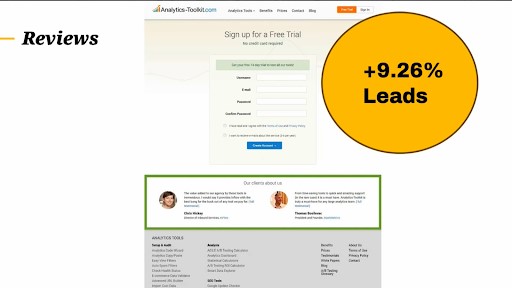
On product pages and especially on checkout pages, the application of some genuine testimonials can have a significant impact. When the website, analytics-toolkit.com, added two testimonials to a sign-up page for a free trial, leads increased by 9.26%.
But when it comes to the average review score that you might see for your business on a search engine, what is the ideal average score that you would like to be showing there? In other words, which average review score is the most persuasive to encourage people to want to reach out to you or want to do business with you? And while you think about that,
I will tell you that the ideal average review score is not five.
communicating with other team members about the upcoming training that they really want them to engage with, because of course persuasion science is not just about sales. If they go into those situations with social proof in the form of testimonials by three or four other people, they would likely be more persuasive if they provided evidence of more people who were happy after having taken the action that you are recommending.
Of course, it doesn’t mean that you can confront people with a wall of 10 or 20 lengthy testimonials, which your audience wouldn’t even have time to read during your presentation or pitch. But But you could display more opinions of others if you extracted the most important words or phrases from within their testimonials.
Here are some phrases extracted from longer testimonials about my training. ‘Perfect blend of self-motivated learning and collaboration.’ Dr. Joanna Gray, Trainer Momentum Management. ‘Absolutely practical outcomes.’ Tom Ryan of Tom Ryan Vendor Advocacy. ‘Significant improvements to my sales outreach skills.’ Mark Sanders, CEO of Tiikr
‘Coaching sessions help me to put theory into practice.’ Anna-Marie Timmermans, Relationship Coach.
‘Transformative.’ Fousiya Naskar, Keysight Accounting. ‘This should be the next piece of professional development you undertake.’ Ken Thomas, founder of TenClub.
‘Any organisation we’re getting to, yes, is crucial, book Patrick.’ Rik Schnabel, Life Beyond Limits. ‘We are already thinking about how to apply some of the strategies in our day-to-day.’ Craig Shaw, Director of Home Loan Partnerships at Westpac. ‘I absolutely loved it.’ Rhiannon Lambert, St. George’s Bank.
Those are just some testimonials of people who have enjoyed my training or keynotes.
Your sales team, HR department, customer service people, or your digital marketers could also make a dedicated effort to use the amplifier of similarity. Instead of turning up to a meeting armed with the same five wonderful testimonials that are of a diverse range of past clients or team members that had provided those in the past, we could make an effort to share testimonials of people who are more similar to the people that we’re addressing right now.
If your HR department is trying to convince people in the accounts department to turn up or pay attention and implement the learnings at next week’s training session, then sharing testimonials from their colleagues in the sales department is going to be less effective than if they were to share testimonials from other colleagues who are also in the accounting department who did the training and thought it was valuable.
If you or your sales team is doing a presentation to a company director, team manager or purchase officer who is, let’s say, a female in her 50s, then you or your team members would be detectives of persuasion if you change the testimonials in your presentation to be genuine testimonials of other company directors, team managers or purchase officers who were female and in their 50s.
Clearly, besides the fact that we need to highlight the position and title and the company that the person works for, the use of genuine photos of those individuals alongside their written testimonial and title would be necessary for someone to realise that, hey, that person is just like me.
You need to realise how lightning fast system one in your brain will make decisions for you based on any information that is related to the seven principles of persuasion, including social proof. Now that I’ve warned you and you’re learning a little bit about social proof in this episode, you’ll be building your defenses against this automatic reaction you likely have to social proof information.
When you are presented with social proof, especially testimonials, you need to realise that this information could be fabricated. For as little as $5, unethical businesses are obtaining video testimonials from people who have never used their services. Websites where people can advertise small jobs or tasks that need doing,
seem a popular place for people to produce fake testimonials. More and more businesses are finding themselves in hot water with authorities over the use of fake social proof.
Here are some examples. Sunday Riley Skincare was charged for posting positive customer reviews that were actually written by employees. Sony Pictures Entertainment arranged for employees to act as fans praising the film The Patriot, and got caught.
The advertising agency responsible for the launch of Apple’s first iPhone in Poland admitted to hiring actors to form queues in front of 20 stores around the country. So be careful out there. We don’t want to use persuasion science unethically because research has shown that it may lead potentially to short-term wins
but it is long-term disaster. Ethical use produces short and long-term success. This type of information is so powerful in changing our behaviour from within that we should not fail to use it ethically so that both sides win. But we should also come down hard on businesses and individuals who try to deceive us with this
powerful information. How dare they? So make sure you are on the lookout for false testimonials and other forms of social proof. If it is the only piece of information that you might base your decision on, it might be wise to put the brakes on and investigate some of the social proof.
Look up those people featured on the social proof on social media, using their name and title. Send them a message. ‘Sorry to bother you, I was recently visiting this website, or I was presented to by this company, and they claimed that you had a wonderful experience with them. I just was wondering if you could confirm that that was the case.
And if you catch someone out trying to manipulate you and clearly many others with false persuasive information, I say make a dedicated effort to expose them. How dare they? Notify the authorities, all your friends and business associates about your experience with this company.
Besides all this value, we also have a pro area where for a small monthly contribution, you can have an added powerful lesson or insight for most episodes from myself and my guests, as well as more exclusive events. Go check it out. The link is in the show notes, or you can get there from the podcast page on my website, ethicalpersuasion.com.au.
If self-defense against persuasion or manipulation is something that interests you, I can dive into the dark side of persuasion in much greater detail with dedicated episodes. Especially the Principle of Social Proof has a lot to answer for. Sometimes through people trying to manipulate us, but too often through our own reaction to social proof we observe.
Cults use its power. Pilots have crashed planes because of it. And thousands of people have walked by in earshot of a girl being raped and murdered without lifting a finger or notifying the authorities because of social proof.
It doesn’t really fit the business growth theme of this podcast, but I bet that we could save some lives and happiness if we did do an episode on the dark side of persuasion. If you’d encourage that, then please leave another review on this podcast about how this show has helped you and how you would encourage others to listen to it. And you could also mention that you would like to know more about the dark side of persuasion.
You can also interact with one of our posts on social media, leave a comment, tell us how much you’re enjoying what you’re listening to, and take the opportunity to tell us that you’d value to hear more about the dark side of persuasion.
We are already noticing increased downloads of these episodes and hear of more and more people who are actively sharing these podcasts with their colleagues, friends and loved ones. That is a wonderful compliment and a nice way for you and me to make the world a better and more successful place. Thank you. Please keep doing it. Until next time, I wish you an influential future in which you’ll hear no less often.