

For me, there’s one thing I think that distinguishes an ordinary salesperson from a great salesperson, it’s they recognise
that relationships ultimately matter more than simple transactions. Transactions are important, they’ll pay the bills, we all need to do them. But actually, if you build a relationship with somebody ensuring multiple transactions over many years, you’re in a better position. And guess what? Your clients like you more.
Patrick Van Der Burght, CLT (00:25)
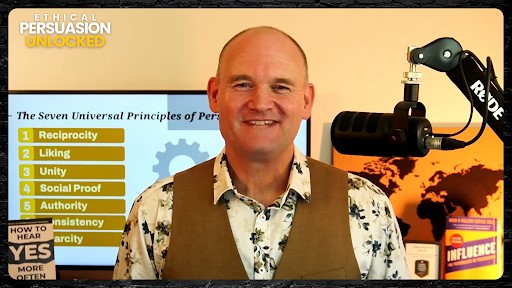
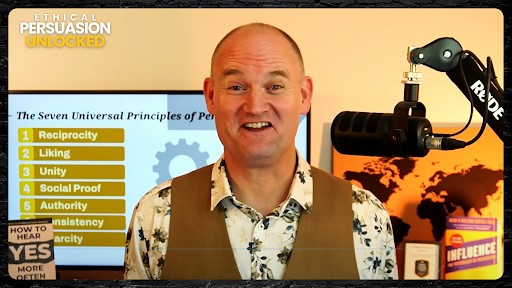
You will have a much smaller chance of successfully convincing or persuading anyone if you don’t have a good relationship with your audience. Building or repairing a relationship is therefore crucial to success. Now some of the universal principles of persuasion are particularly effective for building loyal relationships quickly. And that is what my guest Paul Craven and I will discuss in this episode of Ethical Persuasion Unlocked.
Paul Craven is a behavioural scientist and a professional speaker from the UK. He brings more than 30 years of senior City of London experience to the question of how we influence people well, ethically and in ways that build trust rather than erode it. Paul has held senior roles at Schroders, Pimco and Goldman Sachs and so he has lived the high stakes side of decision-making.
His forthcoming book is called ‘Chameleon Thinking’, and Paul is a member of the Magic Circle, which tells you something about his fascination with how perception works. Like me, Paul is also a founding member of the Cialdini Institute, and we were both amongst the first to be certified as Cialdini Certified Coaches and Licensed Trainers.
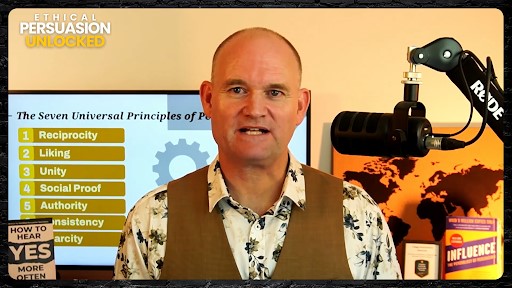
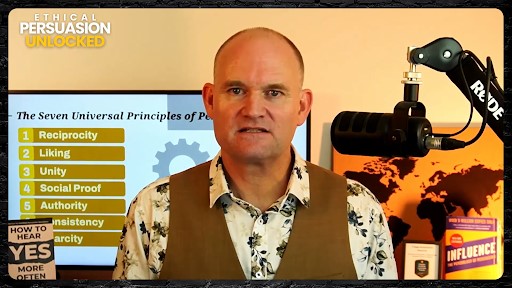
Hello and welcome back to the Ethical Persuasion Unlocked podcast. And today you’re in for a treat because I have guests with me today, Paul Craven, who’s also a Cialdini Institute Licensed Trainer like myself. And what we want to sort of dive in for you is the following concept. So when convincing someone or persuading someone to get them to
buy your product or to do a certain behaviour that you’re hoping for or want them to do or to follow you, create loyalty, all those sorts of things. We could argue that there three important elements to that. And that is, first of all, relationship. Right? If we don’t have a strong relationship with people or if we dislike someone, we’ll actually go out of our way
to not want to deal with those people. So we need a strong relationship in order to be able to move forward and to convince people to follow our advice or to buy our product or to do as we say and so on. So relationship is important. Now, there are people, I’m sure you have them, that they love you, but when it comes to what it is you’re offering or what it is you’re suggesting, they’re just not sure that that is right for them. And so we would say that…
that person is still uncertain about what it is you’re offering. So uncertainty then needs to be lowered. So that could be the second pillar, right? So we have relationships, we need a strong relationship, but we also need people to be certain because if they’re uncertain about what it is we’re suggesting, then it’s also harder for them to move forward. And then there’s a third pillar, so to speak. So, and you’ve got people like that as well, right? They love you, right? They love you, the relationship is good.
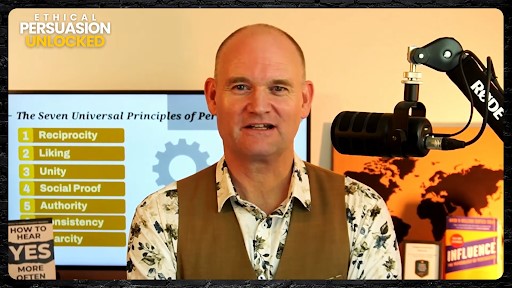
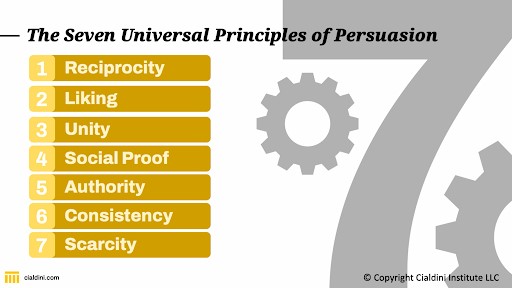
They love your product or they love your service. They love what it is you’re offering. When I’m ready, I’m going to get your stuff. But they’re not buying, right? Or they’re not getting off the fence or they’re not doing that behaviour that you were hoping that would do. And so now we’re missing motivation, right? We need to motivate them into action. And so that’s the third pillar, motivating people into action. And so out of the seven universal principles of persuasion of Dr. Cialdini, there are particular
principles which are great for building and repairing relationships. Other principles are great for reducing uncertainty. And then there’s other principles which are great or your go-to principles if you’re trying to motivate people into action. But of course, if you’re trying to motivate people into action and they’re still uncertain or there’s no relationship, you’re not going to be that successful. So anyway, Paul and myself thought it was maybe a great
topic of conversation for us to dive into and let you listen for no doubt the little strategies that we will share that you can implement immediately. And so we are going to talk about this first pillar, this building of the relationship with people. So Paul, thank you very much for joining me today and welcome on the show.
Paul (05:41)
Thank you very much for having me, Patrick. Pleasure to be here.
Patrick Van Der Burght, CLT (05:46)
Awesome. So relationships, what is, give us your take on it. Where is this important? How does persuasion fit into it?
Well, I think we have to start with the evolutionary roots of why relationships are so important when we come to doing what we have to do in the 21st century. And the answer is that for thousands, indeed tens of thousands, possibly let’s go back to 200,000 years since Homo sapiens has been around, we’ve had to kind get on with each other if society is going to survive. And it’s this relationship building aspect of it, the collaboration part, if you like.
That has allowed us to build up society, to build up civilisation. So I know it hasn’t always gone very well, but generally if you think about it, society start off with an individual, then a family, small family, then a small community and builds outwards. And it strikes me that one of the sort of great Cialdini principles, yes, one of the great principles which Cialdini I think uses ethically and wisely.
Is this idea that we need to like somebody and to be persuaded by them. And indeed we need to like them to help them be persuaded by us. And of course this is the basis of back to society again. If you think about it, if you start doing that with fellow human beings, you start to build trust and liking is a stepping stone to trust. And very important when it comes to business. But again, I want people to think about the evolutionary roots of this. That is how society basically builds up from scratch and how
it takes us out of the wildness to be like and we can actually create things and do things together. So I think there’s a very good motivation for it. And we’re kind of almost pre-wired to want to get on with people, I think, in most cases. that’s part of some strange individuals. Generally, people have a desire to like and be liked. And that’s a good thing for humanity, of course. And so when it comes to wanting to use the liking principle, let’s start off with that one first of all.
It’s a way of really trying to get to trust as quickly as possible Now I think it’s worth just emphasising. We’re about here about ethic doing ethical persuasion, and I really don’t can’t emphasise this enough It’s not about just fake cheesy. “Hello. You’re wonderful person, please buy off me”. Nothing like that at all this is about genuinely trying to build a proper relationship and we were chatting about this weren’t we recently?
There’s a well-known car salesperson in the US called Joe Girard. I think he won car salesperson of the year many years in a row.
Patrick Van Der Burght, CLT (08:27)
Yeah, and in the Guinness Book of Records, he was in there as well.
Paul (08:31)
That’s right. And you’ll know this story, but perhaps others might be enlightened by it. It’s certainly enlightened my life. And I genuinely mean that. Joe Girard used to be well known for being very good at selling cars and not just because he was a good salesperson, it’s because he was liked and trusted. And he had lots of things. He’s written a very good book, by the way, which is I’d recommend. And in it, there’s some nuggets on how you can behave. And so, just one little example. If he saw someone come into the car showroom,
and he’s obviously behind a glass screen and he comes out to greet them. Obviously he’d say hello, nice to see you, blah, blah, blah, and all that stuff. But in his head, he’s thinking of something, right? He’s not thinking, how am going to sell you a car today? He’s thinking, how am going to sell you your next car after the one I’ve sold you today in two, three, four years time? Now you think about it, if you go and wear that attitude, you’ve taken that
today’s business away from being a transaction towards building a relationship. And it’s an incredibly positive way of thinking about your clients, your customers. How do I sell them something that they will need and want and will be a benefit to them, note: in two or three years time, not just the day. And for me, there’s one thing I think that distinguishes an ordinary salesperson from a great salesperson, it’s they recognise
that relationships ultimately matter more than simple transactions. Transactions are important, they’ll pay the bills, we all need to do them. But actually, if you build a relationship with somebody ensuring multiple transactions over many years, you’re in a better position. And guess what? Your clients like you more. And if you can come across with an attitude and mean it genuinely, then you’re in a very good starting place. So that’s why I started off with this idea that it can be a benefit to society, it’s how civilisations start. Liking
is a great Cialdini principle, it’s a stepping stone towards trust, which is the ultimate foundation of a relationship.
Yeah. And with, I mean, just circling back to, you know, where you said in the past, we needed to get along. It makes evolutionary sense as well, right? That, for example, similarities and my audience may have heard this before in the episode where I did a little bit of a deep dive into liking. But we could define liking as in ‘People like people that are like them.’ So that’s similarities.
We like people that like us and we like people that like us and say so. So that’s a roundabout way to say in compliments. But from this similarity perspective, you know, long, long time ago, if somebody was similar to us, we had the same genetics as each other.
And that meant that we were safer with them. And so it’s sort sort of hardwired in us to look for similarities. And of course, genetics is not important now anymore, but now we’re looking for, okay, well, hang on, this person likes the same type of hobbies that I do, or that person has a particular care about the environment, which I also share. And now we’re…
identifying those similarities that way, which strengthens that relationship really fast, which I think a lot of professionals underestimate. They’re too eager to just jump straight in and get to business where, as you and I know, Paul, there’s plenty of studies to indicate if you just take 5-10 minutes at the start of a conversation to…
have a little bit of a social chat, find out what people are into and discover those similarities that cooperation can be so much easier and negotiations can be shorter and overall outcomes and things improve.
Paul (12:40)
there, Patrick, I we’ve seen plenty of experiments and whereby and I’ve seen them plenty of times in real life, but that’s also been done kind of in the in the laboratory with, you know, and there’s that very good one we looked at not so long ago where people were given challenges of trying to negotiate a settlement and one group of people were given it as a look, here’s your business thing. You’re you’re representing this side.
The other side were told, you you’re representing that side, try and come to a settlement between you with this particular case study. And then the other group divided into two were given exactly the same case study, but they were told to spend, I think it was 10 or 15 minutes just chatting before you get down to business. In other words, you know, you can talk about whatever you like. Can you find a common piece of common ground? You can talk about whatever you like, the travel, the weather, anything you like.
building up any sort of relationship is better than zero relationship. Unless something is purely transactional, purely trust driven. And very few things are that just that in this day and age, even in the age of the internet. Build up a slight relationship and, you know, talking about buying things on the web, for example. Again, you and I have seen plenty of studies that show that some of the behavioural science type techniques on using them on a website is more powerful than just simply price reductions.
There was that survey, wasn’t there, done a few years ago. And they surveyed hundreds, think thousands of companies actually, and tried different A-B tests on what works on the landing page. What would encourage people to click on indeed ultimately to buy? And most of the factors, an A-B tests for those that don’t know is when you could put up a screen with your example or experiment on there
and then you can have the same screen without it and you can see which screen is more successful in terms of the public using it and then clicking on. And you know, something as simple as a welcome message. Hello, welcome to the website.
with click-throughs.
Patrick Van Der Burght, CLT (15:10)
Yeah, because people
crave that human connection. And when you’re on a website and it’s all straight into business and you know how wonderful we are and what we’ll do for you, people, you know, there’s this, they’re missing that human connection so welcome message is incredibly powerful.
I don’t think it’s conscious thing, I think it’s an unconscious thing. I think we’re, what was it, Viktor Frankl, man is pushed by drives but pulled by values. I think unconsciously we want to relate to other human beings. And I’ve always likened this to this, my favorite metaphor of all is by psychologist Jonathan Haidt, who uses this idea of the elephant and the rider. And the elephant is your…
powerful unconscious mind in the background upon which you sit as the rider and the rider is the conscious mind so conscious think analytical, research based, evidence based, reason, logical, all those good things we think we are all the time. The elephant, the unconscious mind is big, powerful, silent. Sometimes you don’t even know it’s there you’re sitting on it. But guess what if you want to go that way with your logical rational analytical strategy and the elephant’s thirsty and wants to go that way
which way you’re going to go. And of course it’s from the elephant, from the unconscious mind that all of our habits, a lot of our addictions, a lot of our biases, a lot of our mental shortcuts come. So for me, this is about as much, if you’re trying to be persuasive, talking to the elephant as it is talking to the rider. You need your logic, your reasons, your evidence. Of course you do. I’m never ever going to undermine that side of the persuasive argument.
But actually appealing to the unconscious motivation of the elephant is that it’s quite good as well. So I think with this liking thing, for example, it’s not a conscious thing. It’s an unconscious desire to be liked, appreciated and trusted. And we can do things ethically to help people get to that stage.
To put things a little bit in perspective, Paul, you just mentioned the A-B testing. With A-B testing, a lot of this stuff is done online by web designers and bless them. They make wonderfully pretty looking websites, but most of them have no idea about behavioural science. And so when it comes to A-B testing, this often comes like, okay, let’s try something. Let’s try a green button over a red button. See if that makes a difference. Well, the problem is…
you can make people arrive at two different pages with that small difference, but now you’ve got to wait three months to gather the data to see if your gut feeling actually produced the idea or produced the results that you were after. It might not produce any results or it might actually produce the opposite. You’ve lost money over the last three months. So you’re wasting so much time of your clients, so much time and money of your client where if we use behavioural science instead, you know, it’s at over 60%
more likelihood that you’ll end up with a improvement using behavioural science on a website. And you mentioned the welcome message. Another simple thing that came out of that same study was, you know, having a smile on the, on the front page is someone smiling at you instead of your beautiful building, let’s say, right? The simple things like that to increase the overall, persuasiveness of that. And also,
Paul (18:18)
Yeah.
Patrick Van Der Burght, CLT (18:34)
Paul, you mentioned that study with the negotiations. I’ve actually got some figures on that for people who are interested. Because often we can talk about this and say, oh, it was better this way. But sometimes when you hear the percentages, it’s just jaw dropping. This was a study of Northwestern versus Stanford. And it was in their negotiations, they found that 30% of the negotiations would end up in deadlock, which represented an enormous cost.
Paul (19:18)
Hmm.
It’s extraordinary and yet that you wouldn’t think, would you, that it would make that much difference? I mean, you’ve told, but it does. It makes a huge difference in this idea of sort of expressing some kind of humanity. It’s a reminder that we’re human beings negotiating or dealing with the other human beings, which takes us back to that evil issue point we started with. It’s a powerful, unconscious motivator. And that’s why I think this whole idea, the three principles that go into relationship building are so…
fundamentally important in business. But of course in the hard nosed world of business, it’s all about immediate transaction, or many people think it is. Let’s get down to business straight away. Careful, it may work, but let’s improve our chances of it working.
Patrick Van Der Burght, CLT (20:02)
And then another observation as well, or realisation, which is good to think about every now and then, is that to get a new client, now if we’re talking about client acquisitions and trying to sell people, to get a new client is incredibly costly. Lead generating efforts, all this stuff to build trust and get that first transaction, where if you can build a strong relationship that repurchase, the frequency of them repurchasing, lot of business owners
seems to neglect that. And so that can start right at the beginning to build that strong relationship. So you increase your repurchases and people coming back to you and staying with you and referring other clients to you.
Paul (20:45)
You’ve just reminded me of something, Patrick, which is probably worth, I mean, the idea of cold calling or indeed writing a cold email. And I was, I was doing a talk, to about 400 people a couple of weeks ago, and this came up, about emails. How do you write an email to somebody who you’ve never met before? With a view to promoting some sort of business line. And I immediately sort of said, well, it answered the question. Stop,
stop what most people do, which is, dear so-and-so, I hope you’re well. Which is kind of, and by the way, if you ask some of the AI engines to write an email for you, they’ll start off with something as bland as I trust you’re well or hope you’re well. And this is terrible. This is, I mean, this is not the way to engage with somebody initially. And by the way, I’ve been as guilty in the past as anybody else, so I’m not trying to be clever. But I don’t think I’ve, since I’ve been working certainly at the Cialdini Institute, I’m aware of things like the liking principle.
if you do take up this idea of trying to come up with something creative as an opening line in email, it must be your own style and don’t copy anybody else’s. I think about your own thing. I had a few in my back catalog. One I quite like now, which was an email is no substitute for a handshake, but I hope that we’ll have a chance to meet soon in order to have a handshake. Now that might be bit cheesy for some, but it worked. It got their attention. It was a bit more human.
Another one I tried once which again led to further things was something like the algorithm says we should we should connect. For once the algorithm was right I’m a hopefully a bit of humor it made them laugh and then we saw it. So you see what I was trying to do there and again some of them don’t always work. But it’s so much better than I hope you’re well which is just a machine turns out and this is the liking principle. This is trying to start to build that early
Paul (23:11)
stepping stone towards something bigger than just, you know, opening the dialogue with something bland. And I think this is pretty important. If someone says something curious to me as an opening line, I’m much more likely to engage them, aren’t you? I mean, it’s just the way of the world, I think. The bottom is common things.
Could be in a pub, could be walking down the street, could be anywhere, not necessarily. And it struck me, we always say, I’m very well, thank you. And it’s sort of a social protocol and norm, and it’s a way of breaking the ice. But I’ve been trying to experiment where you try and come up with something new and immediate and creative that isn’t very well, thank you. And it can produce some quite funny ones. So came up one day, someone said, how are you? And I said, if I was any better.
I think I’d pop with a big smile on my face. And do you know what? Immediately,
bonding. I mean, it won’t always work, but it’s, it’s a good thing to never waste a cold call. If someone calls you on a cold call with something that you don’t want, you’ve got no interest on, don’t be rude to them. They’re doing their job. I’m assuming I’m using the word cold call and not a scammer. Slightly different. If you could spot there a scammer, that’s slightly different, but don’t waste it. Just have a little go at engaging with them. You you can try lines with cold callers.
And they’ll start off, and they’ll have a script probably, something like, how are you? I hope you’re doing well today. And you can play with them humorously, not mocking them, but you can try and see if you can build a little relationship from your side. And sometimes if you say something like, if I was any better, I think I’d pop. They haven’t got a script to cope with that one. And when they’re looking down there, what do I say next? And it’s also quite a way of exposing if an AI type inspired machine is phoning you as well.
I digress, but it’s all the pro- liking principle, it’s all relevant to this.
I was going to say when it comes to, to opening lines in reaching out to someone, of of course the compliment can also activate their principle of liking. And we do know that of course AI is looking for, you know, a company achievement that then can be mentioned as a compliment. I really like how you won that award for such and such two years ago, right? And you get these sorts of compliments, but if you can
demonstrate early on in your communication that you’ve actually taken the time to look at who this person is or who this company is and something they have achieved or a similarity that you might have in common with that person, you’re also demonstrating that this is not just a generic email that’s sent to everyone, but some customisation went in here. And so, you know,
feels like certainly this person had a look on our website or had a look on my LinkedIn profile. You know, when you come with, hey Paul, I see that you’re into fly fishing and you know, so do I, or you know, something and you can raise a similarity or you can compliment on something they’ve achieved. Then again, it’s a system one part of the brain that might go, you know what this is…
may be okay to pay attention to the second paragraph. Or if you just use something generic, you’re out already because people get so much communication and they need to filter. They can’t keep up.
Paul (26:48)
And I mean, very wise words and you can apply this in all sorts of places, of course. So again, remember, you have to, I think, be authentic. This is not trying to find a false similarity. This is really important to emphasise because, again, sometimes I get called by people who try and pretend they’re my best friend from the get-go and they’re not. And it just goes the other way. I just want to reject them.
the third principle, well, I always think of as Reciprocity, Liking, Unity being the one, two, three, Cialdini principles of cultivating relationships. The unity principle, if you can find a shared experience or shared identity that can be something that’s something that, it could even be something as, you know, you might’ve been born in the same year or something or the same month or you grew up in the same town or the village, even if you didn’t know each other, you’ve immediately given yourself a better chance of establishing a relationship.
Because people do have, and again I think they’re unconscious often, allegiances and it helps to sort of start something growing that might not otherwise exist. There are of famous experiments about this one, Patrick, as you know, and we’ve looked at lots of them at the Cialdini Institute, but I’ve got plenty of personal anecdotes where if you can find something that’s just a shared thing, you know…
people sort of sometimes mockingly say or they went to the same school together or something. Well, yeah, you can mock it, but actually that can make a big difference. Growing up in the same town or something like that, really, even watching the same TV show as a child, there was so many ways that you can find some sort of shared thing with somebody. And again, as long as it’s done, not done cheesily, it’s done authentically and honestly as part of a longer term conversation, this isn’t necessarily the opening line thing we were talking about earlier.
And they all happened to be Man United fans. I think it was Man United. Apologies if I get that wrong. And each of these fans was brought in individually. They had to walk across the college campus individually to answer a survey. And the survey was a bunch of questions about, in this case, I think it was Man United, but it was about their club.
Patrick Van Der Burght, CLT (29:31)
Manchester
United you mean for those who are soccer challenged?
Paul (29:36)
I’m a Spurs supporter for my sins, so it’s a very difficult time for us at the moment, I digress. And anyway, so these fans were invited in one at a time. They came to answer this questionnaire, and the questionnaire was about their team. And then they were told, thank you, that’s the end of the today’s survey. I think they got some reward for doing the survey they left. And…
so you’ve to imagine they’re leaving the campus. They’ve relaxed. They’ve kind of forgotten about the thing. What are you going do next? And this is the way the experiment set up. Very clever. So an individual fan walking back across and then somewhere in the distance, not too far away, and it was a campus so there were a few other people around. It wasn’t just one person. But someone a bit further away would fall over, fall over accidentally or
they would be doing on purpose, but the other person didn’t know that. It looked like an accident. And they wanted to see, would the football supporter who just done the survey help?
Patrick Van Der Burght, CLT (30:41)
And
the person falling over had a shirt of Liverpool on, right? Which are like fire and water normally, right?
Paul (30:44)
So
what they did was they did three different ways of doing it. They had the person having a Man United shirt on, a person having a white shirt on, just a sort of blank shirt on, and a person having a rival shirt on, like a Liverpool shirt on. And they wanted to see if the Man United supporter coming back after the experiment, after the questionnaire, would go over and help. Remember, this is the middle of the day, there’s no game on, it’s just… And what they found is that if it was a… the person was wearing…
a Man United shirt, I think 92% of the time, or 90% of the time, would come over and immediately, are you all right, mate? Can I help you up? You you all right? If it was a rival shirt, it would stand at about 30%. So in other words, people really are are possibly more consciously than unconscious in this case. They’re spotting what the shirt is is, and and it’s changing how they behave. Now interestingly, and that, if the experiment stopped there,
that is interesting enough. So in other words, about a third of the time you’ll stop if it’s the wrong colored shirt to help them, then you would do it if was a fellow shirt. That experiment is genius, but the second bit of the experiment for another bunch of people was very, very interesting indeed. So this time the people came in weren’t actually asked to do a survey on their own football team. They were asked to do a survey about the game of football.
So they weren’t talked to, the Man United fans weren’t asked about Man United, they were asked about football generally and their love of the game. Now this time, remember, there’s a scenario, they’ve done their 100 questions or whatever it was, they’re walking out individually, someone falls over. Now, as you’d expect, if someone falls over in the same team shirt that they support, they’ll go over and help, so the numbers are equally high.
The extraordinary thing about this experiment is if someone’s wearing the wrong shirt, in other words, a rival shirt, let’s say a Liverpool shirt, whereas it was only 30% of the time they’d go over and help if they’d been talking about their own Team Man United. if If they’d been talking about football, generally, in their survey, their questionnaire, it goes up to 70%. So in other words, if people have been primed to talk about football and think about football. Then when they see someone else in a football shirt.
It’s not a rival shirt, it’s a football shirt. They’re much more likely to go over and help. So the relevant numbers are 92 versus 30 in the first experiment, and then it was actually 80 versus 70. Then the actual numbers don’t matter, it’s the magnitude of the numbers. So people will almost always go over and help someone. This is the Unity principle, it’s extraordinary. Not now, he or she isn’t a member of the same football team, it’s we both like football. There’s the shared thing.
Patrick Van Der Burght, CLT (34:03)
And that’s for the detectives of persuasion and influence. that’s where people need to build this application skill. mean, it’s awesome listening to this podcast and getting little ideas from this, but of of course we need to first of all understand everything that’s involved. mean, Paul and I can only mention a few little strategy and dynamics, but there’s so many dynamics per principle and subtle nuances. So you sort of get that more of a…
Paul (34:27)
Let me give
you one more, because first of let me endorse that last point you made, because when you give these examples, and I’m always aware of this when I’m standing on stage doing a speech, I’m giving examples that don’t necessarily have immediate relevance to the roles and responsibilities of people in the audience. But I always try and say, look, just think, we’re talking here about an idea, an idea that seems to work in this context. Now, how can you apply it in your context? And…
how can you apply it working with your colleagues? Doesn’t have to be with your clients or customers, it can be with your colleagues. How can you get on better with them? And this is why I think this stuff is gold dust. And also you find these examples everywhere. I found myself on a skiing holiday last year and one of the people in our party was a vet. And I got chatting with her and we’re talking about, I say I’m really into psychology and she said, she said, can I tell you one story about,
what we do in our vets and I said, yeah, sure. And she said, well, obviously, and I’ve got pets of my own, so I’ve been to vets many times before and I’ve been to the surgery and I know what it’s like in there, it can be stressful, people have got sick animals. It can be a tough time as well, because occasionally animals, you take them in to be put down, sadly. And some vets, as you may know, some vets have this policy, they’ll have a little candle or a light bulb or something, normally a candle, can be a real one or a fake one.
And there’s a sign by the candle that says, as you got to the reception, “If this candle is lit, please, please will you keep your voice down because someone somewhere in the surgery is saying goodbye to their beloved pet.”. And I’ve been in surgeries before, in fact, I’ve had the sad experience myself of taking my own pets in to be put down and they light the candle and that the reception area is very quiet and respectful when that candle gets lit.
And people, and what’s the sort of shared unity? We’re all pet lovers. We appreciate what the owner and indeed the pet is going through. And I was talking to this vet and she said, look, sometimes she said, we’ve got on our roster, most of our clients are lovely people with lovely animals and we love to treat them all. But we have one or two very, very difficult customers. People that come in and shouty, abusive, rude. You know, they wouldn’t be allowed in any other
context, but they come into the vets with their animal, we have to treat the animal. We have a sort of duty to do that. But they demand immediate service, and they complain about the bill every time very loudly. They swear, these aren’t particularly nice people to have, but we have to look after their animals. And if we know that someone’s coming in, and she said, I really shouldn’t tell you the story, but I will. We sometimes light that candle, even though there’s no animal at the moment being put down, because we know it will
utterly transform their behaviour. They will become very nice, very pleasant to deal with, very respectful. They won’t start shouting or disagreeing or swearing. And I thought to myself, well, yeah, you could argue that’s slightly unethical. But I think in the context of what the receptionist has to put up with sometimes, I think I’ll let that one go through the slips. I think that’s absolutely fine. But it shows you again the power. And this is Unity. This is the Unity principle. We’re all come
Patrick Van Der Burght, CLT (37:21)
Easy.
Paul (37:47)
We’re all animal lovers, we’re all pet owners. There’s a bond. And again, you won’t necessarily find bonds as strong as that, but you will find some bonds. And if you can work those bonds as part of your business, you can apply. Very, very powerful at relationship building. Very powerful.
There’s another dynamic which I wouldn’t mind touching on just because I find it absolutely fascinating. And that is also part of the principle of Unity and often when we talk about Unity and it is the newest principle that Dr. Cialdini uncovered through additional research. And so we often talk about the feeling of we-ness and that feeling of community, like being part of the same group, which is exactly what Paul just talked about with the…
and the animal owners, right? We all love our pets. We’re all similar. And so we want to cooperate with that. There’s another facet to unity, which is acting together, which I find absolutely fascinating. Let me give you an example. People were in a room on a table and they had headsets on.
and they were listening to music with a particular rhythm. And so they were asked to tap the table in the rhythm of the music that they were listening to. Now they had somebody sitting opposite of them, also with headset on, they didn’t know them. And some of the test subjects were listening to different types of music. So the tapping would have not been in sync or in concert with each other. tapped in a different sort of timing, different sort of rhythm.
Other people in the test, they were listening to the same music at the same time. So they were tapping the table at exactly the same rhythm. And when that part of the test was over, thank you very much, right? And one person was led away and then without them knowing, the other person was led away. And then they were told the story that, thank you very much for participating in the study that you’ve just done, that was very helpful. Now your colleague that was
that was in the room with you, they’ve been offered to play a game in which they can, sort of a maths game, I think it was, where they could earn some money. Now, you could do the same game as well, if you like, but if you so choose or if you wish, you can also help the person that was in the room with you before, and that will dramatically increase the chances that they will actually win something.
And then you think, well, what would be the difference between the two groups, right? I mean, they’re just sitting on a table for crying out loud, tapping at the same time or not tapping at the same time, right? And 49% versus 18%, as in 18% of the people that didn’t tap in time said, yes, I will go help the other person. And the people that tapped at the same time, 49% of them decided to…
forgo the chance that they might win some money themselves and go help the other person. So of course, this is not something you do in an initial email, know, persuasion, science, it applies to everywhere where we’re communicating and where we have our goals to achieve. So if for example, I mean, Paul, myself, we stand on stage, we talk to crowds of people and you know, often we talk about audience participation.
Right? And it’s great to keep people awake and keep them alert and keep the energy levels up. But taking this lesson from that, you can, first of all, if you can have your audience do something together, like even just raising the hands to a question that you get a likely room full of yeses answered to. Then that can have that synchronised action and you build that unity between the group.
And in that case, you want to make sure that you do the same thing with them at that time. So you’re part of that group and increase that unity. I always love these sorts of studies that blow me away.
Paul (41:59)
Yeah, just to add something to that, I also occasionally find myself performing magic on stage. You mentioned I’m a magician as well. It’s quite interesting. I’ve had a sort of parallel career. I was working for Schroders, Pimco and Goldman Sachs. And then the other side of me or my spare time was as a magician. And so just to pick up on one little thing you did there, I can say this as a magician, but I’ve also worked on public speaking as well.
If you want to get a response from the audience and you say hands up, dot dot. You will get some sort of response. But if you do this, there’s any works of you can see what I’m doing now, you go hands up those who, and you put your own hand up as you do it, you will get a much better response by a huge margin. You make the gesture with that. Hands up those who. Likewise, if I say, does anybody here, and you put your hand behind your ear, then you’ll encourage people to call out.
Now that’s not synchronising movement with the audience, like the hands up, but it’s the same principle. I’m encouraging interaction. And again, I think this is all about connecting better with human beings. And let’s be frank about this. The whole thing is about communication. How can I communicate better, more authentically, more effectively, more honestly? And that applies to whether you’re performing a magic show or whether you’re trying to sell a piece of real estate in Queensland. It doesn’t matter what you’re doing,
you need to connect with someone on the other side. And that’s why for me, I mean, I had to say this, but I mean, for me, behavioural science, psychology, and indeed the art of magic, they all kind of connect around the back of the same circle. It’s about how the human mind does and doesn’t always work and how to talk to the elephant, back to my psychological metaphor, the elephant and the rider.
Exactly. All right, so let’s round this off a little bit. So we have three principles that that help us to build and strengthen relationships. And we haven’t really touched on one of them, and that’s okay. There’s too much for us to cover. that can come another time or in another discussion, or perhaps you’d hear this in formal training with myself or with Paul. So what does this…
mean, maybe that’s a good thing to reflect on. So we have relationship building principles. So it is important to realise when you make your communication that you recognise where you are in the relationship. If you are early on and there is no relationship, then going to strategies to motivate into action or reduce uncertainty will
not be as successful than if we have built that relationship. And so we need to realise where we are and then use the appropriate strategies. And I’m sure you get this as well. You get that question from people. Okay, so what is the most powerful principle of persuasion? And I smile because it kind of knows you don’t know the science because there is no most persuasive principle in persuasion. It depends on where you are.
[chapter time="45:12" title="Understanding Context in Relationship Building" thumb="https://ethicalpersuasion.com.au/wp-content/uploads/2026/03/ep15-frame17.jpg"]Right? If you’re, if you’ve got that relationship covered, if you’ve got uncertainty reduced, well then probably your motivating principles will be the most powerful, but that won’t be another situation.
Context as ever is so important where you are in this situation and also what I think I’ve learned the more I’ve learned about the seven principles of persuasion The more I realise although it makes it sound form formulaic. It’s not it’s about you have to be flexible You have to to me you have to listen And again back to what we were saying only about just establish your relationship You can’t really go in with too many pre plan things. You have to listen to what they’re saying
actively listen to the old cliche, you know, two ears, one mouth, because actually that’s how you build a relationship, is listening as much as talking. And it’s not to be underestimated.
Wonderful. All right, Paul, if people want to learn more about you, do they find you? How do they get in contact with you?
Paul (46:12)
I’m on LinkedIn, Paul Craven on LinkedIn. Please send me a message, please connect. Try and come up with a good opening line, not hope you’re well. It’s a joke, I hope you had to listen to the beginning of pod, of the caster to understand why I said that. But I’m delighted to connect with anybody that wants any thoughts on behavioural science or the art and science of influence and persuasion. I’ve got a website, www.paulcraven.com and I’ve got a book coming out later this year which I think is going to be called “Chameleon Thinking”.
Due to be published I think in the autumn of this year so hopefully that may be of interest talking about justice sort of stuff. So Patrick thank you very much for having me it’s always a pleasure to talk about these things and and I haven’t even talked about my favorite principle persuasion we’ll keep that for next time.
Patrick Van Der Burght, CLT (46:58)
Sounds like a promise. All right. Thank you very much for your time, Paul.
Paul (47:01)
Thank you very much indeed.