
But if those proposals were, I don’t know, 2-3% below, it’s much easier to get 1-3% extra than just handing out to them, this is the 25% that we need to do this year. So each member of the team said, OK, I think that I can do this. And this is my commitment. This is my goal. So if they say that, and everybody in the team knows about this, then the chances of them getting that result are much higher.
Patrick Van Der Burght, CLT
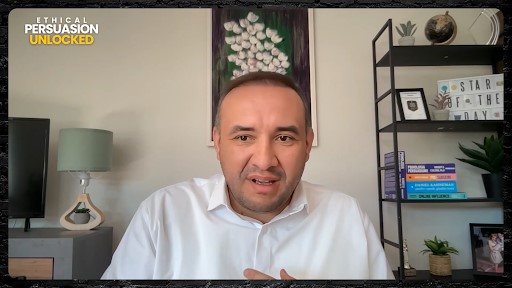
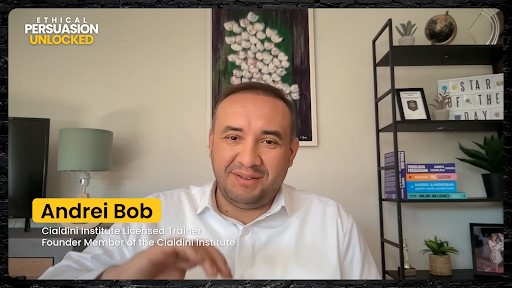
Today’s guest, Andrei Bob, is also a founding member of the Cialdini Institute, country manager in Romania and one of the highest rated internationally Licensed Trainers. With a background in marketing and master’s degree in human resources management, Andrei brings nearly 20 years of professional experience, including leadership roles such as business development manager at Philips in Romania.
Over the past 20 years, he has dedicated his work to helping organisations improve performance, strengthen their organisational culture, and achieve measurable business results and real impact by applying ethical persuasion principles and understanding the psychology behind decision-making. Today, Andrei and myself are discussing the use of ethical persuasion in manufacturing.
Patrick Van Der Burght, CLT
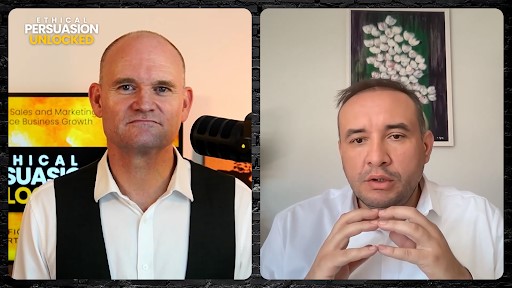
Okay, welcome everybody and I’m delighted to introduce you to Andrei Bob from Romania, also a Cialdini Institute Licensed Trainer like myself. So welcome, Andrei, I’m really excited you’re here.
Andrei Bob
Hey, hello, Patrick. Hello, everybody. Thank you for the invitation and thank you for having me. I hope this will be a really, really nice conversation.
Patrick Van Der Burght, CLT
I think it will be. And you, you’ve got a lot of experience with manufacturing companies as well. So you and I thought it would be an interesting topic to dive into persuasion science from a manufacturing perspective. So where do you want to, what direction do you want to start taking us Andrei?
Maybe the word Kaizen is very familiar with many of you. So how do you have like a continuous improvement mindset? Okay, so it’s a really great topic that I like to work with. And this was naturally niche developed by me because I worked in Philips before and I had the chance and the opportunity to learn about management and also lean management.
And what was really nice when I joined Cialdini Institute and after I really understood the science of ethical influence, ethical persuasion, I realised that this was the missing piece. Okay. Everybody knows about management. I mean, Toyota is developing it maybe 80 or 90 years already,
they are still perfecting it. And it’s a big challenge to implement lean principles, which are more or less like hard principles of management without also adding this ingredient like ethical influence. This is my revelation. This is the missing piece. And I have a lot of discussion with lean leaders or manufacturing leaders from our country.
And they say, OK, we are trying to improve our way of working, are trying to improve management, productivity, efficiency and so on. But yeah, sometimes something is missing and this principle don’t always last that long. And ethical influence, we saw that the best ingredient to add it to the main course.
Yeah, exactly. And, know, when implementing new procedures, of course, we got to get people out of the old way of doing it. We want people to start embracing what it is we want them to get excited about. Yeah, you know, of course we need to be persuasive in order to do that. And for those who are sort of tuning in new to this topic, the science of ethical persuasion is basically the use of words and images and picking the right ones to motivate people to want to comply with us.
So the decision comes from within them. At a previous episode, we brought to the surface the concept of when the cat is away, the mice don’t play. That applies to ethical persuasion. If you change, you can change people with pressure.
Right? So they do what you ask because you’re the boss. But if you can change them from what is within them, then they stay changed. Even if you walk away, when the pressure goes away, they keep performing that action. So needless needless to say, they’re valuable and typically costless to implement. So, Andrei, do people in manufacturing realise that they need to be persuasive?
Andrei Bob
Yes.
Well, that’s the first challenge we need to tackle. Yeah. And me as a Licensed Trainer and also business owner, managing my own training company, this is the first challenge. How do you convince manufacturing leaders to adopt ethical influence? Basically, how do we sell this program to manufacturing companies? Yeah.
And it’s harder to sell it than if you will want to target a sales company, for example, or a sales team. Because a sales team or a marketing team or a procurement team knows that they need influence and persuasion to do their job and have results. But in leadership, in manufacturing, but also in other industries, you as a leader and as a people manager, you basically know that you have a job description.
I mean, the job profile is really clear. Your employees have clear KPIs. Okay. And in manufacturing is very clear. What’s your job description? What are the processes that you need to follow? So they don’t always realise that they truly need influence and persuasion because, okay, I have these employees, the job profile and job description is pretty clear. They have an obligation to do it. Why do I need to influence them?
I mean, it’s clear that they are being paid for this. So this is why convincing leaders in manufacturing sometimes it’s a little bit harder. And this is why I’m trying to present present ethical influence as an alternative to managing people by force, yeah, by only relying to standards and procedures and job descriptions and so on.
And like you said, we want people to act because they really want to act because they that this is the right way to go. Not only because they are obligated by their job description and by their obligation to follow standards. Because when you are not there, when you as a leader are not present anymore, you want them to continue. And this is what I also like and really recommend when I’m doing training programs.
We are trying to look how the operational meetings are set up, how they are going. And the most mature meeting setup, if I can say so, is that setup in which if the leader is on vacation, the meeting is the same, the agenda is the same, the discussions are the same, they are not relying only on the leader’s presence. And this is a really nice way to measure how influential you are.
When they respect all those strategies, considering how do they discuss in the meetings when you’re not present. So this is why ethical influence is the missing ingredient when doing management, also manufacturing.
Okay, maybe you consider, I paid them and I paid them really well, so they should do their job. Well, again, nobody comes to work if they have like a lot of money, if they are millionaires. So of course we are coming to work because we need to get paid. But if you are only relying on the payment for you to influence them, then it’s pretty expensive to keep performance teams in your company.
And if they are very good at what they do, somebody maybe will pay them even a larger amount of money to steal them from you. So it’s not enough. It’s not enough. And you need ethical influence as a strategy to keep the most performance teams and employees in your team.
Patrick Van Der Burght, CLT
And just to just to elaborate on that a little bit, what Andrei is trying to touch on is that we pay people. We often also try to motivate our team members by offering incentives and rewards. You know, if you meet this target, you get X or, you know, it be money related, could be a holiday away, could be helicopter ride with the boss or something.
But these things, they don’t tend to work long term. For us and violence and money, the strategies have short term effect, but not necessarily long term effect. And so the problem is also that you might have a number of employees, some of which just naturally excel over others.
So those who are, let’s say a little bit less productive, but still wonderful workers, they’re not at all motivated by these rewards that are up for grabs because they feel I’ll never get that anyway.
It’s always the other guys or the other ladies that get these bonuses. And once people get used to receiving these bonuses, it’s very hard to start taking them away. So you’re sort of digging a hole for yourself where if we use persuasion science, if we can actually motivate people by by principles that are within them,
Patrick Van Der Burght, CLT
So they’re motivated without having that outlay and they’ll actually be more satisfied with it. So yeah, good point you’re raising there.
Yeah, that’s very important. And the last thing I want to add is that if you are still using only financial motivation, they will get used to it, as you said. But even worse, when you need something extra from him, maybe you need him to be involved in the project, the first question inside his head will be, OK, what will I earn extra?
So because you got him used to paying him extra and bonusing him when you want him to do a better job and on the long term, like you said, that will never work.
Patrick Van Der Burght, CLT
Okay. So just before we move on, of course, leadership is very important in manufacturing, but there’s other areas in manufacturing that would benefit dramatically from being more effective with their persuasion attempts. And we might not have time to elaborate and dive into each and every one of them. But of course, manufacturing has also sales departments. Of course, they need to be persuaded to do their job, the way management would like them to do.
Andrei Bob
Yes. Yes.
Patrick Van Der Burght, CLT
But they themselves of course also need to be persuasive going out trying to convince their wholesalers or their retailers or whoever to actually buy the products and services that are on offer. And so needless to say, doing that without the available science is going to, you know, see us underperform dramatically.
Then there’s of course also, you know, procurement. need raw materials to start manufacturing with, and we’re gonna have to negotiate prices with our suppliers.
And so also there, we’re gonna have to be persuasive, which will have a massive impact on our profit margins, depending on how successful or not we are there. So it’s, course, a lot of areas, and even far more than I’ve just mentioned, where we need to be persuasive.
Yeah, especially in big companies that also have manufacturing. Like for example, I work with a big client in Romania. So, okay, there is the manufacturing stage or before that is procurement or and after that is sales. They also have marketing, communication, everything. of course, the ethical principles apply or are more relevant in some way to different areas, but other principles are even more relevant to different areas. But…
I would like to share with you the most important ethical influence principle, not from my point of view, but from a plant manager, a general manager in Romania that leads more than 3,000 employees. And after we did like a one-month project with trainings, online, sorry, face-to-face trainings and also application workshops, he said to me, “Andrei, I think the most important principle is the unity principle.”
Because yeah, we have a lot of departments and we need to have like a shared goal, a shared mission before we talk about KPIs and projects and tasks. Because everybody, now being a big company, everybody has its own priorities. And how do you reconcile that? Okay, so you have the production manager that really wants to boost productivity.
And then you have the safety manager that wants to stop some of the machines in order to do safety procedures to check if they are working well. So they need to stop the production line.
But the production manager wants to run the production line. So how do you reconcile those discussions? Also sales, you mentioned sales.
Sales want to sell as much as they can, but they also need to synchronise with production in order to have the product at the time and in the quantity that is asked by the client. Also, you mentioned about purchasing department.
Yeah, one of their objective is to keep the prices as low as possible for the products they need to purchase from the materials. But the quality manager wants the highest quality products. How do you reconcile that? So there are different in these kind of industries and not only manufacturing, but I think this applies to every type of company. You have different positions with different objectives and different KPIs.
And the best way to put them all together is using the unity principle. We need to have a shared goal. What is our team’s objectives? What is our company’s objective? What is our mission? What do we want to reach this year, for example? And only after that can you talk about different KPIs. Because it doesn’t need to be a conflict of interest between two different departments.
And if you have a conflict of interest, then it’s an influence challenge that you need to really, really tackle with. Really, really need to tackle with.
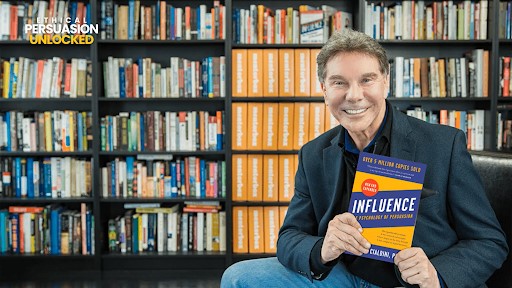
Just… If, I can interrupt here real quick, Andrei, Unity for those who are sort of tuning in. Unity was the principle that Dr. Cialdini sort of discovered last after a lot of additional research and was first published in his book, Influence the Psychology of Persuasion in 2015 when the new edition came out. So, Unity hinges on the fact that we favor those people who we feel are
Andrei Bob
Yeah.
Patrick Van Der Burght, CLT
But part of the same community as we have. You know, might be sitting in an airport and you meet someone and they’re from the same suburb as you. Well, you don’t know that person from Adam, but all of a sudden you’ve got this familiarity going on and, and, know, favouritism towards each other. That same favouritism you can have with, let’s say clients, potential clients or manufacturer or suppliers that you work with.
Andrei Bob
Yeah.
Okay.
Patrick Van Der Burght, CLT
But you can also have that within your own team members. So they have more favouritism toward each other, more loyalty toward each other and more forgiveness. So, Andrei, your client was astute to pick that up. That is one very powerful principle. Yeah, please continue.
Andrei Bob
Yeah, one of our core values at Cialdini Institute is that we need this principle to be applicable and effective. Okay, so how do you apply this? And one idea, one practical idea that the plant manager wanted to apply also with his team, before every big project, before every big, I don’t know, change in strategy, they need to have like a workshop.
They will do a workshop in which they will discuss and realign and focus more on values, on behaviours, and what is the company’s mission and vision. So they will try to have this kind of discussions before starting a new big project. Because when you start to discuss about the task, about the effort that we need to put in to resolve this new challenge, we all need to be aligned together to a shared goal.
We all need to feel again or reiterate that we are part of the same team and we all have the same goal and the same mission. If we are all aligned on this, then it’s easier to discuss about conflicting key performance indicators because they will not be conflicting anymore.
And this also applies with suppliers. I know suppliers, it’s a different entity. But if me as a manufacturing company and you as a supplier really understand that we really need to work together on the long term, again, it will not be a conflict of interest if you are trying to renegotiate the prices. Because I want a better price to be successful so I can buy more from you in the future. It’s not like I want you to go bankrupt.
That’s not the reason why I’m trying to negotiate some of the prices with you. I’m trying to negotiate it so you can be a long-term partner, so we can both be profitable, yeah? And reach our goals together. So it’s not a conflict of interest, neither in this case.
Patrick Van Der Burght, CLT
Absolutely. ⁓ Yeah, go ahead.
Andrei Bob
I just think that this could be like… I know we are talking about manufacturing, but you see, it applies also in all the different areas. And I think me also working in sales, a lot of it with a lot of sales companies and teams, I think that this unity principle, it’s so important to be viewed also with your clients.
When you’re trying to negotiate, when you’re trying to make a deal, this doesn’t need to be a conflict of interest when you’re talking about prices, discounts, and so on. And I think this is why Dr. Cialdini said about this principle that it’s the discovery of the century, something like that he mentioned it.
He said it’s greatest discovery of this century, something like that, because the unity principle was included in the liking principle. They are really familiar, they are really more or less the same, but there are some nuances here. And I think that this is very important to really understand.
Yeah, I know Bob or Dr. Cialdini really loves that co-creation component of Unity, which I think he said was the biggest development in persuasion science in the last two decades or something. And for those who don’t understand what that is, if you can work together with someone to create something, put something together, could be…
Andrei Bob
Mm-hmm.
Patrick Van Der Burght, CLT
you know, getting a certain amount of work done. Let me give you a practical example. Let’s say you have five tasks that you want completing and you have five employees on your staff that you would like these five tasks to be done by. You could go to each employee individually and say, Hey, can you do this? Can you do this? Can you do that? And so on. Or you could address the group of five employees and say, “Hey team,
I’ve got these five things that need doing. Can you guys organise amongst yourselves to get this done by next week?” Now you’re still going to get the same five tasks done, but they now have to co-create between each other and how we’re going to do this. And because they’re doing this together, they’re actually build more loyalty and you know, favouritism, forgiveness between them.
Andrei Bob
Mm-hmm.
Patrick Van Der Burght, CLT
So you can do exactly that same thing with a client who might potentially be buying from you. So now instead of you going, okay, this is what I think you should be doing and give them a whole finished proposal. Instead, you could actually work with them to figure out, well, what do you think would work well here? What do you think would work well there?
By the time you complete it, you’ve now co-created a solution that they were part in making and that activates that unity principle. They feel now part of it like you’re part of it and they’re therefore more loyal to it. Yeah, very powerful.
Yes, very powerful and again, for us working with this big company, this principle was fundamental to all of the other principles. Somehow we felt like it activated the other principles or made them relevant. And just maybe to add some examples here, for example, commitment and consistency, like you said, yeah, instead of asking for an employee to do a specific task open the discussion to your team and see who wants to contribute?
Yeah, as questions not set tasks. And whoever will want to take on a task or on a project will feel committed and responsible to doing it the best way he can. Yeah, because he committed to that.
So that unity goes to commitment and consistency and that’s very, important. So, on I don’t know, strategic meetings, you need to have like strategic objectives. What do you want to improve on the medium term, on the long term? And also in operational meetings, like daily meetings, okay? Nobody can leave, nobody should leave from a meeting without a commitment. Yeah, even if it’s an operational meeting.
What do I prioritise for today? What’s my main activity that I should work on today? And this should be a shared commitment, a public commitment. All the other teammates need to know about that commitment because if it’s only inside you, doesn’t, it doesn’t count. It doesn’t count.
Patrick Van Der Burght, CLT
Let’s unpack that a little bit. Let’s give those listing a strategy here. I mean, I know this is the wrong way to do it, but just to paint the contrast here, what I could do is I’ve got a team of people in front of me and I could say, okay, “John, if you can get this done by Wednesday, that’d be great. Sally, if you can get this and this done by Thursday. Michael, if you can do this by Friday,” right? And I go around the room and I assign the tasks, right?
And everybody you know, gets up and they leave. That’s probably the most, less persuasive, less productive option of doing that. Right. So, Andrei, what should they do instead?
Andrei Bob
Exactly. Exactly.
Well, you should ask questions. Again, I know it’s trivial sometimes to say about that questions, but you should ask questions. When I worked at Philips for me at the beginning of the year, it was a priority to do a team meeting with my team, of course. And we usually went out of the office and I started to ask, okay, what do you think?
So how much do you think that we can grow in the next year? Okay, so I led the sales team. Of course, I had my objectives delivered by my manager before that. So I knew, for example, I had to grow 25%. But instead of saying that number to my team, I tell them, okay, how much do you think we can do this year? Okay, and I let them come up with ideas and proposals. And if those proposals match up with my plan, great.
But if those proposals were, I don’t know, 2-3% below, it’s much easier to get 1-3% extra than just handing out to them, this is the 25% that we need to do this year. So each member of the team said, OK, I think that I can do this. And this is my commitment. This is my goal. So if they say that, and everybody in the team knows about this,
then the chances of them getting that result are much higher. And another maybe, I don’t know how to say, it’s not like a trick or something like that, but it’s ethical persuasion from my point of view. After that meeting, I send an email to the CEO or to the general manager that was my direct manager, and I cc’d my colleagues and I said,
“Dear manager, okay, well, these are the commitments from my team. We are really confident that we can do it.” So now not only the team knows, not only I know, also the general manager knows about these commitments in a very ethical way, we share that to them. And then the principle of commitment and consistency kicks in and they feel an internal pressure to deliver on what they promised, not on what I
set on them and it’s a different energy, it’s a different way of working because it’s their commitment and it’s their result. If they can grow 25% because they propose to go to it, if it’s their idea, is their initiative, that will be more rewarding. The results will be much more rewarding for them personally, not only financially.
Because they did something they committed to. It’s not that they did something I committed them to. So they can take the result as their own. It’s their result. It’s their achievement. Their self-esteem is boosted. And you need self-esteem to be boosted, especially in sales and manufacturing in every industry, in order to keep them motivated. So I think this is very, very important.
Patrick Van Der Burght, CLT
Yeah. And to unpack that a little bit further, I love sharing value on here. So what Andrei was touching on were some of the amplifiers of consistency. So a commitment is more long lasting when it is active, when it is public, and when it’s uncoerced as in coming from within that person.
Andrei Bob
Mm-hmm.
Patrick Van Der Burght, CLT
So by asking someone, instead of telling them what the goal should be, by asking them, what do you think you can achieve? Well, first of all, it’s active because they’re speaking it out. Alternative would be for them to write it down, but by making it public so that other colleagues can hear or what Andrei was saying, are sending that little message to the CEO, copied them in on it.
It’s now become more public of what you said yourself that you felt comfortable to achieve.
And so that’s going to, you know, build on that pressure we feel inside that we want to stay consistent with what we’ve said and done because people have nasty names for people that don’t do as they said they would, right? So we go to extraordinary lengths to make sure we stick to what we said.
And so by making it more public, not in a nasty way, we ask them to tell us what they were comfortable to do what they could see themselves doing it and making it more public. There’s now a little bit more internal motivation to get this done.
And of course we asked them what they wanted to commit to. So it’s voluntary as well. Or if we pressure people into it, then the commitment is not going to last very long either.
Yes, and a key ingredient that I think is very, important also in leading sales teams and also manufacturing teams and, I don’t know, being a leader, it’s about reciprocity. And one of the key insights talking about reciprocity in the manufacturing teams, but again, not only in teams, that reciprocity also means
modeling the behaviour you want to see. So you as a leader, cannot request from one of your teammates to act in a way that you’re not acting. Okay, so if I want them to be open to new ideas I should be the one that model this behaviour. If I want them to
come up with new objectives, I should be the one to propose new objectives for me as a leader. What I can do, not what I can delegate. So you need to model the behaviour you want to see. Like openness, committed to your goal and so on. And this is reciprocity and you want this from your people, you need to model this
behaviour first. Yeah. And this is very, very important because I think it’s, it activates also the other principles. And like you said before, it also amplifies them. And I want to share an example, a personal example from, that I learned from my, manager, the former CEO from, the Phillips Romania, Robin van Rozen, his name. And yeah, he’s a Dutch guy. So I really love the Dutch people like
Patrick here. Yeah, I learned a lot from them. Again, Philips, it’s a Dutch-owned company. So one of my best professional period in my life was working in this company. I learned a lot. So that’s why I am very grateful for that experiences. So Robin had the challenge in the manufacturing plant in Romania.
Patrick Van Der Burght, CLT
That’s very good, that’s very good.
Andrei Bob
The cleanness was not at his standards, okay, was not the best. And you know, in lean management, we have that concept of 5S. 5S, it’s a general concept that helps you to be more organised in the way that you do cleanness in the factory. And it’s not only about cleanness, it’s about discipline, but cleanness is like the first visual impact that we see.
And he was not satisfied with how the production area worked. But he did not request that immediately. What he did was for him to come back to the office and do a 5S project in the office. So he implemented in our office a very, very well organised cleanliness. Everything was well organised. The desk, the cleanliness, everything was at his place. It was, I don’t know, almost perfect.
Then he invited the plant manager to come to visit the office to see how the office was organised. And only then he requested to the plant manager to do the same in the production area. So he modeled the behaviour he wanted to see in that production area. Because you cannot request, he knew again, he probably knew I was not a
big expert on influence and persuasion right then, this is more like 15 years ago, but he knew that he cannot ethically request for one of his teammates to implement the 5S project if he didn’t do it to his own office before. So model the behaviour you want to see.
That activates reciprocity, it activates also liking, it activates unity, it activates social proof.
Okay, maybe we cannot explain all of this now, but I’m sure that your audience is very familiar with all these principles. But again, all these work together. All these work together if you as a leader model the behaviour you want to see and create a unity within your team. Unity, a shared goal, a shared objective, a shared vision. All these work together perfectly.
Patrick Van Der Burght, CLT
I think that might also nicely steer us towards a bit of an end of this discussion, Andrei, unless you’ve got anything further to add.
Andrei Bob
Yeah.
No, no, first I think we touch upon a lot of really important things that as a leader, not only manufacturing, but also in other areas can prioritise in order to be more influential within his team.
Patrick Van Der Burght, CLT
Is there any final words of wisdom in terms of something you would like to whisper in a leader’s ear when it comes to understanding how crucially important it is to communicate effectively?
Well, I don’t know if there is one big thing. I think we need to be consistent in what we want to achieve. And this is another thing that as a leader we need to model. Ok, I really like this thing that you need to model the behaviour you want to see.
So you cannot request someone to do something that you are not doing before. The leader always puts a cap on the team. No team can overgrow its leader. You, you’re the top man in your team. You need to be the top man in your team. Yeah So, yeah, maybe this could be one advice invest in yourself invest in developing your
influence and leadership abilities. It’s a skill, you can master it, you can learn it. My advice and our advice as a Cialdini community is learn from the people that have practical insights. Learn about the science of persuasion and use it strategically, not only when it feels like nice to have.
Use it strategically, so invest in yourself and use strategically, influence and persuasion based on science and based on the things that are really proven that work.
Patrick Van Der Burght, CLT
Yeah, absolutely. And for me personally, I just, I’m sure you have the same. I can’t see the world without recognising what people are losing. Right? You see staff members walk away, you see sales falling through and you can just hear it.
You can see it, that they’re not implementing the simple ingredients that would have made a better outcome. So, Andrei, I thank you very much for having you here. It was great. How do people get in contact with you if they want to reach out?
Andrei Bob
That way is to reach out on LinkedIn. So, Andrei Bob, Romania. I think on LinkedIn is the easiest way to reach out, to connect, share ideas, communicate. I think it’s much more nicer than only via email or something like that. And we can all get connected there and share opinions and so on. So, yeah, let’s connect on LinkedIn.
Patrick Van Der Burght, CLT
Wonderful. Great.
We’ll put the link in the show notes as well. Thank you very much for coming. It was nice to sort of have this discussion and I’m sure people got a lot out of it.
Andrei Bob
Thank you also for having me here and I hope this was an inspiring discussion Keep in touch and maybe we’ll do this again. Yep!
Patrick Van Der Burght, CLT
Thanks, Andrei.
Andrei Bob
Thank you.