
























how your life will unfold. Not because you weren’t smart enough, not because you weren’t qualified enough, but simply because nobody taught you one particular skill. Research analysing 17 million job advertisements found persuasion to be the third most requested skill by employers. Yet it’s a skill that very few schools and universities ever teach. In this episode,
you’ll discover how the ethical use of truthful words and images can dramatically influence the way people respond to you, helping them see you as more knowledgeable, more trustworthy, and more capable, all without lying or manipulating anyone. You’ll hear how job applicants did something simple that led to being offered salaries that were, on average
10% higher, how people form lasting impressions of you in just seconds, and how that can help you or hinder you. And why the smallest changes in the way you communicate can have an extraordinary impact on the opportunities that come your way.
Patrick van der Burght (02:24)
I’ve been looking forward to doing this episode because it is part of my community project, my effort to make an impact on the younger generation. Within limitations, I donate my time to introduce the soft skill of social influence or ethical persuasion to young adults by donating my time to speak on this in schools, business schools, and universities. In this episode, I’m going to share some understanding and insights that young adults should
take to heart, because social influence or ethical persuasion is not only a life skill that will help you to not sabotage your own private and professional success, meaning you don’t underperform your potential, but it is also a skill that the World Economic Forum in the Future of Jobs report in 2023 prioritise as the fourth most urgent skill needed in the workforce.
And in 2025, they moved it up to priority number three. So this episode is for young adults, ages 15 to 23 and beyond for anyone still needing to enter the workforce. And I hope it may also function as a sample for proactive schools, business schools, and universities who really care about their student success after the education with them. Which
of course, directly impacts their employment rate score. So this also has a self-serving purpose for educational facilities. I’d welcome their request for me to present this to their students in person or over video call.
entertaining research and case studies. Before the end, I will touch on the universal principles of persuasion and dive deeper into a few of those. I’ll give their definitions so you know how they work, illustrate how effective they are by sharing research results, and give you some strategies that you can use to be more persuasive in job applications, in business
and with family and friends. What I’ll share with you are ‘small bigs’. The smallest and easiest things that you can do that have a big impact on your success. And you can use this to be more influential with your teachers and professors. And as always, in an ethical way. So both parties win.
Which builds strong relationships. To use a quote from Dr. Robert Cialdini, “This will be the perfect marriage between ethics and effectiveness”. So what is persuasion? Have you ever noticed that if one or another person asks a question, makes a request or proposal, one person
might be more or less successful in getting agreement or cooperation than the other person. Two people might ask for the same thing and one person gets a no and the other person gets a yes. I have a younger sister and when it came to my parents she certainly seemed to get more agreement than I did. You might think that it may depend on the mood
of the person granting the request. Or that the person asking is more liked or more charismatic. Or that the timing of the request might be better from one moment to the next. Well, those are nice justifications for what might be going on, and could certainly have something to do with it. But here is an insight that too many people, and especially young adults, don’t know.
There is a science to how people make decisions, to accept or refuse a request that is made of them.
doesn’t work all the time, but it can dramatically increase the chances that someone will say yes to you, that they agree with you or cooperate with you. Let me hit home how powerful this is, and I’ll explain exactly how some of this works later.
By adding a single sentence containing a truthful piece of information that those hoping to be persuasive already knew, but never thought to use it because they didn’t know the science, a real estate office converted 20% more incoming phone calls to appointments, and signed contracts went up by 15.5%. When Dutch high school students
were told that other students like them ate fruit to stay healthy. Students defiantly said that they didn’t care and that hearing that information would not change their eating habits. When later consumption of fruit was measured, it had gone up by 35%. When a company selling home insulation for existing homes rephrased
to homeowners the financial effects of insulating their home fully, 150% more people decided to insulate their home fully.
In all of these cases, it didn’t cost anything to achieve that success, and that success, that cooperation or compliance was always possible. It was just that if a request was made one way, you get little yeses, and if it’s made in another way, you get a lot more yeses.
your parents or guardian might allow you to do something like going to an event, trip, or night out? Or maybe you’re hoping that they’ll lend you or give you some money. What if you ask somebody out on a date? It would be nice if they said yes. And what about applying for that first dream job that will lay in the trajectory of your life and where you’ll end up?
If you don’t get that dream position, you’ll have to settle for something less ideal. And your future career advancements within that or other companies will likely change and not for the good. Again, this is not magic. There’s no guarantee that this will produce success every single attempt you make, but it will scientifically increase the chances
that you have at success. Is that something that you can afford to waste?
Finally, you’ll understand what this crucial soft skill is all about. How developing the application skills will make you more valuable for any employer or make your own entrepreneurial ambitions much more likely to bear a lot more fruit and success. I’d encourage you to invest just approximately 20 hours to do formal training with a Cialdini Licensed Trainer like myself.
It also gets you a certificate and lifetime accreditation as Cialdini Certified Practitioner, which is going to be a strong addition to your resume, but that choice is of course yours. If that’s not on the cards for the moment, then you could always go back to episode one of this podcast and empower yourself with the insights that you’ll find in the first 20 episodes and beyond.
Doing that is still not the same as doing a course. It won’t help you develop application skills, but you will learn more.
How to do that in the most effective way. But it also works best long term when we use the science ethically, without lying or cheating, or forcing people to do things that they don’t want. That would be manipulation, which is what we don’t want to use. But yes, the science can be used unethically as well, meaning we
could use it to put unfair pressure on people, but that is a bad idea for a number of reasons. Research shows that unethical use of persuasion science might produce short-term results, but it creates long-term disaster. Because eventually we get found out for lying and cheating people. And clearly, people won’t want to deal with you again.
But the community as a whole can also find out about your deceitful tactics. And nowadays, with social media, you can destroy your personal name, a brand, or a company name that you might represent literally within a day. And that can follow you around for a long time, possibly the rest of your life. Secondly, it doesn’t sit well with too many of us,
if we need to lie and cheat other people to get ahead, this can cause stress. And we see this in workplaces where employers ask their employees to lie and cheat to get the sale or to achieve the goals of the company. That there is more sick leave amongst those employees, they also leave companies more frequently, and that is also very costly because it
costs a lot of money to find and train new staff. This is an enormous cost.
With persuasion we want to not lie, not exaggerate or manufacture things, or propose things that are not to the benefit of the other party.
If the stockroom was in the other building, and you say that this is the last one you have in the shop, you are technically correct. But if I bought it because it was the last one, and two hours later I returned to your shop and another one has appeared on the shelf, then I could confront you and say, “Hey, you said that the one I bought was the last one you had in the shop.” And you could answer, “Well, yes, it was.
But we have another hundred left in the other building”, then I would still feel that you lied to me, and I wouldn’t want to deal with you again, so it’s still unethical.
clean up after themselves or follow safety procedures properly. Then they are going to want to keep staying true to that decision even when we’re not around. The decision to do this has come from within them, not pushed on them.
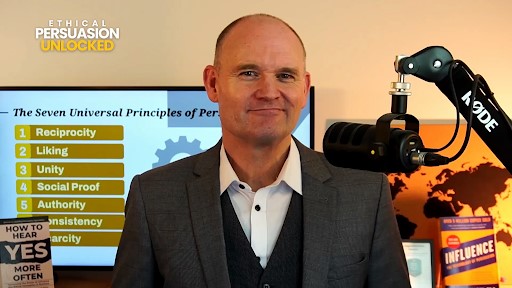
We refer to them as universal because they work in all languages, all cultures, and all countries. This makes them even more valuable because within our own country we have diverse cultures, and it is easier than ever before to connect with or do business with people in other countries. Let me list the seven principles: reciprocity, liking.
Social proof, authority, consistency, scarcity, and unity. They are the principles of persuasion.
Why are the principles of persuasion so important? Why do they work to motivate our behaviour?
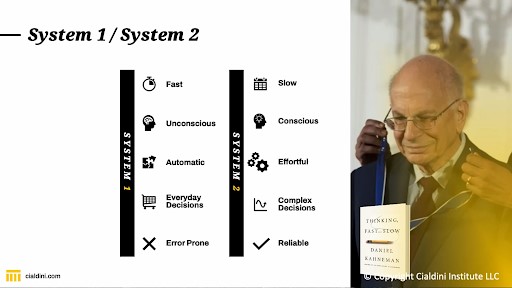
outside of our conscious control and is active all the time. System one uses many shortcuts or rules of thumb to make quick decisions. These rules of thumb can be hardwired in us, like paying attention to what other people are doing and attaching greater value to that.
Another rule of thumb is that things that are rare and more difficult to obtain are more valuable. And so we place a higher value on things that we have the potential of losing. Think about it. In a fight for survival, it is nice if we get extra things, if we get more money, if we get more food.
We obtain a better place to live. It would be nice if we get more of that. But if we lost what we had, if we lost resources that we could trade with, if the amount of food we had was reduced, or if we were not able to live in the place that we are living, and we were forced to go somewhere that might be less safe.
Then this could be detrimental. And so it makes sense to pay more attention to things that we could be losing than things that we could be getting more of.
“Expensive equals good.” So when we find ourselves in a situation where information comes to our attention and suggests that there’s a high chance that this is a good decision for us, those rules of thumb allow us to make a decision more quickly.
So that is system one. We could call it the intuitive part of the decision making brain.
If you think about riding a bicycle or driving a car if you’ve got that experience already, when you have done that many times, you’ve driven home or ridden home many times, you can do it without much conscious thought. Sometimes you get home and you might not even be sure which route you took. That is because System One, the intuitive part of the brain, was doing things for you.
But now imagine having to go somewhere where you’ve never been before, or having to navigate a street with much more traffic than usual. If you had to pass others who were coming very close to you, then you would need to pay attention, or the outcome wouldn’t be that good. You might bump into someone or something. As you need to pay attention,
and be conscious about what it is you’re doing, that means that you are then using system two. Your logical, rational brain is now working. We use system two for complex decisions. It helps us consider all the options to make the best and most reliable decisions.
Now you’d think that if you or anyone needed to make a decision, that we’d make most of those decisions using the logical, rational part of the brain, right? That’s what people and science thought for the longest time. But this Professor Kahneman won a Nobel Prize basically for proving that that’s not the case.
Back in 2002, he demonstrated that 90% of decisions made by people are made by System One instead, the intuitive part of the brain. Now it is thought that that percentage is 95% or more.
Convincing your boss or your teacher to allow you to complete some work by a later date. 95% of decisions are made by the intuitive part of the brain, including many, if not most, of these important decisions.
But for that to happen, for that to work in our advantage, there does need to be information available for that intuitive part of the brain to respond to. Information that indicates to System One that what you are suggesting is a good choice for them. Remember at the beginning, I mentioned that job applicants
got 10% higher starting wages because the way they were dressed. That’s because the way they were dressed provided information to those needing to decide whether to hire the applicant and where to set their starting wage. And that was based on how they were dressed. The way they were dressed
influenced the interviewer’s perception within a second of seeing them. They hadn’t even said anything yet.
That’s how fast this information works. And the seven universal principles of persuasion help you to identify and use all those types of information that can have these effects. Are you starting to see how impactful this can be for you moving through life and business? But also for those who might hire you to work for them?
That’s exactly why this is such a high demand soft skill now. Workers who can move the company forward towards its goals more quickly are more valuable and needed in business.
or receive something from someone else without giving in return. When someone invites you to their birthday party, then well, you feel that you ought to invite them to your birthday party. If someone does you a favour, then when they ask you to help you with something, you find it really difficult to reject that request.
So remember this rule. People have a tendency to give back the same type of behaviour that was first given to them. And when it comes to agreeing to a request of others, we are more likely to say yes to someone when we feel that we owe that person something.
a gift. Would the promise of a balloon after ordering, or giving them one before they ordered, influence how much people would spend on their meal?
Giving it afterwards didn’t have much of an impact. But the people who received the balloon before ordering spent on average 20% more. And interestingly, while the balloon would bring more joy to kids than it would to the parents, the sale of coffee, which kids don’t tend to drink, went up by 25%.
Now you understand why in shops they sometimes give things away, including just to kids who might not be in control of the spending in that store. A supermarket near me gives free fruit to kids. Might that affect the spending of the parents, like with the balloons? Yes it would.
5% of those asked agreed to donate a full day’s wages. But to another group of people that they approached and made that request too, they first gave them a small bag of sweets worth about fifty cents.
Out of that group, 11% donated a full day’s wages. That is more than double the number of people, and a day’s wages would for them have been more than tens of thousands of dollars or pounds in this case.
How can I help this person genuinely without expecting something in return?
Think about fellow students. Of course, we don’t want to interfere with their need to study or their ability to learn skills by doing their homework. But we can be helpful in many other ways, either related to their education or privately. You could remind your friends of when particular work is due. You could point them to helpful materials. You could take and share some notes if they miss the class.
Think about teachers or professors. How could you help them? Of course, you don’t want to be difficult in class. That would be the opposite of being helpful. Instead, be helpful in class, volunteer for projects, and keep an eye out for things that the teacher or the professor might benefit from, professionally or personally. Now, we all know that if others
see us be particularly helpful to a superior, that might give rise to some criticism. So you might want to be discreet about how you do this. Genuine, from an interest to help, but not too often in front of a group that you’re part of. And that could be a group of fellow students, or once you are working, that would be fellow employees.
In which case you don’t want to do things in front of too often.
There’s a lot more to reciprocity, and it has many more dynamics, but a trust you found is simple and valuable. Intangible gifts like helping others can be very powerful.
If your approach to this comes from a genuine desire to be helpful to the other person, it will help you build strong relationships quickly, and when you need their cooperation or agreement in the future, it will come far more readily.
And have people pay more attention to you, even if you’re young. And this also explains why some people were hired more easily during job interviews and when why they got higher starting wages. Would that be valuable to you? And while we’re on value, if you think that what I’ve covered is valuable to you, then it would be valuable to your friends too, wouldn’t it be?
Provided that this episode wasn’t recommended to you by your school or university, in which case your fellow students will already know about it, you might agree with me that all other students would benefit from hearing this. And you could bring it to their attention. Likewise, mature family members that you have, you know, maybe run their own business, they’re working, they also need to know this. You could,
because you care about them, or because you’d like to help others and would like to see them succeed in life, share this with them and tell them how valuable and entertaining you found this. Tell them that they should not miss out on these insights. You’ll be doing them a favour, wouldn’t you? And that would also, in your favour, activate the principle of reciprocity that we just talked about.
That’s not a bad thing either, is it?
My favourite principle is the principle of authority. I’m not sure why. Maybe because it helps others to listen to what you say more intently or with greater importance. Maybe because it helps to establish trust, or maybe because its impact can be nearly undetectable.
who knows more about a particular subject than you do. It is impossible for us to know everything, and so when there is someone who has more knowledge and expertise, we are typically better off, could be safer and more successful if we followed their advice. And that is another shortcut. A shortcut
for that system one, the intuitive part of the brain, to make a quick decision. So So remember this rule: “People tend to follow those with superior knowledge and wisdom.”
come in and they were wired up to brain measuring instrumentation. They were then confronted with a number of questions to consider, and the researchers would be able to see the activity in their brain as this was happening. At some point, the couple who had children were being asked to consider difficult financial situations. For example,
how they would prepare themselves so that their children would still be able to have high quality education if one of the members of the couple was to die. So we’re talking about very serious questions, about very serious situations.
When this question was asked of couples, their brain lit up with activity. We could say that there was high, intense activity going on in the brain.
Shortly after that, the researcher would enter the room accompanied by a person dressed in a very professional-looking business suit. The researcher would then tell the couple: “This is one of the best financial planners in the country. He has won multiple awards and has helped thousands of people organise and restructure their financial situation for the best possible outcomes.”
We can’t say that the activity in the brain stopped. I mean, that would have meant that they died on the spot. But their brain activity reduced dramatically. When they heard this introduction, they stopped thinking for themselves.
In case it wasn’t clear to you, this effect in their brain occurred without the person in the business suit ever having opened their mouth. As soon as they heard that there was someone in the room to help with superior knowledge and wisdom on that topic, their brain stopped worrying about it. As there was someone else
that they could hand the work to formulate this decision to.
have knowledge and expertise on that topic. And especially when people are uncertain about how to judge you, we can also help to establish ourselves as trustworthy, knowledgeable, capable, and credible.
Does that sound pretty amazing and powerful? Without lying or cheating, if we know what information people should hear or see, we can make them understand that you have skill and wisdom, even if you’re young, and help you be seen as more trustworthy, capable, and credible.
I’d be happy to do a comprehensive presentation or lesson at your school or university, in person or online. But for today, let me explain the dynamic that saw job applicants get hired more quickly and be awarded higher starting wages.
Because, and this is why I’m so passionate about introducing persuasion science to young adults, without you knowing how to be more persuasive in an honest and ethical way, you are unnecessarily letting success that was yours to have slip through your fingers.
But I’ll do my best in here to give you some things that you can do to not go in unarmed when hoping to convince in what are for you life changing situations and moments.
waiting for the pedestrian crossing light to turn green. The men would start to cross the street when the light was still red, provided it wasn’t life-threatening to do so, but of course it was still against the law. The question was: “How many people would follow him when he did that?” Half of the time he would turn up wearing a work shirt and pants.
The other half of the time he was wearing a three piece suit and a tie. Now ask yourself, did what he was wearing make any difference to how much of an authority he was on the subject of crossing the street? Would he have known any more about crossing the street than you do?
What he was wearing should not have made any difference to the number of people who thought that crossing the street against the light at that moment was a good idea. But yet, three and a half times as many people followed him when he was wearing the three-piece suit. He just had the look of authority.
He had the look of a man who was successful. So how does this work?
When people are uncertain about you and need to form an opinion about you, they look for outward clues. Your appearance helps them to make a snap judgment about you. And snap judgment is surprisingly accurate. Research shows that those judgments are made within a second.
Your appearance can therefore have a negative, neutral, or positive impact on how people perceive you. Meaning that if you don’t pay attention to this, the chances of success, the chances that someone will see you in a more positive light, the chances that people want to cooperate with your request are slipping through your fingers unnecessarily.
This explains what one study found regarding candidates who were attending job interviews. Those candidates who wore designer label clothing were hired more quickly and were, on average, offered 10% higher starting wages by the candidate evaluators.
Unfortunately, we haven’t got enough time to dive into the many aspects of the principle of authority here, but you can scoop up a few more from listening to other episodes in this podcast. For today, let’s re-emphasize that you can use the way you look to your ethical advantage in persuading others to do as you ask.
truth in that. But there are a few rules that you should not fail to keep in mind.
You want to present yourself in the best possible version of you. Your clothes, your shoes, your hair, and potentially some jewelry. You should even consider items that you might be using as you spend time with your audience. And with audience, I mean, for example, the person interviewing you.
If you have to take notes and then you’re gonna use a pen and paper, bring a nice compendium to store your notebook in. When you grab a pen, it’s not going to give this feeling of authority if you pull out a cheap plastic pen that came out of a box of 24. I’m not saying you should turn up with a crazy expensive fountain pen.
Use something that looks nice, that you are comfortable using, and that doesn’t fail you when you’re actually writing. If you’re bringing your tablet, then consider how it looks. Consider the cover that you have around it. And ask yourself: “Is it such a professional look to use the keyboard feature to take your notes?”
If you’re bringing a bag, what does it look like? What does it say about you? A linen bag that was a souvenir from the last music concert you went to may not improve your chances.
might involve going to dinner with some of the parties involved. Your table manners, the way you sit, the way you use your cutlery can quickly signal to people from more affluent or traditional backgrounds that you are not part of their social circle and negatively impact or obliterate your chances to getting the job
before the interview even begins. If I am reaching you early on in those moments when your interactions with other people that will shape the trajectory of your life are still further in your future, then you could consider taking classes in language and etiquette and table manners. Perhaps a parent, a family member, or carer might actually be really good at these things. Perhaps you’ve been rebelling
against that. I know I have when I was a teenager. But now that you know that these things could hold an incredible influence over your future, you might seek these people out. Pay them a compliment. Apologise for having rebelled against it and tell them that you now understand its importance and would appreciate it if they could teach you.
It is relatively safe to say that at some point these skills and habits will impact how your life will go one way or another.
When it comes your education in general, knowing your stuff or mastering the skills of your trade may not have the impact that you’re hoping for, and it won’t be the only thing that influences whether you are the best applicant for the job. If you can’t persuade others that you are the best choice, or if they’ve already judged you to be unsuitable or inferior,
before you even opened your mouth, it’s game over, and your future will unfold less favorably than you could have achieved.
Life may very well be harder than it needs to be. The total earnings of your career may be significantly less as a result. And perhaps the opportunities your children will have will be less because you didn’t end up where you could have ended up.
This may start to raise some eyebrows and could seriously backfire on you. So, what do you wear? Here are two rules you should remember. Dress well, but wear what you are comfortable wearing, using things you have in your own wardrobe. But at the same time, you need to be conscious of how your
audience is dressing. Your aim is to dress just one level better than they are. When it comes to job interviews, if they are conducted in an office setting in a typical business environment, then dressing formally is likely the best choice. But if you know that you’re applying for a job in a company that prides itself on being less formal, then wearing less formal clothing
would likely be the best choice. You would stick out like a sore thumb if you turned up in a three piece suit.
Try to find out what the other people might be wearing. And if you’re not sure, then make sure that you dress very well. But think ahead of what item of clothing you could remove to dress down in an instant when you realise that you are overdressed compared to the other people in the meeting. If you’re wearing a suit jacket, you could quickly remove that.
If you’re wearing a tie and you notice that nobody else in that office is wearing one, you could quickly remove it. Good luck.
The principle of scarcity teaches us that we value things more that are rare, scarce, and whose availability is limited. This goes back far in our evolution and is a basic survival skill. I mentioned this before. Think about the time of primitive man and primitive woman. If you have a certain amount of resources, be it safety, security, be it things to trade with.
Then it’s nice for you to get more of that, but it could be detrimental or fatal to you and your family if you lose some of those resources.
In episode 16, I dive deeper into scarcity. And in there, I highlight some research showing that when college students consider the potential decay or improvement in their romantic relationships, they experience much stronger emotions when they considered equal-sized decays in their relationships rather than improvements. People are more likely to
cheat when they need to avert a potential loss than they are to achieve a gain. And we all know the pressure we feel when we’re in a good, potentially important conversation, and the phone rings.
When we ask something of someone, we seem to have a natural tendency to explain what the other person will get if they decide to follow our recommendation, proposal, or request. You might hear someone say in a brochure or in a website or in a job application: “If you do this, you will save money.”
“If you agree to this, you’ll be safer.” “If you go along with our request, it’ll be better for the environment.” “If you purchase our product, you’ll be able to work more efficiently and save valuable time.”
All this is language that tells people what they will gain, what they will get more off if they go along with the request. But we know that people pay more attention to news that highlights that something is scarce, that something is running out, or that they will lose something. So we should, and we can, use a different way of explaining the impact of
what we are proposing. Instead of explaining what they will get if they go along with our request, we can point out what they will lose if they don’t go along with it.
If I will save money if I go along with your request, what would happen to my finances if I didn’t go along with your request? I would lose money, right?
If I would be safer if I went along with your request? What would happen to my level of safety if I didn’t go along with your request? I’d be more unsafe than I can be. What if I would save time?
Right, I would lose time if I didn’t go ahead. Now, how big an impact can all this have? Well, that depends on the situation and how suitable what it is you’re offering is for the person that you’re offering it to, as it does with all the strategies and all the principles. But let me share one study that I love.
of fully insulating the home. At the end of the assessment, homeowners were told the outcome of the assessment and what that would mean for them.
If they did or didn’t insulate their home fully, would have an effect on their finances in terms of being better insulated or not. This would be different for each home, of course, because every home is different. But let’s use $1 a day as an example. Half of the homeowners were told that if they insulated their home fully, they would be able to save a dollar a day.
Is that gain language? Yes, it is. If they save a dollar a day, that means they have an extra dollar a day.
The other half of the homeowners were told that if they didn’t fully insulate their homes, they would be losing a dollar a day. That is clearly lost language, right? In the end, it was the same $1 in our example, but truthfully highlighting the fact that they would be losing a dollar every day,
allowed system one of the intuitive part of the brain to pay attention and make a yes decision more easily.
In this case, homeowners who were given the loss instruction decided to go ahead a lot more than the homeowners who were told how much they would save. 150% more people decided to fully insulate their houses.
Will the application of persuasion science always produce percentages like this? No, it varies. It might be less, and it can also be a lot more.
had within their instructions a dynamic that activated one of the principles of persuasion, they were 514% more successful in raising their grades enough to avoid being expelled. So, yes, the impact of using persuasion science and in an ethical way can have a big impact, even much bigger
than 514%.
Students were 514% more successful in achieving the grades that they needed by how they were instructed or asked to do something at the start. Persuasion science is valuable for any person, professionally and privately, and that includes teaching staff and educational facilities. If they want to lose less students,
who could have enrolled to begin with. If they would like to avoid more students achieving more poorly than they can, which of course affects the school performance figures. If they would like less parents to withdraw their kids from school unnecessarily, and cultivate a loyalty with parents and students that was really theirs to have. Then
the school staff, whether they are teaching staff or sales staff, need to get trained properly in the science of persuasion too.
It’s hard or impossible to measure how this impacts the results of a single individual on only a few interactions like job applications, applications for grants or university placements. But just like building a skyscraper, it is generally to your advantage, and you’ll get better results by using the available science.
At least when we understand the science and use it, we know we have ethically done what we could to not reduce our chances of getting the results that we wanted.
So here is my request of you. And then I’ll give you one more lesson and teach you what could be called a magic word whose power you don’t want to miss out on.
to make myself available to do so, either in person, which is a lot more fun, or even via video.
If you’d like to not miss out on other powerful insights that I could share about persuasion science that I don’t share anywhere else in this podcast show, and you would like to avoid your fellow students from wasting some of their success in life that they could have, then you should bring this episode to the attention of the following people.
The parents committee of your school or university. As social influence or ethical persuasion is the third most urgent soft skill to be developed, and businesses are asking for it, no one will be as motivated as parents and guardians to ask your school to make time for this topic to benefit all the students.
Secondly, of course, anyone at the school or university who has influence over guest speakers or events, you could approach the dean, the career advisor, the head of department for business, the principal of the school, and of course your professors or teachers in English, marketing or business.
Of course, we want you to be as persuasive as possible when you make that request, right? So I’ve written a text that you could use if you like, which you can download via the link in the show notes. There’s one for schools and universities and one for a parent committee. Have a read and see if you can identify some of the types of information I covered in this episode. But let me give you
one more little piece of secret sauce. Before you hand or send your letter, regardless if you’re using the one that I wrote. First ask those people if they think it’s important to get you ready and prepared for what is to come in real life. When they say yes, you can then tell them that you’ll give or send them something
that you’d like them to pay attention to and consider. Just by asking that one question first, you will be a lot more persuasive in getting them to read or listen to you and act on it.
If you can’t encourage others to investigate this topic, then please do the following for me instead. Or do both, because it helps me understand that you’ve enjoyed what you’ve heard and it allows others to find this information more quickly. Please leave a nice comment or review on this podcast for me and others to read and mention in it what you liked about it.
I’d appreciate it.
One of the people, who was part of the experiment, lined up as well and asked the person in front of them if they would let them go in front of them.
When they said, “Can I go in front of you?” Which doesn’t use a reason, 60% of people agreed with that. When they said, “Can I go in front of you because I’m in a hurry?” Which does include a reason, 94% agreed. So it’s definitely a good idea to give people a reason when you’re asking for something.
The third group was very interesting though. They left the word “because”, but removed the reason. They said, “Can I go in front of you? Because I need to make some copies.”
Patrick van der Burght (1:10:23)
Sounds a little bit like a reason, but it wasn’t really. Everyone in the line was there to make copies, and so was the person being asked. Even with the reason removed, but the word “because” left in, 93% of people agreed to the request. We could therefore say that the word “because” has special power. Just by using it, more people will agree with you, as the study shows.
So when you ask something of another person, you would be more of a detective of influence if you made sure that the word “because” is in your request. And your chances of getting a yes are, of course, bigger still if you provide a genuine reason for your request.
of course, we do need your email address, and of course, a newsletter to share regular insights with you. We’re also working on giving you complementary access to one of my teaching programs for about five weeks, which will be an exceptional value. And of course, I can encourage you to listen to other episodes in this podcast, starting with episode one.
Your ability to be ethically persuasive and influence others that what you are suggesting is a good option for you both will impact the rest of your life. I’m delighted to have had the opportunity to introduce this simple and exciting science to you, which is ethical, research-based, costless to use, and very effective.
I encourage you to use what you’ve learned today and always make sure to use it in an ethical way. So don’t make anything up, don’t exaggerate, and don’t create situations that didn’t really exist. Always aim to build strong, loyal relationships with the people that you hope to be more persuasive with in the future. If I can play a greater role
in the mastery of this skill and its subtle nuances, then I would be delighted. I’d like to dedicate this episode to my wonderful daughter, who is nearly turning 18, and I wish her and you an influential future, one in which you’ll hear no less often.