



There are other ways, socially acceptable ways to raise your credibility to the surface.
Persuasion acts on behaviour, not end results.
That is a 65.2% increase.
Now while there’s nothing wrong with that, it’s not the most powerful.
Just because you are raving about your services in a brochure or on a website doesn’t mean that every word you say is believed.
We are actively and effectively working against ourselves if we do that.
By adding a single sentence to what the receptionist was saying to new contacts who were calling the office, the number of appointments booked in this real estate agency increased by 20% and the number of signed contracts went up by 15.5%. Just like many other businesses, T-Mobile was selling its services in an online environment.
And by reordering how the different services were positioned, the top of the line service they were offering experienced an increase in sales of 34.4%.
When sales results during a new product launch were disappointing, Bose was recommended by Dr. Cialdini to change the headline of the ad. They were convinced that the headline they had would motivate people to buy, but it was actually subconsciously working against what they were trying to achieve. The new suggested headline also used one of the principles of persuasion, but this one was now working in Bose’s favour and sales increased by 45%.
These are changes to our approach that don’t cost anything and can produce a welcome 5% increase in results, up to thousands of percent increases in results. And all this without having to lie or cheat. In fact, persuasion science has been shown to produce the best results when used ethically, both in the short and long term.
There is also the contrast phenomenon. Some people think that this is also a principle of persuasion, but it is not actually. Contrast is a powerful phenomenon we should be familiar with because it is an amplifier of all the principles and it works on its own. In my experience, it is the one thing that many professionals use in such a way
that they not only get no benefit from it, but they are actively using it the wrong way around and very effectively work against what they’re trying to achieve.
And this brings us to an important point. The principles and contrast can do amazing things for us when it comes to moving towards our goals. But if we fail to use them consistently and in the most effective way, then we can miss out on successes that were really ours to have.
To make matters worse, professionals often raise information to the surface which engages a principle to work against them. It’s therefore not only possible to not get the benefit of using persuasion science to your advantage, but lacking the knowledge and application skill can actively and effectively work against you reaching your goals.
If I help you in your efforts with thoughtful actions or I supply you with useful information, then you’ll get the feeling you really should be on the lookout for things that you could actively do for me or find helpful information for me. If I do you a favor, then you owe me a favor. And in the context of compliance, we are more likely to say yes to people who we feel we owe.
It is actually quite beautiful how this works in societies. Every society trains its members from childhood that we should not take anything from anyone without giving something in return. If grandma gives us something nice when we are children, we can often hear our parents tell us, ‘Wow, wasn’t that nice what grandma did for you? Now what are we going to do for grandma?’
When someone acts in a nice way towards us or gives us something, we often go to great lengths to make sure that the other person feels that we’ve reciprocated their kind behaviour. Society has some unwelcoming labels for people who take without giving in return.
So it’s not uncommon for a person who has received a kind act or favor to reciprocate with something more than expected, because we want to make sure that the other party feels that we’ve reciprocated their gesture. The concept of reciprocity is widely understood and in business we’ve adopted this principle by recognising the need to give something to others first. While this is true,
I often see businesses investing money and making attempts to activate the principle of reciprocity in their audience, but they are actually completely missing the mark.
It’s important to remember when we want to give to someone or group of people or an organisation or a society, because it works on all those levels, that a gift is something that is provided without a requirement needing to be met.
An example of the results of giving to others is how one of the disabled veterans’ organisations experienced an increase in response rate of 94.4%. In their appeals for donations made by mail, they had a response rate of 18%. When they started including personalised address labels for the person that the letter was addressed to, response rate for donations increased to 35%.
As I said before, it is very common for businesses to think they are doing the right thing when it comes to activating reciprocity, but actually doing it wrong and their investment is not met with the power that the principle of reciprocity has to offer. And then there’s ethics to consider. We will dive into the principle of reciprocity in much greater detail in a dedicated episode and no doubt we’ll circle back to it in episodes in the future.
There must be value to what other people are choosing. And that’s often the case. As with all the principles of persuasion, they are shortcuts that appeal to system one of our decision-making brain. And so they are also prone to being incorrect. But most of the time, what a lot of other people are choosing to do is the right course of action. And this is why this principle is so important to us.
If you don’t know what I’m talking about when I say system one, then you might have missed the episode on The Science of Human Decision-Making which I think is fundamental for you to understand why these principles are so powerful and why our efforts in communication are less fruitful when we are unaware that there is a science available on how people make decisions. And explains why our persuasive efforts, for example in sales but not limited to that, seem to be getting less effective as the years go by.
So if you’ve missed that episode, jump across to it now or circle back to it later.
It is great that businesses are actively collecting testimonials and reviews. However, lot of businesses should ask themselves the question if they are really giving that the effort that it deserves, or if they have systems in place to increase the amount of reviews that they are receiving. Another observation is that most businesses don’t know how to respond to a negative review in a way that is scientifically sound. We will dive into the topic of online reviews in a later episode, but that said,
I can tell you something now that you might want to reflect on for a little while. We are, of course, always wanting our clients to be perfectly happy with the products or services that we’ve supplied them. And we are therefore, understandably, always hoping that they’ll leave for us a five-star review. When it comes to our online profiles, all these reviews are portrayed in an average score.
Understandably, we want people to leave us 5-star reviews, but research shows that having a 5-star average is not actually the most persuasive average score that you could have. There’s a lot more to social proof than just online reviews or testimonials.
If you think that collecting reviews is something that is beneficial and valuable and powerful for your organisation but you’re unaware of what else the principle of social proof has to offer, then you are in for a treat. There are many other strategies and subtle nuances when it comes to the principle of social proof. And if you don’t know what they are, then I hate to bring it to you but you are missing out on some powerful factors that could be working in your favor, but you’re currently missing out on those.
Here is a fun example of the effectiveness of social proof. When Dutch high school students were told that many students like them ate fruit to stay healthy, the students made it absolutely clear that that might be the case, but that hearing that piece of information would not change their behaviour and they would not eat more fruit. When later the consumption of fruit was measured, it had increased by 35%.
It does make evolutionary sense. If you have a certain amount of resources, gaining more resources can be helpful. But if you lose resources, it could be detrimental. Because professionals and organisations know how the principle of scarcity works and what effect it has on us, we can often find this principle being used in unethical ways.
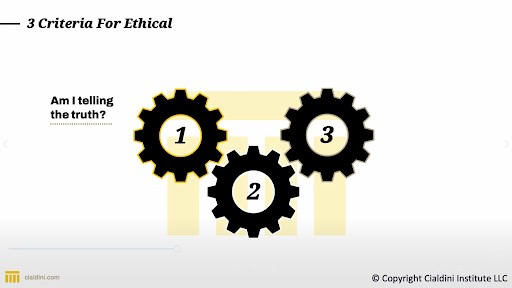
Perhaps now is a good time to talk about ethics for just a couple of minutes. The principles of persuasion can be used ethically and unethically, but research shows that when we use it unethically, it may produce short-term results, but it tends to produce long-term disaster. Because when there is no benefit or not the benefit that was promised, people will not come back to a situation or a person or an organisation where their agreement did not lead to something that was beneficial to them.
The ethical use of persuasion science has shown to produce both short and long-term success, and it builds strong, loyal relationships. We really want to use this ethically.
Are you not importing anything, exaggerating anything or counterfeiting anything? This is where we might reflect on the limited time and limited quantity offers that we might present to our clients. If there is no genuine reason for a limited time offer or a limited quantity, if it’s just invented to have a sale, then clearly it wasn’t naturally in the situation.
The last question we should ask ourselves is, is it wise to make this request of someone? If they said yes to us, if they went along with what we were proposing, would they regret it later? Would they come back to us? If the answer is no, they wouldn’t come back to us, then there’s a good chance that what we’re offering or considering to offer is not ethical.
We’ll go into this in much more detail in another episode, but there are many reasons why we want to conduct ourselves ethically. Certainly when it comes to persuasion science, the long-term benefits are far greater. Also, when it comes to our team members, our staff members,
they don’t actually want to act unethically because the boss asks them to do so. It goes against something that is within most of us. Most of us hate the idea that we can’t get ahead without lying or cheating to other people. This has, amongst other things, an effect on stress levels, sick leave and staff turnover, which can be exceedingly costly.
And that perhaps you decided to never want to deal with that business in the future ever again. Because it casts a serious shadow over the quality of their products and how they would look after us if something went wrong.
A fun bit of research when it comes to the principle of scarcity is the following. A study was done where people were asked to taste cookies. They were all the same cookies. Some people were asked to take one cookie out of a jar that had 10 cookies inside the jar. Other people were asked to take a cookie out of a jar that just had two cookies inside.
They were then asked to taste the cookie and then rate the cookie based on a number of parameters. The cookies were identical for everyone. But the people that took the cookie out of the jar with only two cookies in it rated the cookie to be more desirable, more attractive and more able to fetch a higher price.
What is interesting to note is that while scarcity can make us value things more, it does not change our experience of it. Also in this study, whilst many of the perceptions about the cookie had been inflated, because it was one of only two cookies, the experience of how good it tasted did not change between the two groups.
Probably the most unrecognised element out of those three components is that we like people who like us.
I’ll circle back to that in a minute. You’ll often hear me say that persuasion science is not exclusively about sales. It’s about motivating behaviour. That could be buying behaviour, but it could be many other types of behaviour, which is why persuasion or social influence is such a valued soft skill. It works in advertising, marketing, customer service, HR, PR.
It works professionally, works privately and in many different areas. Whenever we’re trying to achieve a goal, we rely on our ability to be persuasive. This includes goals where we are the only ones that need convincing. Like when we need to motivate ourselves to go to the gym or write that book, the next chapter, because you want to publish it.
To highlight this concept of people liking people that like them, I will now turn to a sales example though. In a lot of sales training, you’re taught that if you’re trying to sell me your product or services, then you should do what you can so that I like you. You need to be likable.
Now while there’s nothing wrong with that, it’s not the most powerful. If you are trying to sell me your products or services, it is nice if I like you. But it would be better if I got the feeling that you genuinely liked me. Because, not to put a finer point on it, if I don’t actually quite like you, but I felt that you genuinely liked me, well then I’d still be safe. Because if you like me, you’re gonna look after me.
When it comes to liking, there are many strategies and approaches. One particular aspect connects well with those of us who are just genuinely caring and interested in other people. The compliment. People like compliments and they like the people that give them those compliments. Again, we want to use this ethically. So please…
don’t just generate compliments for the sake of it. Look for genuine reasons to compliment someone on their actions or perhaps their values.
For this reason, you could supplement your persuasive efforts with the opinions of recognised experts and authorities. But you yourself in your field are also someone with great knowledge and wisdom. You are yourself an expert. But communicating that to those who you’re trying to be more persuasive with, is not as easy as it sounds.
Too many people try to raise their credentials when they meet with someone face to face. And this works against you. There are other ways, socially acceptable ways to raise your credibility to the surface. It is crucial that you do that early in your presentation. If your credibility becomes clear later in the communication,
later in your presentation, then what you communicated before that point will not have been processed with the same gravity that your words deserve.
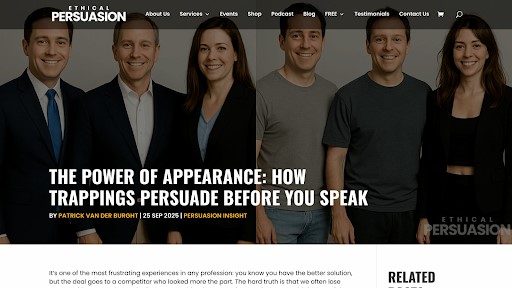
We have a sensational article on our blog that really dives into this topic in great depth. It explains how your appearance will affect how persuasive you can be even before you open your mouth. The article is called The Power of Appearance. Look it up and share it with anyone who is seen by clients or coworkers.
One particular piece of research that I find particularly interesting in this regard is the jaywalking study. In this research, a man walks up to a pedestrian crossing where the light for the pedestrians is red. When it is not life threatening, but still against the law, he crosses the street against the red light and a certain amount of people follow him.
Half of the time he does that wearing normal trousers and a work shirt. The other half of the time he does the exact same behaviour wearing a nice business suit and tie. 350% more people followed him when he was wearing the business suit. Now, that doesn’t make any sense.
I mean, his appearance has nothing to do with his knowledge about crossing the street. He was not more an expert on crossing the street than anybody else there. But he had the aura of success, the aura of authority, and more people followed him.
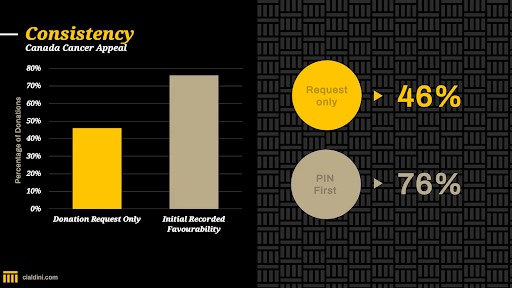
They asked people if they were favourable towards the cancer association, to which everybody said they were. They were then asked if they would be willing to accept and wear a little lapel pin in the lead up to the start of the collection period. The pin said something along the lines of, support your local cancer association.
And people agreed to accept and wear it. As I mentioned, one week later, the collection period started. And of course they went to every door now. At the homes where they had not visited the week before, 46% of homeowners made a donation. But from the homes, that they had visited earlier and where people had accepted to wear the little lapel pin, 76% of people made a donation.
That is a 65.2% increase.
It’s relatively safe to say that people are generally favorable of cancer associations. But what turned this general favourability into action was an initial step, an initial action and statement that they had made by accepting and wearing the lapel pin.
This explains how we define the principle of consistency. People generally want to act consistently with earlier actions and statements that they’ve made on a particular issue. We feel an internal pressure to do so. This, like we mentioned with reciprocity, has to do with our place in society and how we interact with others.
If we say that we would do one thing, but then do something totally different, people don’t tend to view that very favourably. People could see us as unreliable. Society has many unfavorable names for people who say they’ll do one thing, but then do something totally different. Because we don’t want to be seen as someone like that, we will go to great lengths to stick to what we signaled earlier we would do.
So what does that mean to us? How do you use this to your ethical advantage? Again, there are many strategies and nuances when it comes to this principle, but generally, we want to see if there’s an opportunity for people to make an active statement about what is important to them or what they value. If our request or proposal is then logically consistent with what they stated earlier was important to them and is therefore in line with what they value, it becomes harder to say no.
And it does but the angle or the feeling that it hinges on is very different. Unity is about the fact that we favor those people who we consider part of us, part of our community, of our group. If that’s the case, then you could very likely describe those people as we, us.
We therefore say that this principle of unity is about a feeling of we-ness. There are many factors that can bring this feeling of we-ness to the surface. One is location.
You’ve probably bumped into someone you’ve started talking to and you’ve discovered that they went to the same school as you. All of a sudden, you’re a lot more friendly with them and there’s a favorability towards each other. That is a feeling of unity.
Also, co-creation falls under the principle of unity. When people do things together, create things together, they get a greater sense of belonging amongst them, a feeling of unity. Let’s say you have five tasks that you need completing and you have five team members you could allocate those to.
If you gave a task to each of the five team members, then those tasks would no doubt get done. But you’ve wasted an opportunity to create a stronger bond between the team members. Instead, you could have told the five team members that you have five tasks that need to be completed and that you’ll leave it up to them to work out between themselves how these tasks will get done.
Now the team members have to work together to at least decide who’s going to do what. Because they are working together on the five tasks, they are now co-creating and creating that stronger bond and increased loyalty to each other.
Let me share some research that illustrates how big an effect acting together can have on people.
In this particular study, people were asked to walk a certain distance. Some people were asked to just walk together. Other people were asked to walk together, but to synchronise their steps.
Later they were told that their partner had an opportunity to participate in an activity in which they could earn some money. This opportunity was also available to them, but they could choose to help their partner and increase the chances that they would be experiencing a financial benefit. From those people that walked together and synchronised their steps, 50% more were willing to forgo their own chance of making some money and helping their partner instead.
Isn’t human behaviour fascinating? This is what makes learning this so enjoyable. And it has a big impact on achieving our goals. It’s just win-win everywhere. Besides that, there is the fact that by being more educated about how these principles work, we develop our own defenses against other people trying to use this on us unethically.
Well then, I’ve got one more thing to share with you, which I mentioned at the beginning, the contrast phenomenon. Before I go there and before I finish up, let me share some important insights with you about mastering persuasion.
First of all, if you think that the principles are relatively simple to understand, then you’re absolutely right. The concepts behind persuasion are easy enough to understand. This is why this is a relatively easy skill to learn and master. It doesn’t require a three-year full-time university course to master this skill.
At this time, the flagship training designed by Dr. Cialdini that I facilitate is an investment of just approximately 20 hours, split in half by just 10 hours of self study at home watching training videos with Dr. Cialdini. And the other eight to 10 hours are split over eight group training sessions that we often do online, spread over eight weeks.
But the hardest part about persuasion science is the following.
The hardest part in persuasion is knowing what you want to persuade. Most people think of their end goal, as in, I want to increase our sales. I want our team members to follow our safety procedures. Persuasion acts on behaviour, not end results. So a part of learning this properly is to learn how to identify what it is we actually want to persuade or influence.
The next thing to realise is that we have to be actively on the lookout for opportunities to use these principles. We need to identify what is naturally there in the situation we are facing. This could be when we’re writing a message to someone, designing a brochure, designing a page on a website, creating lead generating or social media efforts.
Sales pitches or a briefing to team members.
We must continually view our influence challenges through the lens of persuasion and recognise what is there for us to use. If we don’t develop our application skills and cultivate this habit of looking for what is available for us to use, or we lack the confidence that we’re doing it right, then we might know how persuasion science works, but we’re still not using it.
That’s where formal training is crucial. This skill is too valuable to be left to the chance that you or your team will figure out what they should do from free snippets of information and insights you find in blog articles, newsletters and podcasts.
And then the final thing is this. Let me assure you that I am really excited about sharing all these insights in these podcasts with you. I’m sure you’ll pick up many things that you can immediately implement and profit from. But I do need you to realise that when it comes to knowledge, knowledge is not power. Any of us…
has got access to unlimited amounts of knowledge, including on my podcast, but it is application skill that is power. And I would argue that you need to combine that with confidence. Otherwise you’re still not going to be using it.
That’s why I feel so privileged to be able to guide people through this process and help them to develop a skill that has now been prioritised as a number three skill for businesses to develop according to the World Economic Forum. And in studies like those done by Cashnet, where they looked at 17 million job listings on indeed.com and found that persuasion was the third most requested skill that employers were asking for. If I can help you and your team with this, I’d be honoured.
Okay, then. Contrast.
I hope you’re grasping the gravity of what I’ve just said. You can change the way someone experiences your price, your kindness, the amount of effort that is involved with what you’re asking for. This is incredibly powerful and contrast is able to be used in any influence situation that you face. As trainers, we have a saying, if you can’t find contrast, you’re not looking hard enough because it’s always there.
The thing to remember is that you can change how one thing is perceived by what comes before it. And this works for all stimuli. If I ask you, to lift something heavy, like a chair. I can make the chair feel heavier than it is, than it actually is, if I ask you to lift something light before it.
Or I can ask you to lift something light after you have lifted the chair. Now you will experience the lighter item to be significantly lighter than it actually is, because the chair came before it.
The example I gave all the way in the beginning of T-Mobile increasing its sales of their top of the line service by 34.4% was achieved by using contrast the right way.
Contrast is one of those cases where people often use it the wrong way round. They present multiple things and place something at the front that makes your second option seem less favourable. We are actively and effectively working against ourselves if we do that.
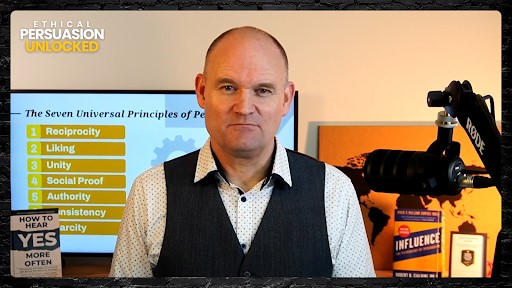
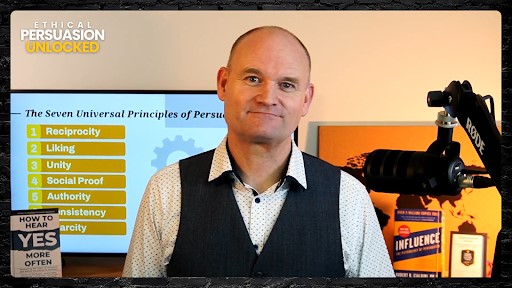
There is a lot to be won from understanding how contrast works. And as I mentioned, it is also an amplifier of the principles, which is probably a little bit too advanced to go into here. It’ll be one of those many things you’d learn in more formal training. For now, just realise that there is a way how you can use contrast to make reciprocity, unity, liking, scarcity, authority, consistency and social proof work even harder than they already do.
I will go deeper into each of the principles and contrast in their own dedicated episode. And I’m sure we’ll circle back to them in other episodes in the future. Also, those including my guests.
Knowing about the science of persuasion and developing your application skills properly will help you to save time and resources on predictably inefficient communication, which would otherwise continue to see you lose every single day. Please follow me so you don’t miss any of these nuggets of business growth gold that my guests and I will be sharing with you.
Visit my website ethicalpersuasion.com.au and download the free ebook. You don’t even have to give us your name or email address. Otherwise it wouldn’t be a gift. Just right click and download. If you like, you can also use some of the other complimentary tools.
When you use some of these strategies and you get benefit from it, then please leave us a comment on any of the social media feeds or leave a review on this podcast. Share this podcast with friends and colleagues and also consider young adults who are about to enter the workforce.
and stop doing without the science, then please reach out. We’ll have a discovery call and together we can figure out what your influence challenges actually are.
You’ll likely get some more complimentary advice for your situation. And together we can co-create what is the best way forward for you and your organisation. Be it a keynote, certification training, a quick workshop even online, or perhaps consultation services. I wish you an influential future in which you’ll hear yes more often.