

And so I made an effort to push myself to give this girl a compliment. The effect was amazing.
It was like the relationship defrosted. It has only been a week, but we’re talking and I think we’re starting to like each other.
This is one of the beautiful things about the science of persuasion. It allows us to restore, strengthen and build relationships.
Pay someone a compliment and watch what happens. See them smile, see the tension drop, and see the relationship grow.
When people don’t really like you, the chances that they will accept what you have to say or go along with your proposal reduces because we often make an effort to avoid those people that we don’t really like. Research shows that we can easily double our persuasiveness or our chances to get a yes from someone if we have a strong relationship with them.
But you might be thinking, well, that’s great Patrick, but doesn’t it take months or years to build a strong relationship with people? If you’re thinking that, then that is system two talking. System one of the decision-making part of the brain can form a bond in as little as 10 to 15 minutes. If you don’t know what I’m talking about when I say system one and system two, then please visit episode two,
The Science of Human Decision-Making. You’ll get a crash course in how people make decisions and you’ll understand why getting yes from people has been getting a lot harder for professionals who don’t know the science of human decision-making and ethical persuasion.
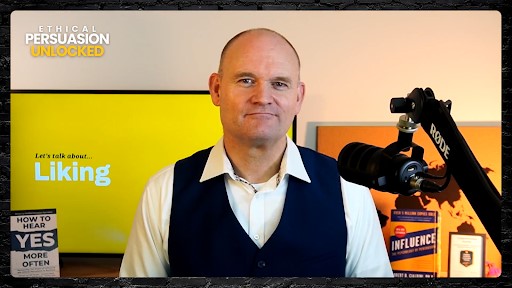
We like people who are like us means that we like people who are similar to us, similarities. We like people who like us means that we say yes more readily when we know that the other person likes us. Lastly, we like people who like us and say that they like us means that we like compliments.
I will share with you some powerful insights in this episode that you will be able to use immediately to be more persuasive and be more liked. But I do need to remind you occasionally that this podcast is not a course. It does not by any stretch of the imagination provide you with the application skills and
confidence that you’re using it right. When it comes to the universal principles of persuasion, there are dozens of different application strategies and many subtle nuances. While I like nothing more for you to have some powerful takeaways that you’ll be able to implement and benefit from immediately, I might be doing you a disservice by letting you think that you now know how to be ethically persuasive.
Please see these nuggets of persuasion gold as proof of concept, but know you will continue to lose out on successes that were always yours to have until you and your team get trained and build that application skill properly.
How we are dressed, for example, can have an impact on how much people like us. One study looked at people marching in an anti-war demonstration. And they found that people were more likely to sign a petition if the person asking for the signature was dressed like they were. But also that many of them didn’t need to read the petition before placing their signature. You are similar to me,
you probably have the same values as me and there is the shortcut information that system one is listening for to facilitate a quicker decision on how to behave in that situation. ‘Yes decision’ made. I find it very entertaining to realise how small and insignificant these similarities seem to be allowed to be
and still have an impact on how people behave or say yes to us. Here are some examples.
There are fingerprint types. After people have been made aware that they share the same fingerprint as other people, they become more helpful to those people. If a brand name starts with similar letters as your own name, we are more likely to purchase that brand.
We like politicians that we feel have similarities with us and our romantic attraction to someone is increased when they use similar words and expressions as we do or if they use similar texting styles.
When someone faces us and they relax their left leg and extend it a little, we will relax our right leg and extend that a little. When they place their right hand on their hip, we will place our left hand on our hip. So again, it appears that we’re in sync. It is also very easy to produce claims that we have things in common.
When the salesperson sees a picture in your office of you playing golf, they could lie and say that they play golf as well. If you are new to this concept, you might be shocked to learn that some people are trained to pay attention to eye movements in an attempt to figure out how a person likes to process information. Armed with this intimate knowledge, they then change their language to use words that are more visual, auditory or kinesthetic, to appear more similar.
When people naturally like each other, mirroring and matching someone happens automatically. But to reproduce it, to lie about the hobbies and values that you have, or to change your language style to something you don’t normally use, is of course smoke and mirrors.
Just imagine, if you used these tactics on someone who knew exactly what you are doing, you would destroy that relationship immediately. They might even warn other people about you and your company.
And here we see a big difference with how we conduct ourselves when we are ethically being more persuasive. We need to be detectives that are on the lookout for the information that is really there in the situation. And then we simply bring that to the surface, which is often the facts that our audience not only needs to hear from us, but also wants to hear from us.
Why not have a look to find out what you might have in common. A beautiful side effect of this is that you might find out that you have things in common that you really appreciate, values that you share. You may genuinely come to like and appreciate the person that you’re dealing with. And that incidentally activates that second component in our definition of liking. We like those who like us.
A study done in North Carolina shows how automatic system one in our decision-making brain responds to compliments and praise, and how helpless we are when faced with compliments and praise. In this study, men received comments about themselves from another person. This person needed a favour from them. Some of the men only received positive comments, whilst other men received only negative comments and another group received a mix of both positive and negative comments.
As you might expect by now, the person giving the compliments was most liked when the comments were all positive. In addition to that, it didn’t seem to matter if the men found out that the person providing the positive comments had something to gain from being liked.
Lastly, the praise didn’t need to be accurate to work. Regardless if the comments were true or not, as long as they were positive, they had just as much effect on how much they liked the person giving them.
Have you ever done something in the house that you’re not really good at and you’re really doing an average job at it? And then for your partner to go, you did a great job, baby. You can’t help but like that, don’t you? ⁓ I get a lot of those compliments, especially when I’m in the kitchen.
I teach a course which I consider the best and quickest, the most efficient way to learn the intimate details of persuasion science in a way that doesn’t just give you knowledge, but it helps you to develop application skills and confidence.
This doesn’t take a time commitment like doing a university course. It is typically an investment of just 20 hours, split 50-50 between self-study and group training spread over eight weeks.
Not a big commitment for an individual or a team, but a career-defining exercise. In this course, I have a student from North America. She’s a more mature lady who’s been doing very capable work in an office environment. Recently, a young woman in her 30s has been put into the position of manager for the department.
Each of my students is encouraged before the start of the course to pick an influence challenge that they are facing, professionally or privately. They then develop application strategies for that challenge every time they hear a new application strategy related to the principle of persuasion that we’re focusing on that week. They develop these strategies during the course.
by brainstorming with their fellow students and bouncing those ideas off me, which enables me to confirm that they understood the theory correctly and that they’re applying it well. If they miss some finer nuances, then I can give them a bit of a course correction and put them back on track.
This has a positive impact on their confidence because we might know something, we might develop application skills, but if we’re not sure we’re using it correctly, then that will stop us from implementing it and we continue to lose out.
We don’t want to produce fake compliments or false flattery. And so I tell the students that we encourage people to look for genuine things that we can compliment people on.
Faith asks me, well, how am going to do that? I really dislike this person and she’s not fond of me either. And so I remind her that even if we don’t like someone, they can often have certain values or traits that we can appreciate about them. It’s a little bit like, well, he is a total ass, but at least he turns up on time.
We continue the one hour group session, everyone goes their own way, and a week later Faith is back saying, have I got a story for you.
Faith explains to all of us how, after last week’s she was thinking really hard about what she could possibly appreciate about this woman who she didn’t like. And I thought to myself, she said, I suppose she does make excellent reports. And so I made an effort to push myself to give this girl a compliment. The effect was amazing.
It was like the relationship defrosted. It has only been a week, but we’re talking and I think we’re starting to like each other.
The lesson for Faith and for all of us is that even when we can only see the negative, let’s try to find the positive, because it can’t be all bad, and bring that to the surface. Pay someone a compliment and watch what happens. See them smile, see the tension drop, and see the relationship grow.
If you’re on your way to work in the car and you might find yourself in the elevator in the parking garage, get ready. Clothing, shoes, handbags, nails, or a tie. If you like the look of them, let that person know. Maybe it will be your receptionist on the way into the office or a team member on the phone, a teacher, or your partner or child as you walk through the front door. Tell them,
Hey, I forgot to tell you, that thing you did last week, that was really good work. I was very impressed. Watch their reaction. And if you like what you see, do it more often. Become that person that likes other people and tells them that they like them.
And if you’re ready to get out of your comfort zone, have a long hard think about the people you might not like, but wished you had a better relationship with. Look for what you could appreciate about them and pay them a compliment.
This is one of the beautiful things about the science of persuasion. It allows us to restore, strengthen and build relationships. If you feel that what you heard here today was of value, then share this episode with others now. If you had a good experience implementing what you learned here today, or if you want to pay us a compliment, then please leave a detailed comment or a review.
Till next time, I wish you an influential future, one in which you’ll hear yes more often.