
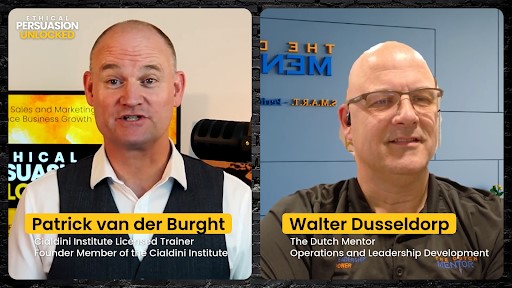
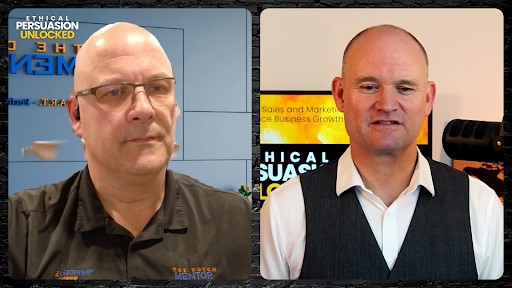
Welcome back to Ethical Persuasion Unlocked. Today I’m joined by Walter Dusseldorp, also known as the Dutch Mentor. An author, thought leader, business consultant and mentor with over 30 years of experience developing high performance leaders and teams. In this conversation, we talk about what happens when strong technical performers step into leadership and hit that wall of despair.
Because they don’t have the experience or the skills to lead and how to get those skills with practical, measurable daily habits.
The Dutch Mentor:
So that’s the system that I built for those types of folks to learn how to get out of that valley of despair over a period of time and find that joy in leading and really finding that joy in life again.
They all have seen promotions within 18 months, 20%, 30%, 40% increases in their pay. And that is really, I’m beaming with pride. Because once they finally understand that the importance of measurement, they said, oh my god, I should have.
Okay, welcome everybody. Today we’re in for a treat. Today we’re talking with Walter, AKA the Dutch Mentor, who is an expert in helping leaders and emerging leaders to go through that point where they might feel that they’re short on knowledge or experience and move more confidently into leadership. So I’m really excited to welcome Walter here. He’s Dutch like me, so we have a lot of things in common. He’s also a pilot like me.
So yeah, looking forward to what he has to share with us. Welcome to the show.
The Dutch Mentor:
Thank you, Patrick, for the invitation. I look forward to having a fun session together and hopefully somebody will take something away from it and become a better leader because of it.
Patrick Van Der Burght:
Exactly. That’s my wish as well. Okay. So what we often find is that people are growing within their position within a company or maybe they’re leading a company and then often they tend to, you know, could say plateau as in they’re running out of skills or abilities or maybe their mindset becomes something that stands in the way. So you help people with that. Could you perhaps explain what some of those common challenges are that you bump into all the time with emerging leaders.
The Dutch Mentor:
Sure, of course. First, I’m a mentor, not a coach, and a mentor comes from deep personal experiences. So I experienced this as a technical clinician, high performing, going into a leadership role, and I said, now what? And I experienced it, and I was lucky enough to find a good coach and a mentor who helped me get through that valley of despair, as I called it.
But even today, we see this all of the time, people who are solidly job as a frontline worker, who are being recognised for the work that they do, with their promotion. And once they get promoted, they kind of get stuck. And the reason why that is is because they end up doing more, because they don’t quite understand what leading is. And doing more means often falling back on their low confidence that if I don’t do it, nobody else can do it as well as I can do it.
If I don’t have control over it, then it will all fall apart. I cannot take a day off because the ship will sink. And it is that kind of like philosophy, that thought process, that people need help to get through. Some people are innate leaders. They sail right through it or they make it really look good until they get enough experience and then become experts. But too many people fall into that valley of despair, never really get out of it. They lose that zest for leadership and they end up leaving the workforce.
And that’s a shame, of course.
Patrick Van Der Burght:
How does it express itself in terms of what, you know, what growth, what possibilities they’re not reaching because they’ve got these limitations.
The Dutch Mentor:
So the first thing that comes to mind, first thing that people tell me, it’s time management. And you say, just take a nurse manager, because it’s a really good example of somebody who they go from being a good nurse to becoming a nurse manager. Now they have 50, 60, 70 people they’re responsible for. And they end up continue to do, because that’s all they really know. Either at the bedside or they get stuck doing certain tasks like scheduling.
And that is, you know, that take so much time that they really don’t have the time to develop themselves or to become highly effective leaders, which becomes a showstopper. Many people who go from the front line to becoming a middle manager have the intention to continue to climb that career ladder. If they don’t learn how to effectively lead people, that’s a showstopper. And that is unseen.
And too often people, you know again people get complacent, well, she’s struggling, but maybe next week is better, next month is better. And they don’t really cultivate that potential in the people. And that’s a short-sightedness of the leaders of leaders. And that is something that we see a lot of is that, you know, there was an interesting survey done by McKinsey that 95% of leaders agree that all of the middle managers need development and support by coaches and mentors in order to really reach their full potential.
Well, interestingly enough, only 5% of those leaders actually took meaningful action. And what ends up happening is that these people are already overloaded with doing, and they’re already struggling with time management to find that right work-life balance, that the employee is now giving them go to a webinar, take online classes, all of these things they don’t have time for. So it adds to frustration, it adds to falling further behind, almost of drowning.
So something has to change. And that’s why I come in and I get them, I go on a journey with them of learning and growing. As I call that 15 minutes a day, you too can become the leader you always wanted to have or the leader that your team needs to thrive under. So it’s a different philosophy of learning and developing from the traditional way of doing it or not doing it at all, which is too often the case.
Is there other common mistakes that people make in an attempt to gain better skills?
The Dutch Mentor:
Yes, they fall into the trap of being the people that they are led by, for one. And often we see that the leaders who are leading are not the most effective leaders. Or two, they end up going back to school and they spend, listen, I have my bachelor’s and maybe I have a master’s, maybe I need to go back and get my doctorate. So they go back and spend another $40,000 to $80,000. As you know, the US education system is rather expensive.
But only to find out at the end of the day, yeah, they get another three letter acronym behind their name, but they don’t know anything more. Because in school, they don’t teach you how to effectively lead. They teach you programs and operations and strategy and economics, but not how to be an effective leader, how to shift the responsibility from me, the owner to the performer with accountability.
And so that’s the system that I built for those types of folks to learn how to get out of that valley of despair over a period of time and find that joy in leading and really finding that joy in life again.
Patrick Van Der Burght:
Okay, so what have been some of your insights or what are the things that you share with people? That you educate people on to become a better leader? Share with us what you know, Walter.
The Dutch Mentor:
Sure, of course. So the key thing is, of course, knowing oneself first. It has to be, you know, sometimes we’ll beat that word self-awareness to death, but people need to understand who they are as people, understand their true why. First, I need to know that they are truly aligned with their passions and purpose, with the people and the processes that they work with. And on occasion, we find people who are not aligned, so that’s the first thing we need to do. The second part of that is to really develop a journey map.
They need to be able to see that, you know, they dream big and act small. Well, if you don’t dream, how can you get, how can you advance, so to speak? But the big dream, 5, 10, 15 years out, now what do I need to do today? 15 minutes a day in order to get one step closer to the outcome that I seek. Now, where we run into problems is that people want all these things, but but they don’t make the time for it. They say, I will, but they don’t.
January 1st, I say I’m going to lose weight and I’m going to go, I’m getting myself a gym membership. I I go three times the first week, twice the second week, once the third week, and I go back maybe once or twice rest of the year. Well, leadership development or any development of any behaviour falls into that same trap. Anybody can do it for a couple of days, maybe a couple of weeks, maybe a month. But if that is not supported in some way,
by two accountability sessions, you know, what I refer to as the cadence of accountability, really on a daily, weekly, monthly basis. The likelihood that somebody will succeed is very minimal. 30% of the people will succeed, leaving 70% of the people who fall short. 70% of most projects fall well short of their initial goals. 70% of the strategies fall short of their ultimate desired outcomes. Well, there’s a common denominator here. It’s behaviour.
And that’s where we need to start with the leaders to really understand first self, to understand where they want to go and develop a journey map. Then it is about how can I make that deep commitment of accountability to myself that I will do the things I need to do on a daily basis to create new normals. And I usually refer to that as this, if you’re not happy with your current outcomes. Well,
Einstein said, keep going back doing the same thing over and over and over and expect a different outcome is insanity. So you have to take a step back and start formulating and getting new experiences. And from those experience, you need to take new actions. And those new actions will deliver new outcomes. And that’s really what I’m trying to guide people in baby steps on a journey
to get to that particular point that they find their new normals that fits with whatever role that they’re in.
Patrick Van Der Burght:
Can you give us some detailed examples of what that might look like? Like if somebody’s listening to this and would like to sample some of what you’re teaching and implement that, what are some things that you could share with them?
Sure. Yeah, so I would first recommend you can go to my app and there’s some examples there at the Dutch Mentor in the App Store. You have free access to that. You can look at it on my website. There’s well some guidance, but it starts with your why. It is to understand who you are as a person. What is the key driver behind you? So it’s the first exercise I do with people. Then the second exercise I do with folks is now I want you to start dreaming, right? Visioning. That’s something that Tony Robbins promotes and we talk about that a lot.
Is that, you know, close your eyes and see where you want to be. What do you envision for yourself? And we are limited by our own dreams. So if I ask the question, what is your dream? And you don’t know. Well, then how can I get you there? So through that process of iterations of self-development, why, and really understanding and how to develop new behaviours, how to visualise for the future, how to take actions, how to measure yourself.
So I give people a very simple example of that. A task to do. If you drive to work, where do you park your car? Nine out of 10 times people say, the closest spot to the front door. So now I want you to think about that is that whose spot is that? Well, that’s a spot for our patients, or for our customers. Well, then you don’t belong in there. Now I want you to change your behaviour from always going to the spot close to the door to the behaviour of parking the furthest away from the front door.
o they fully experience what it is like to go through a change management cycle, right? The psychology behind it. And they see the struggle, but if they stick with it and they measure their performance over a period of time, they can see by day number 30 or 40, they don’t need to think about it anymore. They’re already going to the spot furthest away. Now there two outcomes with that. A, you don’t take up a spot with my customer.
Now you’re getting extra steps in, which is good for your heart and for your health. But more importantly, they actually feel the change that takes place from their current normal to a new normal. And people like to buy, can buy into that and they can follow through in that. And I always tell them this, listen, as a leader, is critically important to hold people accountable.
But if you cannot hold yourself accountable to the simplest of things of drinking more water, reading more, praying more, getting up and using words of gratitude, how are you going to hold anybody else accountable?
And once they get that, once they really understand it, and many don’t get it on the first time or a second time, it is when we keep going back to that same point, that lesson starts sinking in and that’s when they finally start following the suggestion of doing and measuring and accountability and countermeasures.
So would you say that, know, being a more effective leader is a lot more about attitude towards yourself, instead of skills on how you treat, let’s say, people underneath you, how do you see that balance?
The Dutch Mentor:
Well, I think it is both, right? In order to be a highly effective leader, and I have four principles that I say, you need to love the people that you lead. You need to lead through context and not control. You need to create a winning environment, psychological and physical safety, and you need to work and execute a great focus. So again, being a highly effective leader is not just about yourself. Obviously you have to lead people. People want to be led. They need to have a clear vision. Well, it is your role as the leader to be able to articulate that.
To set people up for success. It is your role as leader to genuinely love and care for the individuals, not just treat them as one big group. It is your responsibility to people that they feel safe at work. They feel they’re part of a winning team. And all these things are drivers to the outcomes that we seek, which is improvement in safety, quality, growth, cost, transformation, and continuous improvement. Those are the six P’s that all of us are after. I don’t care what industry you’re in.
Those are the outcomes. But the leader needs to drive these and that needs to be done through clarity. And it’s really using a simple equation of performance is the function of trust multiplied by engagement. It’s the leader’s role to be trusted, to be trustworthy, to build that trust on the team itself. If that is not there, it’s very difficult for that team to ever become a high-performing team.
Yeah, there’s some lessons in the psychology of persuasion as well that sort of tie into that nicely. You say, you know, love the people that you work with. You know, when we genuinely are interested in other people, that builds that stronger relationships, which makes, you know, makes you more persuasive as in you can get more cooperation out of people. When it comes to trust, the principle of authority, there’s people who are
in authority, because they’re the boss and so people might do as they say because they’re the boss, but when people are an authority, as in they actually know their craft really well and they’re, you know, they’re not do all the work for their employees, but they’re there to assist them, help them grow with, a level of expertise that they have that’s very well respected, then people, actively want to follow
those people that are an authority rather than in authority or, know, people that are in authority, those who are the boss, those who are the leader should should work to become an authority so people also want to lead them, lead them more.
The Dutch Mentor:
Yeah, 100%.
Patrick Van Der Burght:
Do you want to elaborate on that more as in terms of that relationship you build with the people you work with?
Yeah. So another component of that is we need to learn how to become a partner rather than having relationships. And it is not, it’s when people understand the difference between a relationship with someone, knowing somebody, but a partnership is actually now working together for a single focus. I said, if I have a relationship with somebody, we go with two or three boats and we meet in the middle somewhere. We all have our own paths, our own reasons.
Well, to build a genuine partnership requires work and requires a give and take it. But it also requires clarity of purpose on where it is that we want to go. So once we get into the same boat, rowing in the same direction at the same speed with the same intentions, and we feel we can do this together, one plus one really becomes three, right? Where we potentiate a partnership to become high performance by being in synchrony with each other.
And that is, of course, the first thing we need to do is that everybody we run into is not somebody going to be who is in synchrony with us. There might be some disruption. We might have to develop that relationship into a partnership over time. And that’s the way I think you talked about when you have bosses who are often the poorest of examples because they lead, do as they say, not as they do type philosophy. Old style of that directive.
And you as a new age leader, and again, I don’t want to use the word per se of only servant leadership, but servant leadership or situational leadership, you have to understand the most valuable asset that you will ever get to lead is people. We manage process, we lead people.
And the sooner you can wrap your head around that, that it is the people who get that ball across the finish line and how you can lead each person to what it is that they need, in other words, under their intrinsic values, the quicker you get the team in sync for a common purpose, with a common goal, where there’s real trust and there’s teachability on all folks sitting around the table itself.
Patrick Van Der Burght:
Yeah. And that’s, I mean, the reason that that would work, what you’re describing is, you know, as we would say with ethical persuasion is the principle of unity, which has the element of co-creation within it. When we work together to achieve a certain goal, we take ownership of it and we feel ourselves as more part of a group. And therefore we achieve more loyalty within the group, more cooperation and more trust. So that makes all makes perfect sense.
Okay, so you teach this or you mentor people on this. Can you tell us a little bit about how that sort of process looks like when you start looking after someone with this?
Sure, absolutely.
So aid, I talked about it little bit earlier, is that we cannot teach the way we, like what we are used to. Go to a webinar, go to a conference, send it from the classroom. It’s literally one ear in, one ear out. The retention of information is maybe 5% by the Monday after they were taught something and then even that last, 5% is forgotten.
So again, it is more important to have a conversation where you take actionable, measurable steps on a weekly basis where you can maintain a scorecard. So my long-term clients, I work with them 30 minutes a week for six months, 12 months, 18 months, some of them stay with me for years. It is the fact that you really help them with a couple of three things. A, they need to have a safe place they can debrief.
A lot of them work under very high stress environments and they have nowhere to go with that stress. They can’t go home with it. They can spill the beans at work. So it is really good to have somebody like myself that wants a week for five minutes. He can just say whatever you want to say, get it out of your system. Two is there real time scenarios that pop up that they might not have the skills, knowledge or abilities, or they just want to have a second opinion. So we can work our way through those scenarios. So whatever the scenario is,
I utilise my operational rhythm, my problem solving, and then of course, really about understanding who you are as a person as techniques, as ways of teaching and coaching and mentoring them through that particular event, whatever it is. And then lastly, it is always the key actions or the cadence of accountability. What is it that do, what it is that you’re going to do next week that will move the ball forward? So with laser focus and then have them report that back, both in word as well as a measurement on how that is done.
Now that is done one to one. I work with groups of people where we have that same cadence of accountability on a weekly basis. So we look at the things that matter, those six key metrics. And it’s not always six for all teams, but it might be one, two, or three metrics. And then it’s continuous development of people. So there’s cycles that we talked about, people management or talent management or financial planning
or strategy, depending on what time of the year you’re in. So this continuous cycle of building capacity, building knowledge, building skills in order to become more effective. And of course the outcome of it is that whatever their bosses hired me for to drive it, it’ll be a better turnover time or gaining efficiency, reducing error, setting up continuous improvement, set up Kaizen event, whatever it is, it is all done on that same cadence of accountability on a weekly basis.
Now with that said, I think you might’ve seen it. I released the Dutch Mentor app in the Apple Store just this week. Because too many people, many people want access to the same information, but they can’t afford to hire a coaching mentor. So I wanted to come up with a more affordable way of doing it. So you can do this. And I call it the 90 day accelerated program. But again, if you spend 15 minutes per day listening and doing, it’s a combination of those things
plus measuring in the app itself, you too can make your way through all of the process steps and be a better person on the backend. Certainly be a better interviewer, have a deeper understanding of what leadership is, but it is all anchored in doing things that need to be measured. And over time, you need to create new normals. And of course, that’s still the sticking point for most people that it’s the lack of behavioural capacity to follow through.
But the key thing is, is I’m trying to get away from online courses or classes because none of them really work. Sounds good, feels good, but Monday morning is long forgotten. And that’s why I tried to bring real change to the table.
Yeah, the app sounds, it sounds really interesting. I’m going to have to have a look inside. What are, what are some of
I guess the feedback from people that have used your services in the past. What did they say after having experienced that? from the positive, stories, I suppose.
The Dutch Mentor:
Yes, I mean, I’ll tell you both positive and negatives, because not everything is roses and sunshine. One thing is that people who were with me for a month, 6 months, or 12 months, those who did not buy in, and the key word is buying into measuring their performance on a daily basis, only wished they had started earlier. Because once they finally understand that the importance of measurement, they said, oh my god, I should have.
put something on paper five minutes before the meeting. I don’t know. When they show you they’re being accountable, but it’s not meaningfully done. And if it’s not meaningfully done, it doesn’t build capacity or knowledge or skills. It needs to be done on a daily basis. It’s the cadence of accountability to somebody else on a weekly basis. It’s the cadence of accountability to yourself. So that’s one.
So most of them recover from that at some point in time when they get frustrated. The success stories are, of course, people who buy into early and are deeply committed and do work on a daily basis, at least five or six days per week. They all have seen promotions within 18 months, 20%, 30%, 40% increases in their pay. And that is really, I’m beaming with pride.
Other people who were laid off and looking for work, once they joined me, once they went to the program and actually learned how to look for a job, how to market and brand themselves, how to present themselves in an interview. They too got jobs and I mean real jobs on you know, on direct to senior direct AVP, VP level. So it is a proven methodology. if you, but again, the key to it is this, you have to do some, right? You have to measure and you have to keep going back at it until it becomes part of who you are.
Every class we take, every mentor you meet, every coach that you work with, if we do something else that you do, you’re wasting your money. If you make that deep commitment to make it something of who you are, that’s where the real growth and real development and real outcomes come from.
Interesting. Walter, you wrote a number of books. Can you take us through those and maybe explain, depending on what people’s interests are, which books are perfect for that interest?
The Dutch Mentor:
Sure.
First, want to say all my books are written for people with attention spans or attention spans on a mouse, meaning that you literally can read it one page at a time for the most of it. So I try to keep it very short and powerful to the point, no fluff, right? No BS. And it is, some of them are more as written as guidebooks because people do better when they read guides. I need to do step one, two, three, four, five.
So is something that is all actionable. there’s many different, you know, there’s books on how to think with a positive mind frame, how to do A3 thinking, how to climb the proverbial career ladder, how to establish an operational rhythm, how to be a happy leader. So there’s no one order to do it. The order of the Pure Leadership Power, one, two, three is read the happy leader, make sure that you understand how to solve problems of good causes, establish this operational rhythm.
But all of the books complement each other in order to be able to become that highly effective leader. Now you and I both know very few people read any books, right? Most of the stuff that we do today is done in 186 characters on X or short videos. So we as leaders, we as mentors and coaches have to adjust our style to that as well. So in the app itself, there’s very few segments that are more than 15 minutes.
The vast majority is three to five to seven minutes. So these are small bite size. So you literally can learn something of great value within 15 minutes. And the most beautiful thing is because it’s a mentor in your pocket. You can literally click on the app, open it up and today I need to have a difficult conversation. Well, let me remind me what Walter says about how to motivate with fierce resolve, how to have this difficult conversation or how to set up, you know, A3 thinking.
And it is through the bite-size information, managing their time and learning is where the growth is coming from. And it’s been very successful.
Patrick Van Der Burght:
Wonderful, sounds great. If people want to connect with you, how can they find you? What would you recommend they do?
The Dutch Mentor:
Yeah, just look me up as Walter Dusseldorp on LinkedIn. try to be, I have a significant presence there and a post on a daily basis. Of course you can go to my YouTube channel or to my Instagram channel. That’s all, you know, there’s lots of information there. My fun channel, which happens to be the larger with almost 50,000 followers is Flight Path Pioneers. If you want to see what Patrick and I do in airplanes and helicopters, but remember that aviation, we can learn a lot from them,
as leaders. So it is all kind of sort of integrated altogether. And of course, I would encourage people now to go to the App Store and pick up my app, thedutchmentor.com, all one word, and you get a seven day free trial with that. So you can sign in, enjoy the whole entire app for the seven days. It is subscription based, 49.99 per month, can be bought worldwide, cancel anytime, no risk. And if you follow through,
I guarantee that you will get the fruits of your labors within 12 to 18 months. If not, I’ll coach you one-to-one to get to that particular point. But you have to do the work. I can do it for you.
Patrick Van Der Burght:
Wonderful. Well, thank you very much for being so generous with your time and your insights. yeah, hope a lot of people will investigate what you have to offer. Thanks a lot, Walter.
The Dutch Mentor:
Thank you, Patrick, for the invitation. I really appreciate it.