
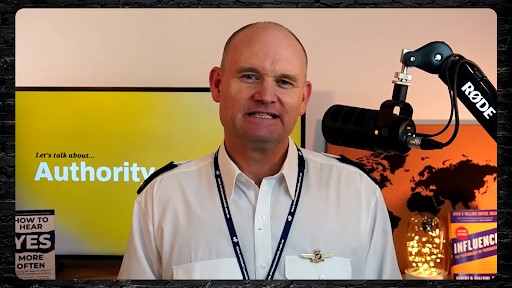
while people might feel obligated to follow the request of those who are in authority, they are normally very keen and eager to follow the advice of people who are an authority.
I think it’s safe to say that Dr. Cialdini is considered the global authority on this topic. And so a kind word from him about this podcast would have the biggest impact.
Welcome, so glad you’re here. Curious, motivated to learn more and hopefully empowered by previous episodes. We’ve only been going for about two months now, but we can already see a steady, generic increase in the amount of downloads to this podcast, which is encouraging. I hear of our followers actively sharing this podcast with others, which is all we can ask for really, so thank you.
Please remember we have a complimentary community that you can access for early access to these episodes and exclusive events. The link is in the show notes. And there’s also a pro membership area that you can access for a small monthly fee where you receive added insights and lessons from me and many of my guests, which are all very worthwhile and also more of exclusive events.
Which is not something that we want to misuse, of course, but it does make me respect the principle of authority even more.
People often ask me, what is the most powerful or useful principle to use? Which always makes me smile a little because it shows that they don’t know the science and I can help them lose less success. There is no most powerful or useful principle because depending on the situation and the stage in the relationship that you find yourself in, you would go to different types of principles. That is something that I keep
for in the Dr. Cialdini flagship training course that I teach and make sure that my students know very well.
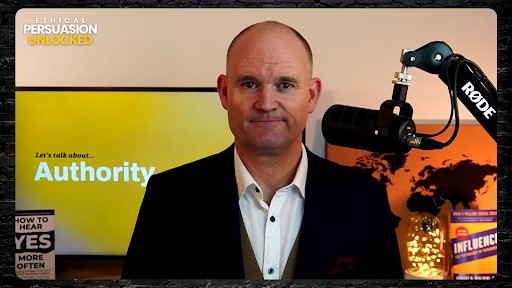
Today we look at the principle of authority and you are in for a treat. Let me share with you how powerful it can be, how you can use it in your own communication through just a couple of the available strategies for the principle of authority and why, if you’re not using it, it will negatively impact your success even before you open your mouth.
People were invited to participate in a memory experiment. They turned up at the agreed time to meet another volunteer who they didn’t know, who had come to partake in the same study.
The researcher explains that the checks that have been given to them are theirs to keep no matter what happens in the experiment. He goes on to explain the experiment itself. The memory experiment is to investigate the effects of punishment on learning. One of the two volunteers will be assigned the role of teacher and the other will be assigned the role of learner.
They then draw a random piece of paper to determine who will be the teacher and who will be the learner. The teacher observes and listens as the learner is asked to sit in a chair in a separate room and then gets their wrist bound so that they can’t get up. They have access to a panel on which they can press buttons so that they can give their answers.
They’re told that the teacher will read out word pairs and that they have to remember which word goes with which word.
hey are also connected to a contact plate through which they will be administered electric shocks when they get an answer wrong. We have a video of the Milgram experiment that you ought to watch once in your life. There will be a link in the show notes. In the initial pair of volunteers you see in that video, the learner also explains that his doctor has diagnosed him recently with a mild heart condition and he seems nervous about the electric shocks.
The teacher is taken to another room and a panel with lots of switches. Each switch will deliver an electric shock as punishment if the learner gets an answer wrong. Each switch is to be used only once and each next switch will deliver a stronger electric shock. The machine is clearly labelled. Moderate shocks around 75 volts. Strong shocks,
around 135 volts. Very strong shock around 185 volts. Intense shock over 255 volts. Extremely intensive shock over 315 volts.
And a danger, severe shock range for the higher voltages. The last switch is 450 volts, which is potentially lethal. Imagine for a moment how you would feel being the learner, strapped in the chair, about to receive electric shocks. I’m sure that you would be wishing that you had ended up being the teacher instead.
Imagine the experiment starts and the memory game is proving very difficult to keep up with. Mistakes are unavoidable and the shocks start. The teacher who is reading out the word pairs is listening for the correct or incorrect answers coming from the learner that they can’t see but can hear in the room next door. They flick each next switch after each wrong answer.
After only a few shocks, the learner cries out in pain as they are being administered. After a few more, the learner says he’s done with the experiment and wants to stop. The researcher encourages the volunteer teacher to keep going. As the voltage increases, the learner screams out in pain and begs for the experiment to stop.
The learner says that their heart is bothering them. Even though the teacher could have stopped at any time, stood up and walked away, most stayed and kept going with the researcher’s encouragement.
Now let’s reflect on that for a moment. What if you were the teacher? What if you were administering the shocks? What would you have done? Would you have stopped and walked away? I think the chances are big that you would tell me, “No way, I wouldn’t keep going till over 300 volts or the maximum 450 volts. I would stop. I wouldn’t care if some researcher tells me that it is important that I continue.”
And good on you for thinking that. But the volunteers in the Milgram experiment came from a diverse range of backgrounds, professions and income levels. Do you think any of them would have answered any different from what you are thinking now?
I think most, if not all of them, would say that they wouldn’t give an innocent, stranger, dangerous electric shocks, especially if they’re crying out in pain and begging to be let out.
Now, in case you’ve never heard of the Milgram experiment before, I can provide you with a little relief to what you might be feeling now. The experiment was certainly set up to create for the teacher volunteer the illusion that everything was as I explained it to you before. But the learner never got any real shocks. In truth, there was only one volunteer being tested.
The draw was rigged and the person who ended up being the learner and got the electric shocks in the other room was always the same person, it was an actor. The shocks weren’t real and the screams and protests were pre-recorded. Still, to the teacher who gave the shocks, everything felt real and 65% went on to the 450 volt shock.
Before I move on, and now that I’ve explained to you that no one was really being hurt, let me let you listen to a fragment of the experiment and contemplate if you, as the teacher, might have possibly gone on past 300 volts like nearly all participants did.
You should watch the video once in your life, if only for the first six and last five minutes in which you hear the conclusion. There’s an important life lesson in there that you won’t want to miss. The link is in the show notes. Now that 63 years have passed since the Milgram experiment, it gets easier to say or think that modern man and modern woman
would react much differently under those circumstances. But the experiment has been redone in similar ways, adjusted for modern safety concerns regarding the person being tested. In 2006, Jerry Burger, a psychology professor in Santa Clara University, redid the experiment, using the same verbal clues to the learner and with a similar setup
in terms of the machine that they used, the game they played and the actor being heard but not seen, screaming in pain and begging to be let out. 150 volts was set as the maximum because it would be less impactful on the person being tested, the teacher, but from Milgram’s experiments they could tell that 79% of people who went past 150 volts
continued all the way through to 450. So 150 volts was set as the maximum for this modern test. The experiment by Jerry Burger demonstrated that 65% of men went on to give the other volunteer the maximum 150 volt shock. What about the women? Women tend to be
more caring you would say right? 73% of women went on to give the maximum 150 volt shock.
We also have a video of the ABC documentary that reported on this experiment and the link is in the show notes. It also shows how the just following orders excuse is still being used to justify people’s actions and how it doesn’t stand up in court. Soldiers torturing prisoners and the McDonald’s assistant manager
strip searching a young girl on her staff because someone she didn’t know on the phone said he was a police officer and that the young girl had stolen something from a customer and that she should be stripped naked to find the stolen item.
The principle of authority is powerful and when abused can land us in hot water with no defense for our actions.
As Dr. Cialdini writes in his book Influence, “The message fills the parental lessons, schoolhouse rhymes, stories and songs of our childhood and is carried forward in the legal, military and political systems we encounter as adults.” The end result is that too often we automatically obey when it comes to authority figures.
Perhaps this is the most visible when it comes to medical professionals. With aches and pains we step into the doctor’s consultation room and even if we have no prior experience with them, we typically blindly accept what they say and recommend.
Hospitalised patients can expect to experience at least one medication error per day. Annual deaths in the United States from medical error exceed those of all accidents. And worldwide, 40% of primary and outpatient care patients are harmed by medical error each year.”
If I hear enough feedback and requests from you, I can do an episode on the dark side of persuasion to help keep you and your loved ones safe. Especially con artists use the principle of authority to trick us into compliance.
How does this express itself? Well, here are some what you could call funny effects. The higher someone’s authority level, the taller we perceive them to be. And we obey people in uniform, even if it makes no sense given the circumstances. And we obey their requests, even if they disappear from the scene.
and wisdom on a topic. And that makes sense too. We can’t know everything, and so it makes sense to follow the advice of people who know more about a particular situation than we do.
As you might realise from this definition, the experience of other people, other than those in authority, qualifies as persuasive information. If we are the boss, our employees may be persuaded by what we say because we are in authority. But at some level it is because they feel they have to.
We could say that there are two types of authority figures. I have, up to now, described in length those who are in authority. But the other type of people I’m talking about are those who are an authority.
People who are an authority are those who have recognised knowledge and expertise on a particular topic. And while people might feel obligated to follow the request of those who are in authority, they are normally very keen and eager to follow the advice of people who are an authority. And here comes the great news. You, in your field of expertise,
are some level of an authority. Depending on the situation, any expert in their field can be an authority. An accountant, electrician, coach, therapist, sales professional, painter, mortgage broker, chef. It is therefore critical to make our audience aware of your expertise.
This, is something that I see too many professionals do wrong because they don’t understand that there is a science to how people make decisions. All too often in meetings, presentations and pitches, I hear people trying to sing their own praises. I’ve worked in this industry for 12 years, I run a business that turns over 3 million dollars, I have 8 employees working underneath me, and I really know my stuff. You even hear it in podcasts.
The host explaining to the listener the reasons why they are an expert on a particular topic.
People do that because they want to make the other party aware of how much they know and how much expertise they have. They want the other party to accept what it is they have to say and process it with the gravity that it deserves, given their experience. But they actually achieve the opposite.
Especially when they don’t know you, your self-praise is going to raise some alarm bells. When you stand there and tell them how absolutely wonderful you are and the 14 reasons why they should listen to you and accept what it is you have to say, something inside them is going to say, ‘You are full of yourself.’
While your aim might have been to raise your authority, you end up reducing it and you lose on liking as you are now labeled as boastful and arrogant. To sing your own praises is simply not socially acceptable. And when you find yourself face to face with someone, you should tread carefully. There are other ways that are socially acceptable in which you can bring your expertise to the surface
and raise your level in authority in the eyes of those that you deal with, and significantly increase your ability to ethically persuade them to see or accept your genuinely expert point of view to go along with your proposal or to buy into your vision.
You should do what you can so that you will be introduced by someone before you meet face to face with an individual. You’ve probably noticed the introduction that is at the beginning of my podcast episodes. I of course knew that there was no way that I was going to introduce myself at the beginning of episodes. I need to arrange for that to be done before the episode starts.
In the lead up to the launch of this podcast, I had different ideas on how to accomplish this.
There are not that many Cialdini Certified Coaches and Licensed Trainers around the world, and I know most of them. And a thought had occurred to me to ask them all to record a little introduction for me and to put that different introduction in front of every episode before I had to start recycling them again.
I could have asked my co-authors of the book, How to Hear Yes More Often, to record a short introduction for me, and I could have used those in the same way. Another option I could have explored was to ask the students that I’ve trained in the Cialdini flagship certification course with live training sessions, and who are now Cialdini Certified Practitioners, to make a little recording and introduce my credentials. We’re reasonably close and I think that…
most, if not all of them, would have been happy to do so.
Let’s analyse this a little and explain. Would reciprocity have been activated? Absolutely. But in which direction might be a little unclear. I would feel that my fellow trainers, co-authors or students would have done me a favour if they recorded an introduction for me to use.
And so if they needed a favour or some assistance in the future, I would feel that I would owe them something. On the other hand, perhaps the fellow trainer or past student feels that I have helped them and assisted them in the past, and they now feel that recording this introduction might be a nice way to return the favour to me.
That’s the beauty about the principle of reciprocity. After a few back and forth exchanges of assistance or favours, it just becomes a wonderful atmosphere of helping each other. It would have also activated the principle of unity. In episode 9, I talk about the Principle of Unity. If you missed that, then make sure you go back and listen to that and all the other episodes in which I deep dive into specific principles of persuasion.
And make sure you’ve listened to episode 1 and episode 2 about The Science of Human Decision-Making and also episode 4 in which I give you an overview of all the principles.
But in episode 9, I talked about the Principle of Unity. And there I also familiarised you with the term co-creation and its power. If I was to ask my fellow trainers and students to help me and contribute to the creation of the episodes for this podcast, we would have been co-creating. This would have created between us and in either direction, more agreement, trust, help, liking.
And if it was necessary, emotional support and forgiveness, which are all welcome things.
In episode 10, I gave you a powerful introduction into The Principle of Social Proof. If the introduction to my podcast episodes would have featured my past students, this would have activated the principle of social proof. Because when you are deciding whether or not Patrick is a reliable source of information or would potentially be the right person to guide you or your team through training or to
deliver a keynote on ethical persuasion in your organisation, then hearing proof from others who have used my services before and are happy would have made the decision easier for you.
But as you know, none of this happened. Because in my mind, the best introduction that this podcast could ever have hoped for would be a recording by Dr. Cialdini.
I think it’s safe to say that Dr. Cialdini is considered the global authority on this topic. And so a kind word from him about this podcast would have the biggest impact. Dr. Cialdini has been kind enough to record a video testimonial for me in the past, which you can hear in the show’s trailer. But I wasn’t sure if he would be willing to record an introduction for this podcast, because when I asked him, it hadn’t launched yet. I was delighted that he agreed to do so,
and as you can imagine, I’m incredibly grateful.
The great news is that it doesn’t matter. It just can’t be you that sings your praises. Introductions from within your own organisation are very effective. So make sure that someone introduces you.
There are many dynamics to the principle of authority and many subtle nuances that you and your team need to master. These are dynamics and nuances that many professionals have no idea about or misunderstand, which will result in them losing time, resources, success, profit and competitive advantage that was really always theirs to have. Please use what you’ve learned here. I’m sure you’ll recover some successes you’re currently losing.
But please realise that this is not a course and there are many things not covered in here that we do cover in formal training. Before I mention some more resources, allow me to explain what formal training may look like, why it’s such a small investment and why you and your team members will love and actually use it.
Because I’m one of Dr. Cialdini’s Licensed Trainers, what you and your team get from me is completely in line with his teachings. What teams say that they love most about what we teach is that it’s ethical and so it doesn’t make them feel uncomfortable using it. It’s backed by science. So you know what you get from me is not some personal war stories that a conclusion was drawn from.
What you get from us is based on science and we share case studies of application to show you how impactful this can be.
that can recover enormous losses. And you’ve been suffering those losses for years, not knowing or using the science. And you don’t even know you were suffering those losses.
Because we rely on our persuasiveness in so many business settings, this is a soft skill that helps your team members and your organisation to stop multiplying their losses exponentially. What I mean by that is the following. Imagine these five factors when it comes to the sales process. Lead generation. Conversion rate. Average spend.
Loyalty or repeat purchases and profit margins. All these factors have an impact on each other. You will double your income if you double the amount of leads you generate and everything else stays the same, being your sales conversion rate, the average spend, people’s loyalty and your profit margin.
Now, it might be nice to increase our lead generating efforts, but this often comes at a considerable expense. If instead your team’s skills improved and they weren’t that ineffective with their communication so that they wouldn’t achieve such low success rates, you could increase the amount of leads generated from exactly the same effort.
Here’s the alarming realisation. You’ve heard in previous episodes, some of the percentages of recovered success when businesses started to implement the science of persuasion. To name just a couple. T-Mobile and how it recovered 34.4% more sales on their top of the line phone package by changing the order in which they were presented online.
And an increase in sales of 45% when Bose changed their headline of their ad after a recommendation made by Dr. Cialdini.
So let’s imagine that the efforts of your company and team members are underperforming by just 10% in their lead generating efforts. This would cost you 10% in revenue and 10% in profits.
Then there is the average order size, the loyalty of clients and how many years they continue to repurchase from you. Then the factor that your profit margins might be affected negatively by not knowing how to negotiate better terms with your suppliers and the psychology of pricing, which affects your profit margin. If we applied just a
10% underperformance in all those five categories. That means a loss of 34.4% in revenue and 40.9% in profits.
Do you want to know what the figures are if it was 15% underperformance across those five factors? In that case, your revenue is down by 47.8% and your profit is down by 55.6%. Not knowing the science of ethical persuasion means your team is multiplying your losses.
As a leader, there is an enormous list of training that you can put your staff through. But social influence or ethical persuasion is a critical skill that affects all your goals in sales and every other department. Too many times have you invested money in training that your staff actually didn’t use because they were uncomfortable with it. And as is becoming clear from the war on talent,
team members more quickly move away from you if they feel that the company values do not align with their own or when the company fails to provide training that enhances their skill and confidence at work. Because our training is science-backed, it is effective. But because it’s ethical, people like using it. And as I sing on the cake, it doesn’t just work professionally,
it also works privately, which gives team members another powerful motivator to lean in, learn, use and master skills that have such an impact on their goals and yours. Maybe this helps to clarify why organisations like the World Economic Forum place social influence or ethical persuasion so high on their list of the top 10 business skills that
businesses should develop in their teams. In their January 2025 Future of Jobs report, it was positioned as the third most urgent skill that businesses should develop.
They are very likely to spend that time and money with professionals who use science and communicate facts that make it easier for them to make a decision. And once they have allocated their time and money to someone or something in another industry, they may not be able to agree to your proposals.
I offer keynotes, which are often a great way to introduce the topic to a larger team, and their workshops allow us more time to actually generate application strategies for your team and your situations. Then there are courses that move each person much faster towards mastery, and consultation is also available to get my professional opinion on your situation more quickly,
enabling a more swift application. For individuals interested in training, I do offer public online courses and workshops that you could join, where I assist you to learn these skills.