



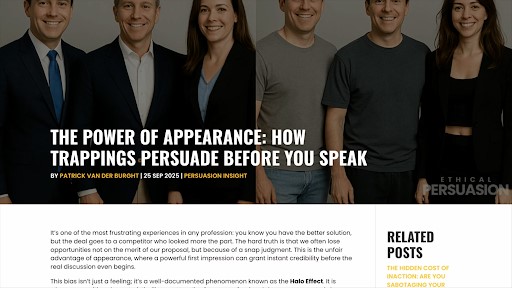

Showing a little bit of style or bling is not a bad thing. You do want to dress to impress. So if you have nice things at home, feel free to wear them more.
Let’s start with piece of research mentioned in Dr. Cialdini’s book, Influence that illustrates how powerful the effect is of being well dressed. Researchers in Texas had a 31 year old man stand on a crowded street corner waiting for the pedestrian crossing light to turn green. When he had some people around him he would, provided it was not life threatening to do so, cross the street when the pedestrian light was still red.
The question was how many people would follow him when he broke the law crossing the street when the light was red. In half of the instances that they tested this, he was wearing a work shirt and trousers. The other half of the time he was wearing a three piece suit and a tie.
Now, let me remind you that he was no more an expert on crossing the street than anyone else there. The only things that were different was that he had the aura of authority when he was wearing the business suit. The results? Three and a half times more people followed him crossing the street against the red light and against the law when he was wearing the business suit.
Now that makes no sense. But it’s perfectly explainable and predictable when we know the science of persuasion and the science of human decision making, which was covered in episode two. Moreover, if if you’re surprised by this result, you or your team members may not fully appreciate how what you look like will affect the results of any persuasive attempt before you even open your mouth.
So let us rectify this blind spot of yours immediately. So you can stop losing out on the successes that were really yours to have and are currently slipping through your fingers because of one little aspect of the science of persuasion linked to perhaps the most powerful but certainly one of the most undetectable universal principles of persuasion.
How beautiful they are.
You might be aware that things tend to come a little easier to beautiful people.
You’d likely be shocked though to hear how much they are better liked, better paid, they are more persuasive, they get help more readily, are seen to have more desirable personality traits and greater intellectual capacities. And if you think that this pertains to how we judge adults only, then you’d be wrong.
Even school teachers judge nice looking children to be more intelligent than their less attractive classmates. And this bias for pretty individuals goes largely undetected. Meaning we have no idea we favour people based on their looks. But it is not what this episode is about. This episode is about what you wear and how that affects people’s perceptions of you.
While uniforms signal a different type of status and perceived authority, well-styled and costly clothing brings an aura of economic standing and position. This falls under the subject of trappings, the outward clues of success.
Why is what our outfit says about us so important? And why do people respond to this so strongly, but in a for them undetectable way? Let me give you a few insights from some of the research mentioned in Dr. Cialdini’s book, Influence. When it comes to the effects of wearing finely styled or expensive clothing, mall shoppers were more willing to comply
with a request to participate in an unpaid survey, homeowners contributed more donations to a charity solicitor at their door, and job evaluators gave higher suitability ratings and starting salaries to an applicant if the individual involved was wearing a shirt or a sweater showing a prestigious designer label.
And the impact of this was large. 79% more willing to participate in a study. 400% more frequent donations to the charity. And nearly 10% higher starting salaries for job applicants.
Regarding the job applicants interview results, another study provided more answers about why and how these decisions or reactions occur. People perceived those who wore a high quality outfit or even a high quality t-shirt as more competent compared to those who didn’t wear clothing like that.
True to system 1, our intuitive part of the decision-making brain, which too many professionals still do not or hardly address their communication towards, this decision about the person wearing the finer clothing was made within a second.
Let’s highlight when trappings are most important in our exposure with people. I think that will explain this for you very well. When people meet you for the first time, they are uncertain about what to think of you. They therefore naturally look for outward clues that can help them to formulate their opinion.
You should by now be familiar with the principle of authority, which I expanded on in episode 13. People tend to follow the advice of individuals who have more knowledge and wisdom on a particular topic. When they observe you wearing clothing that seems to indicate that you are doing well in life or in business, it seems to indicate that you are successful at what you do. And if you are successful, there is a good chance that you know your craft well.
And I live in Australia where the term tall poppy syndrome seems to have come from, which it hasn’t by the way, it came from ancient Rome. But the Australians have taken a shine to it with attitudes that say, “Don’t think that you’re better than others.” And a tendency to want to cut down high achievers, especially when they’re boastful.
I get confronted with that argument sometimes by a student in one of my programs or an audience member at one of my keynotes or a participant in my workshops. In a funny tone, they claim that “That doesn’t work in this country!” or “That doesn’t work on me!”. But then we need to remember something that you got from me months ago. Unless people know the science, they have very little idea or awareness what changes their behaviour or what they might be persuaded by.
The conscious part of the brain might identify these outward clues of success as something to rebel against or reject. And that can affect liking. But research supports that the subconscious, which you now know is in charge of arguably 95% of the decisions, still processes these signals of underlying ability and success which still increases the perception of authority and credibility regardless.
In countries where obvious display of status are consciously rejected or resisted, it still works. And if we use a more subtle display or downplay its importance, we will reduce or avoid resistance.
Thereby reducing or eliminating its negative effect on liking and retaining the positive effect on our authority.
on your or your team’s side, you will experience people paying less attention to you. Fewer people will believe you at the level that they should, and some will not believe you at all. They’ll value your opinion less and agree with you less, and they will not process what you’re communicating with the gravity that it deserves.
I’ll circle back to the ethics in this and how you should use this so it doesn’t backfire on you later. But let’s flip the situation around first. Too many professionals don’t know about the science of persuasion or the power of trappings. Or they have heard about it, but they are not in the habit of consciously thinking about how they’re presenting themselves in various situations.
This could include many members of your team. You might dress well, but because your managers are not trained through formal learning about the science of persuasion, they drop the ethically available ball and underperform their potential with new employees and clients because they don’t realise the importance of this.
Perhaps a service you booked for the wrong time and you’d like to move it at the last minute. Or perhaps your request was dismissed by an employee at the company when you called because it was against company policy and you now wish to make the same request to the manager upon visiting the premises. Perhaps you’ve already noticed why the penny might drop now.
That you tend to be more successful with those requests when you wear nicer, more costly clothing that signal that you’re successful than if you turn up in shorts or jeans and an old t-shirt.
Just two weeks ago I had some passport photos taken at an office supply company. I realised later that I needed the digital copy. When I rang the store to ask if they could get my photos off the camera and email them to me, the girl said that they always offer that when photos are taken, which they hadn’t. And if it wasn’t taken up, then it’s not their fault. Nothing we can do about it. She was quite unpleasant and…
I had just spent a fair bit of money in that store only the week before. I didn’t feel valued. I can tell you that. The first instinct might’ve been, I’ll take my business elsewhere. I mean, there are so many alternatives when it comes to businesses that are happy to take your money, but I like this store. So let’s persuade them to do the right thing instead.
I put on a business suit with some slacks and even took my jacket with me. Asked to see the manager when I entered and I explained what had happened. I didn’t even have to tell her that the girl had been so off putting. It wasn’t a problem. “Let me take you to that department and they’ll fix that right up for you”. As it turned out, they don’t store photos. They took some new ones at no cost and emailed me the photos.
And another happy client, me in this case, left the building.
I would hope. When we need to give a speech to a room full of strangers, tend to think that we need to dress well. For us men, this might mean a nice suit or outfit, a pair of nice shoes, a luxury watch, and being well groomed. For women, this might mean a beautiful outfit, shoes, some jewelry, and hair and makeup. What I often see though,
is that when we are familiar with our audience, being our own employees, for example, networking partners we’ve known for a while, or even clients we see all the time, some of us have a tendency to dress more casually. The signals of authority through outward clues of success are less impactful and arguably less important then because people know you already and have formulated an opinion of you already.
Remember that these clues are quickly used when people are uncertain about you.
But while dressing more casually may signal we’re approachable, it will likely cost us in the perception of our level of authority. Especially when in the office. If you may also need to connect with people who don’t know you, either in person or on a video call, you would be losing credibility and authority, and you’ll be losing a portion of your success that was really yours to have.
[chapter time="19:49" title="The Ethics Involved When Considering the Use of Trappings" thumb="https://ethicalpersuasion.com.au/wp-content/uploads/2026/05/ep19-frame9.jpg"]Now, let’s talk about the ethics in all this. Now that I’ve told you that an expensive outfit can have such impact, you could all run out and get a designer suit, designer watches and jewelry. Here is what I need you to be aware of and remind yourself of. We want to use this ethically, meaning we don’t want to put ourselves into clothing or outfit that we don’t normally or wouldn’t normally own or buy.
That isn’t you and you’re trying to fool people that it is you. Therefore, not ethical. And you might also disappoint later when this trait of yours doesn’t last into your involvement with that person.
Imagine renting an amazing and expensive suit and jewelry to go to an interview for a new position that you like to be hired for. The suit might help you, but when you return it and then you turn up to work in what you normally wear and are comfortable in, something will seem out of place and put strain on the situation. So what do you do? You want to dress in things that you own and things that you’re comfortable owning and wearing.
You should realise by now in this episode that showing a little bit of style or bling is not a bad thing.
You do want to dress to impress. So if you have nice things at home, feel free to wear them more. If you might need a new suit or outfit in the normal or upper end of your usual price range, then now you know you got a little bit of an excuse to defend that purchase with. Don’t go silly, don’t overspend. Just be mindful that nicer things make the perception of you nicer.
And the effect can be subtle, but powerful. If you live in a culture like the Netherlands or Australia, then perhaps you want to make sure you’re not boasting about it and more so downplay it.
Share this article and this podcast with some of your friends and colleagues who success you care about. You’ll be doing them a favor, which will activate the principle of reciprocity, which I covered in episode 6, in your favor. Just give them this persuasive message. I’ll even tell you what I put into it in terms of principles of persuasion.
“I heard this interesting podcast regarding the science of ethical persuasion and human decision-making by one of Dr. Cialdini’s Certified Trainers”. That’s Authority, episode 13. “Which other professionals listen to?” Social Proof, episode 10. “This had to do with how we look and dress and how it can negatively impact our message before we even speak”.
Scarcity, episode 16. “And I thought about how you dress!”. Humor, liking, episode seven. “You need to listen to this and or read this article. It will be entertaining and empowering, I promise”.
If your audience are all in jeans and t-shirts, should you turn up in a three piece suit? You can feel this coming, right? The answer is no. A nice rule to remember is to always dress one level better than your audience. If they wear jeans and a t-shirt, you wear jeans and a business shirt.
If they wear jeans and a business shirt, then you wear slacks or non-jeans looking pants with a business shirt. If they wear business pants and shirt, you do the same and you could wear a jacket or a vest like I often do. I like my vests. And if you ever walk into a meeting and you feel out of place because you’ve dressed a level or two too high, then take something off.
If you’re a speaker, then ask what your audience will be expected to wear and align yourself accordingly, being dressed one level better. If you don’t know what to wear, dress well, but plan ahead so that you can remove or dress down in an instant. If the room is filled with jeans that I wasn’t expecting, then my suit jacket won’t last a minute in that room.
And if I can, I’ll get rid of the vest too. The fancy watch can stay on in my opinion.
I look forward to hearing about your experiences with all this. And if I can help you and your team to become more persuasive, then I would be delighted. Until next time, be more influential through the way you dress to impress.