



150 % more people were perfectly capable of saying yes to the opportunity of insulating their home, but because the scarcity in the situation wasn’t brought to light, as too many professionals do, they left 60% of their success on the table using gain language. What they got was just 40% of what was possible with a single principle of persuasion.
Patrick Van Der Burght, CLT (01:11)
Welcome to the only podcast hosted by a Cialdini Institute Licensed Trainer in which I share valuable insights true to Dr. Cialdini’s teachings that you should not miss and that you’ll be able to use immediately to stop waiting time, resources, cooperation, loyalty, success and competitive advantage that is currently slipping through your fingers.
Everything I share is most powerful when used ethically, which is why my students and my audiences love what we share and it is also backed by the science of persuasion, human decision making and human behaviour.
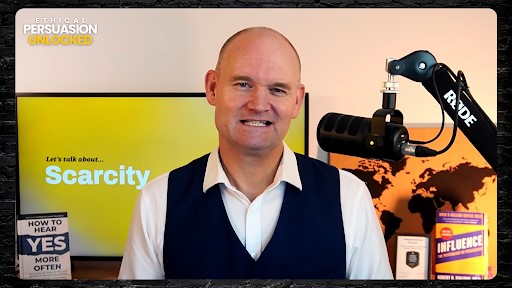
Sometimes I have a guest on my show and we can discuss a wide range of business growth and scaling topics. But today you’ll get another deep dive in one of the universal principles of persuasion, scarcity. I’ll explain why scarcity works and what powers it. We’ll dive into limited time and limited number offers.
And a simple technique that you can use that, in the case study I’ll share, produced a 150% increase in the number of people saying yes to a proposal.
The principle of scarcity is powered by a number of elements. We know that typically things that are difficult to get are more valuable and therefore the availability of an item or a service functions as a shortcut that provides us a clue about its quality. Then we have the fear of missing out or FOMO, powered by loss aversion, which motivates us to not miss out on something that is of high quality.
To make matters worse, if you will, there is the psychological reactance theory. Which means that we react to the loss of freedoms by wanting to have them more than if they were readily available to us. All of this, together and more, makes for a very powerful principle of persuasion that acts on us. If we had to rank principles of persuasion in terms of how difficult they are to detect when they’re used on us, then in my opinion, the principle of scarcity and authority would be at the top of the list.
Once you have developed awareness and application skills regarding how the principles of persuasion work, you can build up your defenses so that when someone uses them on you, you’ll be able to identify that attempt and then consciously contemplate if the information connected to that principle was used in an honest and ethical way.
If that is the case, then you don’t really mind because, well, that’s in your favor because you want to receive that information. But if it was used in an unethical manner, in an attempt to manipulate you to take a certain action or to gain agreement, then in most cases, you can easily free yourself from the pressure that persuasive principle puts on you.
But when it comes to the principle of authority, which we covered in episode 13, and the principle of scarcity, that persuasive attempt may go completely undetected, even for those well-trained in persuasion science.
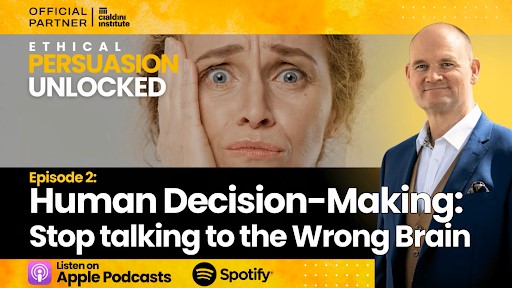
Scarcity information allows our system one part of the decision-making brain to take a shortcut to a quicker decision. If you have little idea what I’m talking about now, then you have likely missed episode 2, where I elaborate about The Science of Human Decision-Making.
Because eventually you get found out, and especially nowadays with social media, your personal and company brand can be destroyed in days.
And besides that, forcing your employees to engage in unethical practices can have detrimental effects on the retention of some of your best staff members. Because most people don’t want to lie and cheat other people to get ahead. And with many options to choose from when it comes to where they want to work, they may move away from you far more readily.
So before I give you a powerful introduction into the workings of the principle of persuasion, a firm wake-up call is appropriate aimed at those who are hoping to fine-tune their underhanded and unethical practices using the principle of scarcity.
If you know that scarcity information is powerful, and you know you’ve produced profits from its use, but you’ve never invested, in formal training for you and your team to learn how to use all the principles in the most effective way, then you are likely still underperforming your potential. And you’ll risk all you’ve built with clients and team members.
I’ve seen it too often and audience members of my keynotes and workshops have realised it themselves once they’re reflect on their own practices.
That you could be using scarcity or other persuasion tactics in what is actually an unethical way. Therefore also risking it all. And there is no need. Just get the skills to use the science of persuasion properly and you’ll be able to benefit from all the principles and use them ethically to build strong and loyal relationships.
Now, let’s teach you a little bit about the principle of scarcity and what’s behind it.
Our reaction to scarcity information is ingrained in us. It is a basic survival tactic and it starts appearing in us very young. Dr. Cialdini’s book, Influence the Psychology of Persuasion, mentions many interesting facts, but let me share some with you. Process this for a moment.
When managers make decisions, they attach greater importance to potential losses than potential gains. In sport, when decision makers take time to consider a situation involving losses, they take more time than making decisions about potential gains.
When college students consider that they could experience a decay or an improvement in their romantic relationships, they experience much stronger emotions when they consider equal-sized decays in their relationship instead of improvements. People are more likely to cheat when they need to avert a potential loss than if they were to achieve a gain. We all know the pressure we’d feel when we’re in a good, potentially important conversation and the phone rings.
It could be a complete waste of time, but too often we turn away from what was potentially an important activity that we were doing and we answer the phone. Why? Because we may not be able to talk to those people later and the potential opportunity to receive the information that the call was meant to bring us could be lost.
You may also be interested to know that compared to potential gains, losses impact our attention more, our arousal, such as heart rate and the dilation of pupils, and brain activity. Dr. Cialdini also highlights in his book Influence another dynamic that gives scarcity more power, and that is the psychological reactance theory.
We fear losing the freedoms that we have. When we are confronted with a situation where something interferes with our ability to access something, we will react against that interference. We end up wanting whatever it is more, and we put a greater effort in to obtain it.
The boys could easily reach over it and access the toy behind it. The other half of the boys were confronted by a different situation. For them, the plexiglass barrier was 60 centimeters or two feet tall, so they couldn’t reach it easily. And if they wanted to access it, they would have to go around the barrier. The question was, how quickly will the boys make contact with the toys under those different circumstances.
Get this, when the plexiglass wasn’t really a barrier, both toys were on average touched just as quickly. But when the plexiglass posed a real barrier to getting to the toy behind it, the boys went for it much more quickly. In fact, it was touched three times faster than the easily accessible toy in front of the barrier.
When kids are around the age of two, they start discovering that they’re individuals. This feeling of autonomy brings up the concept that they have freedoms and they will want to test and discover those freedoms. That is what we parents call the terrible twos. Put them down, they want to be picked up. Pick them up, they want to be put down.
For young parents listening to this, it might be helpful to realise that this is an exciting period for your child as it discovers who they are as individuals. And as they are trying to find out where and when they have these freedoms or when they can be expected to be controlled. It would be wise to give them consistent information.
Of course we also see this in the teenage years of kids as they move from children to adults with more rights, responsibilities and freedom. As Dr. Cialdini highlights, when we as parents place restrictions on our teenage children in, for example, the choice of a partner, we can expect firm resistance.
One study done in Colorado involving 140 teenage couples confirmed that when the couple was experiencing parental interference in the relationship, the pair felt greater love between them and their desire to get married was stronger. The study also highlighted that when parental interference weakened their romantic feelings towards each other also calmed down.
When a book is censored, we want them more. When information is restricted or banned, we want access more and we believe the information more. As was the case with University of North Carolina students, when they were made aware that a speech against co-ed dorms on their campus would not be allowed to happen. They became even more anti-coed dorms, even though they hadn’t actually heard the speech.
They still agreed with its standpoint more. Here is an insight that most people don’t know, and that my students would do well to remind themselves of.
Reactance can be caused when a person tries to convince or persuade someone, especially when they are not trained in the science of persuasion and attempting to persuade. The thing is that when we get the impression that someone is trying to convince or persuade us away from our position, we feel our freedom is threatened.
We feel that we may not be able to decide on our own and immediately become less likely to accept what is being proposed to us.
We know that doing any activity without the science available for it is likely not going to achieve the best results. Imagine an architect building a skyscraper without knowing or using the science. A surgeon trying to operate. Or an electrician wiring up your home. That’s not going to turn out well, and we all know that.
Yet, when it comes to achieving our goals in business, in communication with our teams, in sales, too many people are trying to achieve perfection and falling short without even knowing it. Not you. You are starting to acquire this knowledge slowly.
Having said that, and my certification students will know this, when it comes to the use of persuasive information and the 7 principles, we don’t actually want to use too many at the same time, or we risk our message also being perceived as an attempt to convince or persuade.
For this reason, you want to limit the use of persuasive principles to one or two maybe three in a communication.
This helps you establish credibility, but more importantly, related to reactance, by giving your audience both sides of the choice, the positive and the negative, you reduce the perception that you are trying to push them towards one option.
And I will also explain that there is a lot more to scarcity than just limited number or limited time offers, which will allow you to use it ethically in a far greater range of situations and prevent the wastage of many successes that you’re currently losing.
But let’s dive into limited number and limited time tactics first. Because we know how we react and how people react when confronted with the fact that something is running out, we see many influence professionals use the limited number tactic, making their audience aware of limited numbers being left available. ‘There’s only two of these televisions left in this size and we won’t be able to get more for at least three weeks’.
‘This is last pair of shoes that we have in this size’. ‘There’s only four of these cars left in the country’. And of course we see this online as well. Popular online hotel accommodation sites will tell you how many rooms they have left at that price.
Airlines tell you how many seats are left at that price, which they haven’t been telling people for all that long. Some doctors and dentists will use online booking sites that show how many appointments are still available. And online retailers show stock numbers when they are near exhaustion.
Sadly, the limited number tactic is also used unethically. And too many professionals and websites make false claims about something being limited in number. This of course works, but this unethical use has many risk factors, including one that can see a personal or company brand name destroyed in days. As we dive deeper into in episode 5 with my friend and colleague Brian Ahearn.
Once found out, your credibility can be damaged beyond repair, and more and more governments now hold businesses accountable for misleading behaviour and tactics.
We want to use this ethically. And when we do, our audience will also want to hear about the scarcity in the situation. If you are considering purchasing a TV, or a pair of shoes for an event next weekend, or a book hotel room, or an airline ticket, and it truly is the last one, or one of only a few, you’d want to know, right? It enables you to truly weigh up your options and to assess the risk of you missing out if you wait.
Without that information, you might assume you have plenty of time to consider and research alternatives, only to find out that the thing that was perfect for you is now no longer available, or now you have to accept a less favorable alternative.
We can’t cover every use and nuance of scarcity in here, and neither am I trying to, this is not a course. But there are so many ethical paths to using scarcity and the other six principles and contrast, that there really is no need to use unethical approaches given the risks involved when you and your team can just get proper persuasion skills and maximise the chances people saying yes to you and building long-lasting, loyal relationships at the same time.
In which case, a salesperson, for example, tries to force a person to make that decision right there and then, or the deal is off, or they will have to pay a higher price.
It is course extremely unlikely that genuine conditions exist that would warrant such a firm condition. Someone might make a claim that they can’t process all the sales if they don’t get placed when the consultation happens. But their tactic is not there to take the pressure of their overburdened sales department. It has been put there to prevent their
audience from taking the time to consider the offer more closely, by scaring them that they can’t get this deal later, which makes them want it more.
And I lose interest altogether, because I think it says a lot about the person or the company using manipulative tactics. Would they value a relationship with me? Probably not. Would they be there with good customer service if I needed it after the purchase? Probably not.
We see a lot of this online now. Landing pages with countdown timers on them. A sale that just happens to be on and there just happens to be two hours and 16 minutes left. And guess what? When it expires and you reload the page, you have another two hours before the sale ends. I’ve seen pages where they didn’t even take the trouble to tell you why there is a countdown timer there. No reason.
Just a 5 minute countdown timer on a page where you’re supposed to pick an appointment time. I can’t help it. I need to let it count down and I want to know what happens. Of course, this is my field of work, but even as a consumer, I want to know about the integrity of this company. The timer runs out. The appointments are marked as no longer available, but you refresh the link and they’re back along with another five minute countdown.
You might have decided to make an online purchase and click the finalised transaction button after having organised your payment. And the next page is an attempt to upsell you. That’s not necessarily unethical, but putting a timer on that page, I think would be. That’s just there to scare a scarcity reaction out of you. There is unlikely to be a justifiable reason for a timer.
What does it matter if I decide on that in five minutes or hours? How dare they use such powerful psychology on us to manipulate us? And I encourage anyone to expose these businesses. And lots of people do. Good. Social media is full of videos of businesses being caught lying or trying to deceive people.
But we can’t honour that proposal or price indefinitely. The overall situation may change, and after a certain time we need to re-evaluate if we can offer the same again.
When it comes to booking me for an in-company keynote or workshop, there is a number of factors that impact what the investment in such a program would be. The further in the future the booking is, the more easily it allows me to prepare for the event and to plan around it. That allows me to encourage bookings further out by offering a more attractive price. How busy I am in that month of the proposed booking is also a factor.
To ensure cash flow throughout the year, I’m happy to offer a lower fee for months in which I have no bookings yet. But if I have bookings already, I don’t need to offer that incentive to help my cash flow. So when I give a company or an association a proposal for a keynote or a workshop for their event, and it’s 12 months away, my fee is lower than if it’s 11 months away.
I have a schedule for this which takes into account amongst other things how far in the future the booking would be, audience numbers and how many other events I have already scheduled that month and then it gives a price.
We give a period of time in which we keep the date free and we honour the fee that was proposed. And if this was to expire and I want to revisit the event and my services, we go back to the schedule and take the current state of affairs into account and provide a new price.
If they are still considering the same date, which is now closer, and if other bookings have been confirmed for the same month, the next proposal will not include the factors that reduced the fee earlier. All fair, logical and justifiable. And giving those who can make a decision promptly, within a limited time, the opportunity to secure the best price. And of course, we make them aware of this.
So what should you and your team do when you wish to use scarcity from a limited time or limited number perspective? You need to identify genuine scarcity in your situation. If something won’t be available indefinitely, you can bring that to the surface. If it’s a limited time angle,
I’d encourage you to explain the genuine reasons for it. If it is a limited number, then make sure to be accurate with the number of opportunities that remain.
Which one will motivate us more?
Okay, which answer are you locking in? The answer is limited number situations. They are more persuasive than limited time offers. This is because with a limited number available and other people possibly wanting to take up that offer, we are also competing for this resource which is another amplifier of scarcity.
The way to remember this, when the offer tells you, I have 38 minutes left, I can think to myself, no need to order now, I still have 38 minutes left. Of course, combining both limited time and limited number offers tends to produce the strongest reactions.
When it comes to how we pitch our proposals, the opportunity for change, if we want to use scarcity, then we need to ask ourselves the question, “What won’t they get if they don’t move in my direction with this?”
I see business professionals and copywriters for websites and brochures make this mistake so often. When presenting the benefits of their case, they highlight what the audience tends to gain from moving in their direction. “If you get this, you’ll do better. You’ll be faster. You’ll save this.
You’ll be more efficient, you’ll be safer, smarter, more employable, profitable. You’ll grow, succeed and win.
But as I told you, people are more motivated by the fear of missing out, the fear of losing something, than they are by the prospect of gaining that very same thing.
Let me quantify how big an impact this can have and show you how much success you could therefore be missing out on. Now, this is just one case study with one outcome. The outcome in your case could be less. It could also be more as well.
A company was going around doing home assessments to determine how well homes were insulated. And then presenting the homeowners with the opportunities to insulate their homes more fully. Half of the homeowners were told that if they insulated their homes fully, they would be able to save, let’s say, a dollar a day. A gain instruction.
The other half of the homeowners were instead told that if they failed to insulate their home fully, they would lose a dollar a day. A loss
150 % more people were perfectly capable of saying yes to the opportunity of insulating their home, but because the scarcity in the situation wasn’t brought to light, as too many professionals do, they left 60% of their success on the table using gain language. What they got was just 40% of what was possible with a single principle of persuasion.
And how much is that costing you? If you fail to implement ethical persuasion skills in your business, you will be losing every single day.
I’ve enjoyed giving you these powerful insights, but please realise that there is a lot more to this and that without formal training, you and your team will never develop proper application skills and gain the confidence that you’re using this right.
And that is costing you every day.
So approach us today for a discovery call. Let’s find out how we can best assist you. Perhaps a keynote, workshop, consultation or a learning program for your team or for an individual. Keep an eye and an ear out for an upcoming episode I’ll do on the contrast phenomenon, which is not a principle of persuasion, but an amplifier for all of them. Super powerful and a bit of fun.
Until next time, I wish you an influential future.