
The Dark Side of Persuasion in Politics: Who Is Influencing Your Vote and Our Politicians?

While in medicine the accepting of corporate gifts has already been flagged as dangerous, certain political parties insist they are immune to the effects of donations by industry.
Voting matters. It determines who writes our laws, spends our money, sets our priorities and represents us internationally. Yet when we enter a polling booth, the decision we make has already been exposed to an extraordinary number of psychological influences — some obvious, some subtle, and some we may never consciously recognise.
Politicians and political strategists have understood elements of political persuasion for a very long time. Social proof, reciprocity, commitment and consistency, association, authority, repetition and other behavioural mechanisms can all affect what we believe and how we behave. Some are simply part of normal political communication. Others can be deliberately engineered to create an impression of public opinion or popularity that may bear little resemblance to reality and that would then be political manipulation.
There is another side of political influence that concerns me even more: politicians themselves are human beings and therefore susceptible to exactly the same psychological mechanisms as the rest of us. Yet Australian politicians can accept corporate donations, sponsored travel, hospitality, exclusive memberships and other benefits from organisations with substantial interests in the decisions those politicians subsequently make.
None of this proves corruption or political manipulation. Nor is this article intended to tell you which political party deserves your vote. My purpose is different: to explain some of the science, show you where these mechanisms appear in politics, and let you decide what you think about them.
Because once you understand how influence works, some things that we have come to accept as normal in politics begin to look rather less normal.
Reciprocity: If We Wouldn’t Allow It With Our Doctor, Why Our Politician?
Imagine discovering that a pharmaceutical company regularly provided your doctor with gifts, travel and hospitality while your doctor was deciding whether to prescribe that company’s medication or express an opinion on whether is was safe. Would you be comfortable with that arrangement?
Australian medical regulation recognises the problem. The Australian Health Practitioner Regulation Agency (AHPRA) tells practitioners to recognise that pharmaceutical and other marketing may influence them and not to accept an inducement, gift or hospitality that could affect — or be seen to affect — the way they prescribe, treat or refer patients.
There is good behavioural science behind that caution. Dr Robert Cialdini identified Reciprocity as one of the universal principles of persuasion. When somebody gives us something, we become more inclined to give something back. Importantly, this doesn’t require an explicit exchange — or even conscious recognition that our subsequent behaviour has been influenced.
A remarkable example comes from research published in the New England Journal of Medicine. Researchers examined scientists and clinicians who had published opinions about calcium-channel antagonists, a class of cardiovascular drugs, and compared their positions with their financial relationships with pharmaceutical companies.
Among authors supportive of the drugs:
96% had financial relationships with manufacturers of calcium-channel antagonists.
Among neutral authors, it was 60%.
Among critical authors, it was just 37%.
When relationships with any pharmaceutical manufacturer were considered:
100% of supportive authors had such a relationship,
compared with 67% of neutral authors and 43% of critical authors.
Those relationships included research funding, consultancy, speaking honoraria, employment, educational support and travel expenses. The researchers reported a “strong association” between published positions and financial relationships with pharmaceutical manufacturers. Read the New England Journal of Medicine study
It demonstrates why conflicts of interest deserve our attention even among highly educated professionals whose work requires them to objectively evaluate evidence, and who pride themselves on being truth-seeking scientists on whom our health and lives depend.
So here is the question that interests me: if we recognise that doctors and scientists can be influenced by relationships with organisations that have something to gain from their decisions, why would politicians, who don’t have our lives in their hands as much, be psychologically immune?
Let us investigate the dark side of political persuasion, and let me show you several ways your opinion can be influenced — or even manipulated.

What Do Corporate Political Donations Buy?
Australian researchers examined ten years of political donations from alcohol, gambling, tobacco and supermarket interests. They identified approximately $14 million in declared donations:
- $1.7 million from supermarket interests,
- $1.9 million from tobacco,
- $2.9 million from gambling, and
- $7.7 million from alcohol interests.
The researchers also interviewed 28 current and former politicians, former political staffers and other knowledgeable participants. Among the functions attributed to political donations were “buying immediate influence” and “building long-term relationships.” Donations to the party in government also increased substantially while alcohol-tax and gambling-law reforms were under consideration.
Another Australian study examined 20 years of gambling-industry political donations and found gambling interests to be “consistent and substantial donors to both major parties in Australia”, while identifying temporal relationships between donations and gambling-policy decisions and positions.
That raises another interesting question:
If corporate political donations simply represent ideological support, why would corporations donate to opposing political parties?
Research involving more than 1,500 Australian corporations and 7,500 directors concluded that corporate political activity was largely explained by the “narrow economic self-interest of individual corporations.” Companies in highly regulated or government-dependent industries were particularly likely to hedge their bets by supporting both major parties.
If you don’t know who will form the next government, there is another option besides choosing a side: build relationships or influence with both.
Victorian MP Ellen Sandell walks through the Labor corridor of Parliament, pointing to parcels she says were delivered by the Australian Hotels Association. The observation raises a broader question explored in this article: what influence can gifts and industry relationships have on political decision-making?
When Political Donations Become Something More
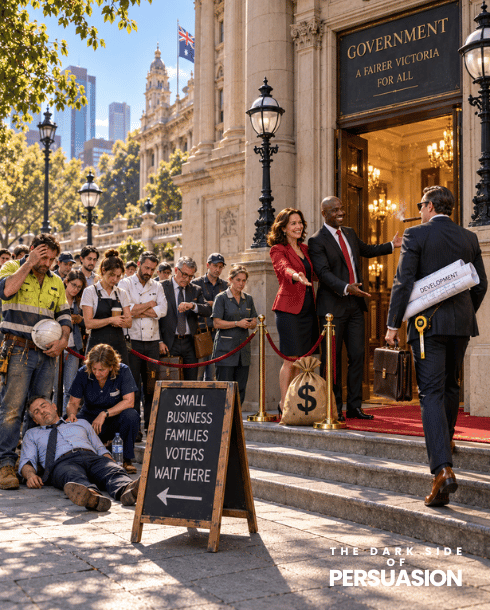
When Labor MPs were found to have advocated for the interests of a major property developer who had financially supported the party, it raises an important question: what does political money buy?
We don’t have to look overseas to see how political money can translate into influence. Victoria’s anti-corruption watchdog, IBAC, investigated property developer John Woodman in its Operation Sandon investigation. Between 2010 and 2019, more than 180 transactions totalling almost $1 million flowed from Woodman’s accounts to Victoria’s two major political parties — approximately $439,000 to Labor and $531,000 to the Liberal Party.
IBAC found that Woodman used political donations and fundraising to gain access to politicians and senior decision-makers, and successfully lobbied Labor MPs Judith Graley and Jude Perera to advocate within government for his interests in the Cranbourne West C219 rezoning proposal.
IBAC described political fundraising entities as an important way of
“buying access to elected officials and senior decision-makers without transparency.”
But Wait, There’s More…
At local-government level, the findings were even more extraordinary. IBAC found that City of Casey councillors Sam Aziz and Geoff Ablett each received more than $550,000 from Woodman or related entities over several years. The watchdog found that both councillors actively promoted Woodman’s interests, voted in favour of his planning applications and encouraged other councillors to support them.
IBAC described Woodman’s relationship with Aziz as “transactional”:
in return for money and other financial benefits, Aziz provided influence over council processes and decisions.
The investigation uncovered bags and a suitcase of cash, payments made under false names, secretly recorded conversations and even scripts prepared for councillors to use in council meetings. In 2025, IBAC announced that a former Casey councillor and a property-development consultant had been charged with offences arising from Operation Sandon; those charges are a separate legal process and should not be confused with a finding of criminal guilt.
And Woodman Wasn’t the Only Property Developer Donating
The Woodman case becomes even more interesting when we zoom out. An analysis of 20 years of Australian Electoral Commission disclosure data by the Centre for Public Integrity found that between 1999 and 2019, the property and construction industry disclosed $2,710,990 in payments to the Victorian Liberal Party and $2,242,773 to Victorian Labor — a combined $4,953,763 to Victoria’s two major parties.
Again, these payments do not prove that a particular planning approval or government decision was bought. But property developers operate in an industry where government decisions about zoning, planning approvals, infrastructure and land use can dramatically affect the value of their investments.
Which brings us back to the same question:
If these payments have no capacity to influence access, relationships or decisions, why are commercially interested organisations spending millions of dollars making them?
And by extension… are voters of Liberal and Labor aware and happy that this was happening and comfortable to keep enabling it, or will they remember for years to come and change their vote?
Behold Figure 3 of the ‘Case Study: The property and construction industry’ by the Centre for Public Integrity.
Recipients of property and construction industry donations 1999-2019
| Recipient | Amount |
|---|---|
| Liberal Party of Australia | $15,186,300 |
| Australian Labor Party (N.S.W. Branch) | $7,711,891 |
| Australian Labor Party (ALP) | $6,506,465 |
| Liberal Party of Australia NSW Division | $5,845,267 |
| Liberal Party (W.A. Division) Inc | $3,692,503 |
| Liberal Party of Australia (Victorian Division) | $2,710,990 |
| Australian Labor Party (State of Queensland) | $2,427,405 |
| Australian Labor Party (Victorian Branch) | $2,242,773 |
| Liberal National Party of Queensland | $1,234,178 |
| The Free Enterprise Foundation | $835,000 |
| Liberal Party of Australia – Queensland Division | $721,014 |
| Australian Labor Party (Northern Territory) Branch | $652,000 |
| Australian Labor Party (South Australian Branch) | $515,000 |
| Country Liberals (Northern Territory) | $515,000 |
| National Party | $500,000 |
| Liberal Party of Australia (S.A. Division) | $474,500 |
| National Party of Australia – N.S.W. | $407,348 |
| Lib (Higgins 200 Club) | $269,727 |
| Australian Labor Party (Western Australian Branch) | $258,981 |
| National Party of Australia (Queensland) – QLD | $216,000 |
| Progressive Business Association Inc | $194,250 |
| Forward Brisbane Leadership | $136,836 |
| The Millenium Forum – The Liberal Party of Australia (NSW Division) | $111,500 |
| Advance Australia | $100,000 |
| The 500 Club (Lib-WA) | $83,000 |
| Australian Labor Party (Act Branch) | $79,500 |
| National Party of Australia (WA) Inc | $75,000 |
| Liberal Party of Australia – Tasmanian Division | $70,000 |
| Liberal Party of Australia – Lib-NSW (Federal Account) | $44,000 |
| Australian Labor Party Queensland | $36,700 |
| Australian Democrats – National | $32,500 |
| 250 Club Ltd | $30,000 |
| Australian Labor Party NSW Branch Watson Federal Campaign A/C ALP-NSW | $30,000 |
| The Liberal Party of Western Australia Pty Ltd | $28,000 |
| Lib – Vic (Higgins 200 Club) | $27,500 |
| The Leaders Forum of Western Australia | $25,000 |
| Liberal National Party of Queensland (Lord Mayor Community Trust) | $25,000 |
| Family First Party – Vic | $21,000 |
| Australian Labor Party (Tasmanian Branch) – Tas | $20,000 |
| Mark Dreyfus Qc MP ALP-Isaacs | $20,000 |
| Liberal Party of Australia – ACT Division – ACT | $10,000 |
| The Brisbanes Future Committee | $10,000 |
| Liberal Party of Western Australia Pty Ltd | $10,000 |
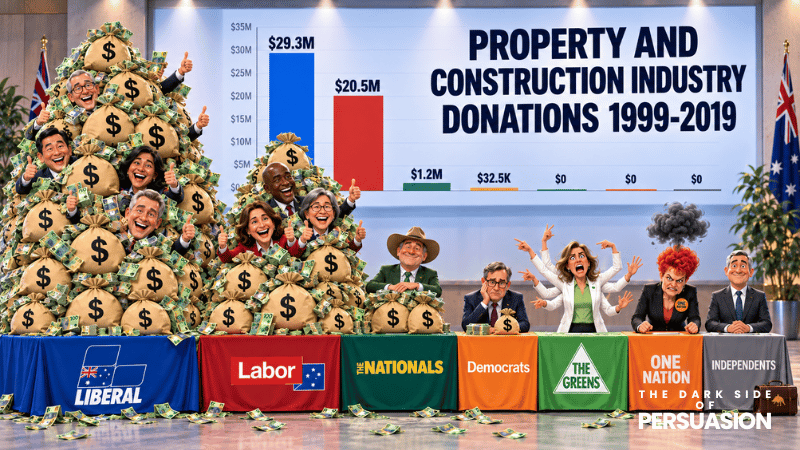
Property and construction industry donations from 1999–2019 among Australia’s major political parties, with approximately $29.3 million going to Liberal organisations and $20.5 million to Labor organisations.
Sometimes Money Doesn’t Buy a Vote. It Buys the Opportunity to Ask.
One particularly revealing experiment involved 191 US congressional offices. Researchers Joshua Kalla and David Broockman arranged for a political organisation to request meetings between congressional offices and local people. The people requesting those meetings were political donors, but researchers randomly changed whether the congressional office was told that.
When they were described simply as constituents, 5.5% obtained access to a senior policymaker.
When exactly the same people were identified as campaign donors, 18.8% did.
Access to a member of Congress or chief of staff showed an even larger difference: 2.4% versus 12.5%.
The researchers concluded that when offices knew prospective attendees were political donors, senior policymakers made themselves available three to four times more often.
The donation may not have been political manipulation and didn’t have to purchase a vote. It facilitated access. And access provides the opportunity for conversation, relationship building, lobbying, argument, persuasion and requests.
When the Gift Is a $1 Million Aeroplane
Political influence isn’t limited to cash donations. Gifts, hospitality, travel and personal benefits raise exactly the same behavioural question. In April 2026, a company controlled by mining billionaire Gina Rinehart gifted Pauline Hanson’s One Nation a new Cirrus G7 aeroplane, reported to be worth approximately $1 million. Hanson has also declared flights provided by Rinehart’s companies, and in July 2026 updated her parliamentary register to disclose that Rinehart had paid for flights from London to Sicily during a European trip. (ABC’s report)
There is nothing inherently unlawful about a properly declared political gift, and receiving one does not prove that a politician was subject to political manipulation and subsequently changed a policy in return. But from a behavioural-science perspective, that isn’t the only question we should be asking. If receiving something from another person can create a sense of obligation and strengthen relationships — why would we deliberately allow enormously valuable gifts to pass from people with substantial commercial interests to political organisations and decision-makers?

In April 2026, a company controlled by Gina Rinehart gifted One Nation a new Cirrus G7 aircraft reportedly worth around $1 million — an unusually large political gift that raises interesting questions when viewed through the behavioural science of Reciprocity.
The mining and resources industry makes this question particularly relevant in Australia. In the 2024–25 financial year, Hancock Prospecting donated almost $900,000 to political campaign group Advance and more than $200,000 to Liberal Party branches. Coal Australia, representing coal producers, contributed approximately $5.1 million to political campaigning through Australians for Prosperity. Earlier reporting also revealed that Hancock Prospecting was behind a $150,000 payment to the Liberal Party via the Sydney Mining Club, which Hancock subsequently declared 444 days after the original disclosure deadline.
Top 20 political donors
The Guardian: Showing the sum of donations declared in the 2024-25 financial year, grouped by donor name
| Donor Name | Value |
|---|---|
| MINERALOGY PTY LTD | $53,192,279 |
| Coal Australia Limited | $5,389,523 |
| Wall, Pamela | $5,260,000 |
| Pratt Holdings Pty Ltd | $3,000,000 |
| Climate 200 Pty Limited | $2,709,200 |
| Keldoulis Investments Pty Limited | $1,987,180 |
| ORYXIUM PTY LIMITED | $1,800,000 |
| Communications, Electrical and Plumbing Union – Electrical, Energy and Services Division | $1,563,800 |
| Farquhar, Scott | $1,500,000 |
| William Taylor Nominees Pty Ltd | $1,500,000 |
| Cannon-Brookes, Michael | $1,300,000 |
| Turpie, Duncan | $1,110,000 |
| Bennett, Paul | $1,100,000 |
| Hancock Prospecting Pty Ltd | $1,099,000 |
| Minerals Council of Australia | $1,000,970 |
| Australian Capital Equity Pty Limited | $1,000,000 |
| Catsaras, Marcus | $1,000,000 |
| Estate of Linda White | $1,000,000 |
| Fairground Investments Pty Ltd ATF Fairground Trust | $1,000,000 |
| Fox Group Holdings Pty Ltd | $1,000,000 |
| New Regime Pty Ltd | $1,000,000 |
The Greens have been particularly vocal about this relationship between the resources industry and politics. They have called for political donations from the mining and fossil-fuel sectors to be banned, an end to “cash for access” fundraising events, and restrictions on the revolving door between government and the industries governments regulate. In Western Australia, Greens MP Sophie McNeill has specifically called for an end to events where corporations and wealthy individuals pay for privileged access to ministers.
Again, none of those donations or gifts proves that a particular government approval, mining decision or policy position was purchased or the result of political manipulation. That isn’t the claim I am making. The behavioural question is more fundamental. Australia’s resources are worth extraordinary amounts of money. Governments decide who may extract them, where extraction may occur, what environmental conditions apply, what royalties and taxes are paid, and what happens to land and communities affected by those decisions. The companies and individuals seeking favourable decisions can therefore have billions of dollars at stake.
Why would we design a political system in which those same interests can give money,
travel, hospitality or even an aeroplane to political organisations
and the people whose decisions can affect their fortunes?
If we wouldn’t be comfortable with a pharmaceutical company giving a researcher a $1 million gift before evaluating a drug, why should our standard for politicians be lower?
Qantas: Benefits Without a Political Donation
Money isn’t the only thing somebody can give us. Consider Qantas. Analysis of parliamentary interests registers found that at least 209 of Australia’s 227 federal MPs and senators in the 47th Parliament had declared membership of Qantas’s invitation-only Chairman’s Lounge. Politicians have also declared complimentary flight upgrades and other benefits.
This is not an accusation against one political party. The practice has extended across Australian politics, which arguably makes the behavioural question more interesting.
In 2023, Qatar Airways sought permission to add substantial additional capacity into Australia. The Australian Government rejected the request. Qantas had opposed Qatar’s application, and the decision subsequently became the subject of a Senate inquiry. The committee recommended that the government immediately review the decision and raised concerns about transparency surrounding the decision-making process.

Qantas’ invitation-only Chairman’s Lounge access for politicians became a heated topic of public debate around the same time the Australian Government refused Qatar Airways’ request for additional flights — a controversial decision that became the subject of a Senate inquiry. More competition may have benefited Australian travellers through greater capacity and potentially lower airfares, while the Government’s decision was certainly welcomed by Qantas.
No evidence shows that Qantas benefits caused the Qatar decision, and I’m not suggesting that making them available was an attempt to gain political influence. My question is simpler:
If we recognise in medicine that human judgement can be affected
by benefits received from an interested company,
why would we encourage politicians to demonstrate their immunity
to exactly the same psychological mechanisms?
When Reciprocity Meets Foreign Policy
There is one final example worth leaving as a question. Between 2010 and 2018, Australian federal parliamentarians declared 102 sponsored trips to Israel, compared with 63 to China and 49 to the United States. The Australian Strategic Policy Institute found that the Australia/Israel & Jewish Affairs Council (AIJAC) was the largest sponsor of non-Australian-government-funded parliamentary overseas travel across all countries during that period. The pattern continued afterwards: research based on parliamentary registers found Israel remained the leading destination for privately sponsored parliamentary travel between June 2018 and April 2022, with another 25 trips, 11 sponsored by AIJAC.
A sponsored trip certainly doesn’t prove that a politician’s subsequent position has been bought. But through the lens of Reciprocity, surely it is reasonable to ask why we permit interested organisations to provide politicians with overseas travel in the first place. Such trips don’t merely have financial value; they create opportunities for hospitality, relationships, repeated interaction and exposure to particular people and perspectives. When Australia is subsequently required to decide how far it is prepared to go in criticising, sanctioning or otherwise responding to the conduct of a country described as an ally, how confident can we be that years of sponsored travel and relationship-building have had no influence at all? That question becomes particularly interesting in the example of Israel — for reasons we will return to shortly.
Social Proof: “Everybody Else Thinks This”
Now let’s turn the behavioural lens around. Until now, we have largely examined political persuasion from the perspective of the influences surrounding politicians themselves.
Politicians are susceptible to influence, but so are we.
Social Proof describes our tendency to look towards the behaviour and opinions of other people when deciding what we should believe or do. It becomes particularly influential when we are uncertain and when the people we are observing seem similar to ourselves. The implications for politics are enormous.
One particularly confronting experiment examined attitudes towards torture. Participants’ existing views about the acceptability of torture were measured before they entered what they believed was an online discussion with fellow students. The other participants were actually computer-generated, allowing researchers to manipulate the apparent group position.
After being exposed to the group’s position, 80% of participants expressed less opposition to torture than they had beforehand. Importantly, stronger pre-existing moral convictions provided some resistance to the effect.
Think about what that means. Even on a profoundly moral question, what appears to be the opinion of people like us can shift our position.
Now put a smartphone in our hands.
Social Media, Political Manipulation and the Illusion of What Everybody Thinks
Social Proof becomes particularly interesting — and potentially dangerous — when we consider its role in political persuasion, opinion polls and live audiences, but let’s first tackle social media.
When we scroll through Facebook, Instagram, TikTok, YouTube or X, we are not simply consuming information. We are constantly being shown apparent evidence of what other people think. We see likes, shares, comments, follower counts and videos with millions of views. We see hundreds of people apparently agreeing with one position and perhaps only a handful challenging it.
To our decision-making brain, all of this can become Social Proof.
But what if the crowd we are observing isn’t an accurate representation of the crowd at all? There is now considerable evidence that governments, political organisations, commercial operators and other interested parties understand precisely how important the online information environment has become and hope to manipulate our behaviour through it.

Our opinions, beliefs and behaviour is shaped by the behaviour we see in others. Controlling what we are shown can give us a distorted view of reality. This can alter our beliefs, our support and our resolve — or even discourage us from taking action or commenting.
Israeli Prime Minister Benjamin Netanyahu provided an unusually direct example. In September 2025, Netanyahu publicly said Israel needed to invest heavily in “influence operations” in traditional and social media to counter its deteriorating international standing (REUTERS). At a separate meeting with social-media influencers, he was even more explicit about their importance: “We have to fight back. How do we fight back? Our influencers.” He went on to describe social media as one of the most important contemporary battlefields. This was occurring while the Israeli Government was facing extraordinary international criticism over its conduct in Gaza.
In September 2025, the United Nations Independent International Commission of Inquiry concluded that Israel had committed genocide against Palestinians in Gaza. Following a detailed factual and legal investigation, the Commission concluded that Israeli authorities and security forces had committed four of the five genocidal acts identified in the 1948 Genocide Convention and that the evidence established the specific intent required for genocide.
This conclusion does not stand alone. Amnesty International’s extensive investigation also concluded that Israel had committed and was continuing to commit genocide against Palestinians in Gaza. In July 2025, two Israeli human-rights organisations reached the same conclusion: B’Tselem published its report Our Genocide, while Physicians for Human Rights Israel published a medical-legal analysis concluding that the systematic destruction of Gaza’s healthcare system formed part of the genocide. Amnesty provides a useful summary of both Israeli organisations’ findings here. Human Rights Watch has used somewhat more specific legal wording. Israel strongly rejects allegations that it is committing genocide.
When our behaviour is shaped by the behaviour we see, can we trust what others put in front of our eyes?
The important persuasion question here is not whether you or I accept one side’s interpretation.
It is this:
When a government facing devastating international criticism
openly identifies social media and influencers as a battlefield,
how confident should we be that the apparent public opinion we encounter online
has developed organically?
And governments are not the only actors capable of changing what the online crowd appears to believe. Human Rights Watch conducted a substantial investigation into Meta’s moderation of Palestine-related material on Facebook and Instagram. Its report, Meta’s Broken Promises: Systemic Censorship of Palestine Content on Instagram and Facebook, documented more than 1,050 cases of takedowns or other suppression of content from more than 60 countries during October and November 2023.
The patterns Human Rights Watch documented included removal of posts, stories and comments; suspension or disabling of accounts; restrictions on liking, commenting and sharing; restrictions on following and tagging; reduced recommendation of accounts to non-followers; and what is commonly called shadow banning — substantially reducing the visibility of content without necessarily notifying its creator.
The significance of this goes well beyond whether somebody’s Facebook post disappears. Think about what it can do and has done to the Social Proof users observe.
Imagine 100 people commenting beneath a political video. If a platform, algorithm or account owner hides 30 comments expressing one position while leaving most of the opposing comments visible, nobody needs to change your opinion directly.
They have changed something potentially more subtle.
They have changed what everybody appears to think.
Meta’s own independent Oversight Board has also documented moderation errors involving Gaza. In several cases, Meta removed legitimate reporting about the Gaza conflict and subsequently restored it after the Oversight Board intervened. The Board has specifically warned that such enforcement errors can undermine genuine efforts to report on and raise awareness of events in Gaza.
The Oversight Board has also documented another important change. Following the 7 October events, Meta temporarily lowered the confidence thresholds used by its automated moderation systems. In practical terms, its automated systems were instructed to act more aggressively when deciding whether content should be removed.
Again, none of this proves that every moderation decision is politically motivated. But it demonstrates that the information environment we observe is being filtered before it reaches us.
Comment manipulation on TikTok
TikTok provides another illustration of how easily the apparent crowd can be altered. I have found it clear to see: Certain news channels allow comments on videos where the public opinion seems to spur on the context the channel supports, but when they air videos, voice opinions, or fail to ask the obvious questions about a situation that audience will feel a need to comment about… they disable comments altogether. But the problem from a behaviour and belief perspective runs deeper.
TikTok itself explains that its systems can hide comments classified as potentially offensive or spam. Its Creator Care Mode can hide comments considered inappropriate or offensive, and creators can also automatically hide comments containing selected keywords. TikTok explains that filtered comments remain hidden unless subsequently approved.
TikTok’s documentation is particularly interesting because the company openly acknowledges what this means for the visible conversation. Its keyword-filtering system can make comments containing selected words disappear not only for the creator, but for everybody else viewing the video — including comments that had already been published.
This does not demonstrate that TikTok deliberately suppresses criticism of Israel, and I have personally observed apparently innocuous anti-Israel comments being placed behind TikTok’s “potentially inappropriate” filtering, but I cannot establish from that observation why the algorithm classified them that way.
What we can establish is the mechanism.
A comment can exist.
A real person can have written it.
And most other people can nevertheless be prevented from seeing it.

Support for controversial or political topics on social media can be manipulated. Yet seeing many people like us supporting a position can subtly influence our own opinions — or gradually chip away at our resolve.
There has also been an important structural change at TikTok in the United States. In 2026, TikTok announced the creation of its majority-American-owned USDS Joint Venture, with Oracle, Silver Lake and MGX each holding 15%, other American-linked investors participating, and ByteDance retaining 19.9%. Crucially for this discussion, TikTok says the new entity has decision-making authority over US trust-and-safety policies and content moderation, while also retraining and updating the recommendation algorithm using US user data.
That does not tell us that a particular political viewpoint is being deliberately suppressed. It does tell us something important about Social Proof: the apparent popularity and visibility of political opinions on a platform are partly products of algorithms and moderation systems controlled by organisations most users know very little about. Nor can we safely assume that every apparent supporter online is necessarily the person we imagine them to be.
In 2026, Guardian Australia investigated some of the largest Facebook groups supporting Pauline Hanson and One Nation. Some had more than 100,000 members, yet the investigation found that many appeared to be operated by overseas digital creators, particularly from South-East Asia, including Indonesia and India. Researchers described operations in which politically provocative material could be produced because engagement itself generated revenue. The investigation did not establish that Pauline Hanson or One Nation had commissioned or controlled these operations.
From a Social Proof perspective, however, that distinction produces a fascinating problem.
Imagine that you are an Australian voter scrolling through Facebook. You encounter group after group filled with apparently enthusiastic Australians sharing Pauline Hanson material, praising One Nation policies and interacting with provocative political posts.
Your brain receives a very simple signal:
A lot of people seem to think this.
You probably don’t stop to investigate whether the person generating the material is an Australian voter in Ballarat — or a commercial digital creator sitting thousands of kilometres away in Indonesia trying to maximise Facebook revenue.
The Social Proof signal arrives in the predominant decision-making part of your brain either way and affects your opinion or resolve a little or a lot without you realising it.
And that brings us back to the behavioural science.
For those educated in the science of persuasion, and those who realise the vast amount of research explaining our reactions to the opinions and actions of others, the change in likes and comments makes perfect sense as having the power to alter behaviour, but there is specific research on this as well.
Experimental research demonstrates that online comments can affect people’s perception of the prevailing opinion and, under some circumstances, their own attitudes. In one experiment involving 415 participants, everyone read the same news story but was randomly exposed to different combinations of comments. The researchers found that the opinion climate created by those comments influenced participants’ opinions and subsequent commenting behaviour. Homogeneous comment sections shifted opinions more than mixed ones, with the strongest effects among people whose initial opinions were ambiguous.
Other experimental research has similarly examined how online comments and apparent public-opinion poll results interact with people’s existing attitudes and willingness to express their views.
This is extremely important. The comments underneath the content are not necessarily irrelevant chatter. They can become part of the persuasive message itself. That means manipulating the apparent crowd can potentially influence an individual without ever needing to persuade that individual directly.
- Add supportive comments.
- Remove opposing comments.
- Hide selected words.
- Use fake accounts or bots.
- Create engagement farms.
- Pay influencers.
- Amplify selected content.
- Reduce the recommendation of other content.
- Change which comments appear first.
None of these techniques requires somebody to tell you:
“Change your opinion.”
Instead, they can change the informational environment in which you form that opinion.
And because Social Proof frequently operates without us consciously stopping to analyse it, we may not even recognise that another person’s apparent opinion has become evidence contributing to our own. Which leaves us with perhaps the most uncomfortable question in this entire section:
How certain are you that your political opinions have not been influenced by what you thought everybody else believed?
Political Polls: Information That Can Change the Thing Being Measured
Opinion polling seems harmless. Ask thousands of people how they intend to vote, publish the percentages, and everybody becomes better informed. Except there is a behavioural complication: telling people who appears to be winning can itself influence behaviour. That means a poll can potentially move beyond measuring public opinion and become an unintended (or intended) instrument of political persuasion or political manipulation.
This is known as the bandwagon effect.
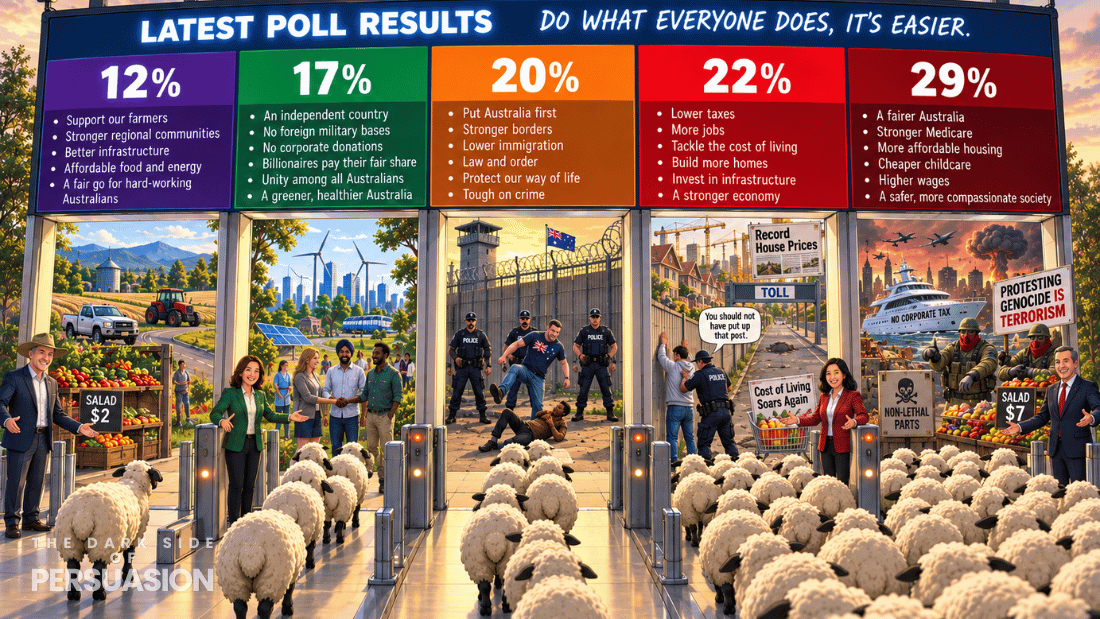
Opinion polls do more than measure public opinion — they influence it. When we see that many others favour a particular choice, Social Proof can subtly encourage us to follow the crowd even without us realising it.
One controlled experiment (read full study by Mike Farjam) using real political organisations found that after people saw pre-election polling, the options depicted as having majority support subsequently received an average 7% increase in votes. And commented: “Modern forms of communication and information sharing, such as social media and instant messaging, can act as a “turbocharger” for the bandwagon effect and thereby increase its potential to disrupt the democratic process.”
A large Danish experiment similarly found that when voters were shown a news story describing a party as increasing in popularity, voting intentions moved in the same direction. The effect was strongest when a party was portrayed as gaining support.
That is particularly interesting for smaller political parties. A repeated narrative that a party is surging, gaining momentum or on track for a breakthrough isn’t merely reporting information. It can itself become persuasive information.
There is even real-world evidence. A natural experiment involving French overseas territories found that knowing mainland exit-poll results significantly increased bandwagon voting towards the expected winner and reduced turnout by about 11 percentage points. Interestingly, concerns about this potential influence are reflected in electoral rules around the world. A survey of 66 countries found that, of the 59 permitting exit polls during an election, 41 prohibited publication of the results until voting had concluded (Spangenberg, 2003).
Polls undoubtedly have legitimate journalistic and political uses. But ask yourself:
Now that you see how big an impact Social Proof has, and that its effect often goes undetected, how certain are you that they have not influenced your decisions?
If your objective is to choose the political representatives whose policies, values, competence and previous performance best match what you believe your country and family needs, should knowing that 34% of strangers currently favour one party and 29% favour another actually be allowed to taint your decision? Or has somebody introduced Social Proof to sway your decision and that of many others in the hope of creating a self-fulfilling prophecy at your expense?
My opinion is that political polling can serve no benefit when shared with the population. And severe responsibility should be placed on those collecting and broadcasting its findings, that they are indeed a true representation of the average person, which is nearly impossible to guarantee. One way or another, chances are that someone is being influenced out of what they truly want and into the agenda of others, and that is more likely to be the agenda of those with funding to initiate and broadcast such findings.
Ignore polls. Be brave. Make up your own mind based on what political parties stand for, how reliable they have been in fulfilling their promises in the past, and the decisions they have made in your name if you have voted for them before.
The Crowd Behind the Politician – Political Manipulation Through What You See and Hear
Social Proof doesn’t stop at polling. Watch a political debate or rally. A politician delivers a line, and the room erupts in applause. Another politician responds and receives silence, laughter or boos. Without consciously deciding to do so, the viewer has just received additional information:
‘One argument is popular; the other isn’t.’
Research analysing the first 2016 Clinton–Trump presidential debate found that applause and cheering significantly influenced viewers’ liking of the candidate who was speaking. Audience responses can therefore become part of the persuasive message rather than merely a reaction to it.
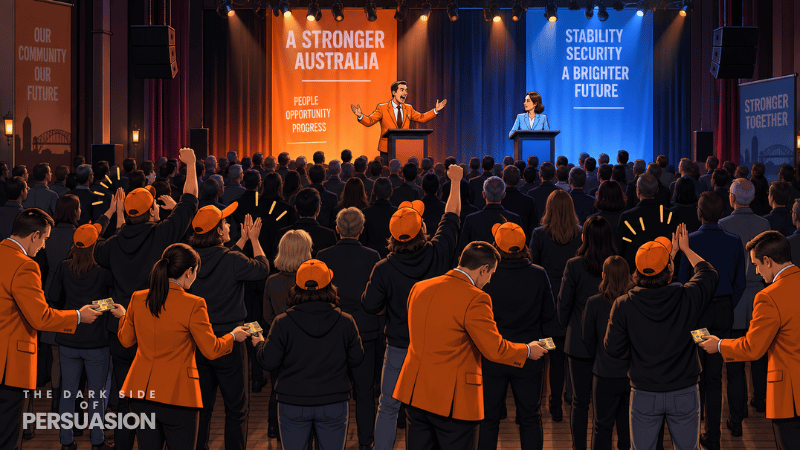
Who controls the crowd can influence the opinions of the masses. Applause, cheering and visible enthusiasm provide Social Proof that can subtly shape how the rest of an audience responds.
Audience manipulation started long ago
Humans discovered long before television that audiences could be manipulated. In nineteenth-century French theatre and opera, professional applauders known as the claque were systematically employed to manufacture audience reactions. A chef de claque could coordinate applause and other responses at predetermined moments, encouraging the genuine audience to follow. (AH Saxon, 2010)
Modern political strategists hardly needed to invent the psychology.
For anyone interested in political persuasion and political manipulation, the important point is that the audience’s reaction can become part of the message received by everybody watching at home.
This makes me wonder whether serious political debates would actually serve voters better without a live partisan audience. Let the candidates make their arguments. Let us hear the answers. Then let each viewer decide whether an argument deserves approval without first hearing hundreds of other people tell them when to cheer, laugh or boo.
Beautiful Politicians Get More Votes: The Halo Effect
There is another psychological tendency we need to be aware of when considering our political preferences: the Halo Effect.
The Halo Effect occurs when one positive characteristic of a person influences how we perceive their other qualities. Physical attractiveness is a particularly powerful example. Attractive people tend to be perceived more favourably in ways that have little or nothing to do with their appearance. We can find them more likeable, persuasive and capable, and may attribute more desirable personality characteristics to them.
It probably hasn’t escaped you that life sometimes seems to come a little more easily to beautiful people. What may surprise you is just how far that advantage can extend — including all the way to the ballot box.
Researchers Michael Efran and E. W. J. Patterson examined 79 candidates who competed for 21 parliamentary seats in Canada’s 1972 federal election. Independent judges rated the candidates’ physical attractiveness, and the researchers compared those ratings with the actual election results. Candidates rated as attractive averaged 32% of the vote, compared with just 11% for those rated unattractive.
That’s an extraordinary difference.
Perhaps even more interesting is how reluctant we are to believe that appearance could influence a decision as important as our vote. Cialdini reports follow-up research in which 73% of Canadian voters strongly denied that physical appearance had influenced their vote, while only 14% were prepared to acknowledge even the possibility that it had.
And as you read this, there’s a reasonable chance you’re thinking:
“Yes, perhaps other people do that, but I don’t.”
That is precisely why biases like the Halo Effect are worth understanding. If we were always conscious of them, they would be much easier to correct for.
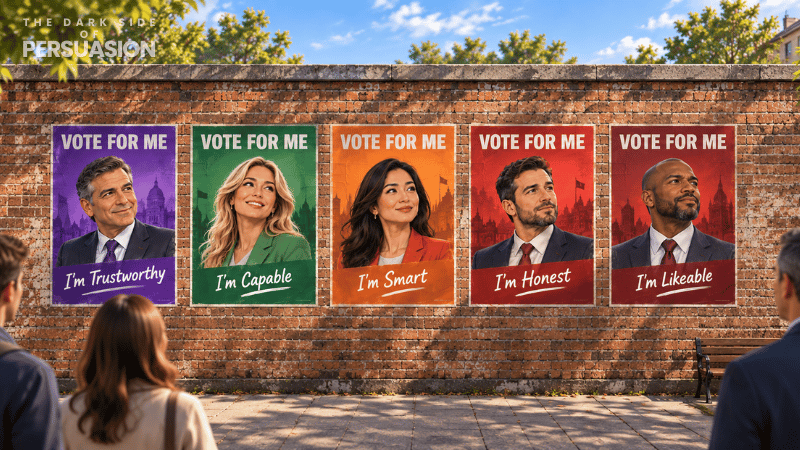
The Halo Effect in politics: Physical attractiveness can influence how we perceive qualities that have little to do with appearance. An attractive candidate may seem more likeable, capable, intelligent, trustworthy or honest — even when their looks provide no evidence of any of those qualities.
Awareness gives us an opportunity to interrupt the shortcut. Whether we’re deciding who to employ, who to trust, who we want to spend time with or who should represent us politically, we can deliberately ask ourselves whether we’re responding to qualities that are actually relevant to the decision — or whether an attractive face, confident smile or polished appearance is quietly influencing how capable, intelligent or trustworthy that person seems.
When choosing political representatives in particular, good looks aren’t a qualification for governing. Policies, intentions, conduct, competence and demonstrated actions give us much more relevant information on which to make that decision.
Kept Captive by the Principle of Consistency: “I’ve Always Voted This Way”
There is another powerful principle of persuasion that can backfire on us personally. It doesn’t require corporate donations, political manipulation strategies, planted audience members at rallies or opinion polls. We can do this one all by ourselves. It can see us staying loyal to political parties that have failed us, while continuing to defend decisions that we might judge very differently if we encountered them for the first time today.
Cialdini’s Principle of Consistency describes our preference for behaving consistently with decisions and positions we have already taken. We do this because society judges us when we say we will do one thing, and then we do something different. We judge other people like that, and we don’t want to be judged like that. Consistency is also a convenient time saver. It saves us from reconsidering every decision from scratch, and in an extraordinarily busy world, that is a very attractive shortcut.
New information takes work. We have to find it, decide whether the source is credible, investigate competing claims, consider what has changed, analyse the evidence and perhaps form an entirely new opinion. It is considerably easier to fall back on a decision we have already made:
“I vote Labor.”
“I vote Liberal.”
“I vote Republicans.”
“I vote Greens.”
“I vote One Nation.”
“My family has always voted this way.”
At some point, a decision we made years ago can begin doing today’s thinking for us. Investigating what every party currently stands for, what it promised last time, what it actually delivered and what it proposes to do next takes effort. Repeating our previous vote doesn’t.
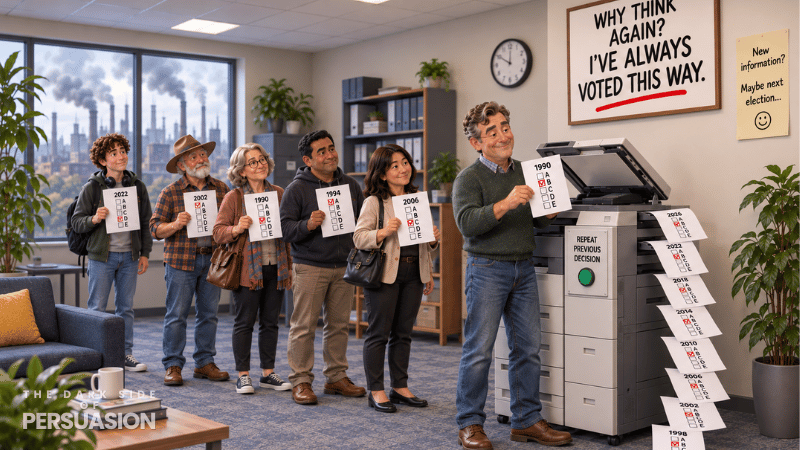
“I’ve always voted this way.” Consistency saves us time and effort, but our previous decisions can become shortcuts that prevent us from properly considering new information.
But political decisions have consequences beyond maintaining our own consistency. When we cast a vote, we help determine how our state or country will be governed, which laws will be passed and how those decisions may affect other people, including people beyond our own borders. Political decisions can shape not only the political landscape but, through the behaviours society permits, prohibits or rewards, its moral landscape as well. And laws and institutions created today can take considerable effort to change tomorrow.
(Learn more about the principle of consistency in my podcast episode dedicated to it.)
There is also a more personal consequence that we will return to later. When our political preference is known to other people, they may associate us with the actions and positions of the people or party we continue to support — including actions we ourselves may never have endorsed.
Giving Ourselves Permission to Change Our Minds
One reason Consistency is so powerful is that changing our position can feel uncomfortable. We may worry about appearing inconsistent, unreliable or even admitting that we were previously wrong. But there is an important distinction between inconsistency and updating our judgement in response to new information.
A responsible decision made with the information available to us five years ago does not automatically remain the responsible decision today. Parties change. Leaders change. Circumstances change. New evidence becomes available.
Rather than asking, “How have I always voted?”, perhaps a more useful question is:
“Knowing what I know today, what decision would I make if I had never voted before?”
More Australians Are Willing to Rethink Political Loyalty
Changing a position because the evidence has changed need not be something to be embarrassed about. It can simply mean that we have reconsidered the evidence and formed a new judgement. Those are the actions of a responsible person.
Australian voters appear increasingly willing to loosen traditional party attachments. The 2025 Australian Election Study reports that the proportion saying they feel no closeness to any political party increased from 14% in 2010 to 25% in 2025 — part of the broader phenomenon political scientists describe as partisan dealignment. Access the 2025 Australian Election Study
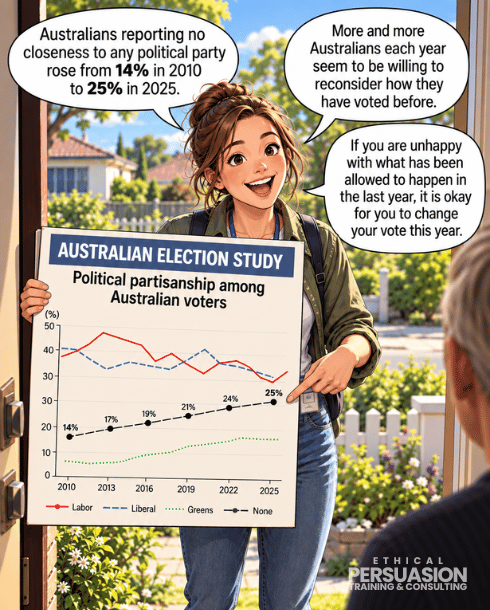
Australian Election Study data shows that the proportion of Australians reporting no closeness to any political party increased from 14% in 2010 to 25% in 2025 — suggesting traditional party attachments are weakening.
Party Allegiance Can Make Us Defend Behaviour We Would Otherwise Condemn
Consistency, however, may not be the only psychological force at work to lock us into a voting habit that doesn’t reflect what we really stand for, condone, or want. The Principle of Unity concerns the favouritism, loyalty and forgiveness we grant people whom we perceive not merely as similar to us, but as one of us. Political identity can become one such source of Unity. Instead of simply saying, “I voted for the Labor Party” or “I voted for the Liberal Party”, we begin saying, “I’m Labor”, “I’m Liberal”, “I’m a Republican”, “I’m a Democrat.”
The political preference has become part of our identity.
That distinction matters because criticism of something we support can be evaluated as information. Criticism of something that has become part of who we are can feel much more personal.
Research highlighted by Cialdini provides a disturbing illustration.
Ashwini Ashokkumar, Meredith Galaif and William Swann conducted four studies examining how people responded when a member of their own political party committed tax evasion. They found that people strongly aligned with their political group were more willing to hide evidence of tax fraud. Especially when the wrongdoing was not publicly known, strongly aligned members were more inclined to overlook or conceal the wrongdoing.
Think about what that means.
The tax fraud itself hasn’t changed.
What changed was who committed it — and whether exposing it threatened a group with which the observer identified.
Another study, by Christian von Sikorski, Roland Heiss and Jörg Matthes, followed Austrian voters immediately before and after a major political scandal during the 2017 parliamentary election. Their results provide a useful qualification: party loyalty is powerful, but it isn’t unlimited. Supporters can engage in motivated reasoning, counterarguing information that threatens a politician they already favour and sometimes shifting responsibility towards other political actors.
This gives us an uncomfortable but useful test:
Would I judge exactly the same behaviour in exactly the same way if it were committed by a politician from the party I oppose?
If the answer changes depending on whose name is attached to the behaviour, Unity may already be influencing your judgement.
A Contemporary Stress Test: Donald Trump
Donald Trump’s second presidency provides a particularly visible contemporary setting in which to ask this question — not because Republican voters are uniquely susceptible to Unity, but because the scale of current political events makes it possible to observe how political identity interacts with rapidly accumulating information.
For example, Trump’s administration launched the current war against Iran without specific congressional authorisation. Legal experts interviewed by Reuters have questioned both the extent of presidential authority for the conflict and whether the attacks comply with international law. Congress itself has been divided: in July 2026 the Republican-controlled House passed a War Powers resolution directing Trump to halt unauthorised military action against Iran, while the Senate subsequently blocked a similar measure.
Trump’s pursuit of control over Greenland also created a prolonged dispute with Denmark and Greenland and tensions within NATO. He repeatedly said the United States should control Greenland and at times declined to rule out economic or military force. That dispute ultimately moved towards negotiation, culminating on 22 September 2026 in an agreement expanding the American military presence while stopping short of Trump’s earlier ambition for US acquisition of the territory.
And Republican support for Trump, while falling, remains substantial. A Reuters/Ipsos poll conducted in September 2026 put Trump’s overall approval at 32%, but approval among Republicans at 73%, down from 82% the previous week. It is worth asking whether the psychology of identifying with a party is clouding people’s judgement.
How much behaviour from someone on “our side” are we prepared to reinterpret, excuse or defend
before we would apply the same standards we apply to someone on “the other side”?
That question doesn’t belong exclusively to American Republicans. The same psychological mechanism can potentially operate among Democrats, Labor voters, Liberal voters, Greens voters, One Nation voters — or supporters of almost any political movement.
And Unity doesn’t necessarily stop at national borders. Political parties, governments and individuals can develop strong identification with international allies, movements and ideological causes. When those allies subsequently behave in ways that conflict with our previous expectations or values, the same psychological challenge can arise:
Do we reassess the relationship in light of the new evidence,
or do we reinterpret the new evidence in order to preserve the relationship?
That is perhaps the most important protection against the darker side of political Unity: judge the behaviour first, before reminding yourself who did it.
Association: Our Choices Say Something About Us
Another psychological mechanism worth considering is how association affects how others view us.
Companies understand association extremely well. That’s why they pay enormous amounts for successful athletes, actors and musicians to appear beside their products. We like the celebrity, and some of that positive feeling can transfer to the brand. The reverse also happens.
When a celebrity becomes embroiled in a serious scandal, brands often race to distance themselves. The person’s behaviour hasn’t changed the ingredients in a soft drink or the stitching in a pair of shoes. What has changed is the association.
Politics creates associations too.
When we publicly identify with a political party, we inevitably become associated to some degree with what that party represents and does. That doesn’t mean we endorse every policy, every politician or that we could have foreseen every deception, broken promise or mistake. No reasonable person should assume that. But especially when we continue our political support, which is a choice, we can logically be seen as having found the past policies and conduct acceptable, and we approve of it continuing.
This is especially confronting, potent and emotional when political decisions involve questions we regard as morally fundamental.

We may not personally support everything a political party does. But when we repeatedly associate ourselves with that party, others may begin to associate us with its actions and positions too.
We Don’t Control What Others Associate With Us
The power of Association becomes particularly obvious when celebrities take positions on highly emotional issues. The war in Gaza has forced actors, musicians and other public figures into exactly this territory. Some have publicly supported Israel, others have publicly supported Palestinians, others have condemned the actions of the Israeli government, and still others have attempted to remain neutral. Whatever position they take, Association works in both directions. People who share their position may feel closer to them; people who find that position morally unacceptable may discover that they can no longer look at that celebrity in quite the same way.
That reaction can be remarkably powerful. A film that once entertained us can suddenly feel different when its star has publicly associated themselves with something we find morally objectionable. A familiar voice in an animated film can acquire an entirely different association. Some consumers boycott artists, films and companies for precisely this reason. Personally, I sometimes wish streaming services allowed me to filter out actors or celebrities whose public associations mean I simply don’t want to encounter them. The product hasn’t changed. The association has.
Singer Ed Sheeran recently discovered how quickly those associations can change. His US tour dropped Macklemore after the rapper made pro-Palestinian statements on stage. Sheeran claims the decision was made by the tour promoter following pressure from venues, rather than by him personally. But Association doesn’t necessarily wait for those distinctions, and Ed Sheeran could have taken a more solidarity stance with Macklemore. The decision became associated with Sheeran and his tour. Other support acts subsequently withdrew in solidarity with Macklemore, public criticism intensified, and Sheeran faced a substantial social-media backlash. Sheeran has since publicly described what is happening in Gaza as “catastrophic and unjustifiable”, but for some people the association created by the controversy may be difficult to undo.
Political association can carry much more personal consequences because our political support helps put people into power.
In Australia, then-Liberal leader Peter Dutton said in 2025 that Benjamin Netanyahu would be welcome in Australia under a Coalition government, after the International Criminal Court had issued an arrest warrant for Netanyahu alleging war crimes and crimes against humanity. An arrest warrant is not a conviction, and Netanyahu and Israel reject the allegations. But Association doesn’t require us to decide the legal case. If you continue publicly aligning yourself with a political movement after knowing the positions its leaders have taken, don’t be surprised if other people allow those positions to influence how they see you.
The same applies to Labor. Prime Minister Anthony Albanese requested the invitation that brought Israeli President Isaac Herzog to Australia in February 2026. Herzog’s visit prompted protests involving thousands of Australians, opposition from within Labor and considerable public controversy; more than 1,000 Jewish Australians also reportedly signed an open letter asking for the invitation to be withdrawn. If you continue publicly and enthusiastically associating yourself with Labor after such decisions, you cannot demand that other people completely separate you from the conduct and relationships you are helping that party retain the power to pursue.
Britain provides another confronting example. The Labor government proscribed Palestine Action under terrorism legislation in July 2025. In the year to March 2026, 2,819 arrests were recorded as linked to suspected support for Palestine Action.
The average age of those arrested was 59; the oldest was 89.
Of those arrests, 484 had resulted in charges at the time the statistics were compiled. Critics have strongly challenged the use of terrorism legislation against peaceful expressions of support. Whatever your conclusion about that dispute, continuing to associate yourself with the party responsible also means accepting that other people may take those actions into account when forming an opinion of what your political allegiance represents.
And the same principle applies to supporters of Donald Trump and the Republican Party. Trump’s second administration has imposed sweeping tariffs affecting longstanding international relationships, pursued immigration measures that have faced serious legal challenges, and dramatically expanded American intervention abroad. Just this month, a federal appeals court upheld a ruling that the administration’s rapid third-country deportation policy was unlawful. Trump has also openly emphasised American military dominance and intervention in the Western Hemisphere. If you continue to publicly identify yourself with that political movement, don’t be surprised if people assume that you support those actions.
What Your Political Support Communicates to Others
None of this means that another person’s assumptions about you will always be accurate. That isn’t how Association works. Association is not a careful audit of everything somebody privately believes. It is the transfer of meaning from one thing to another because we repeatedly see them connected.
And that creates an uncomfortable reality for political loyalty:
We don’t get to choose only the positive associations that come with the political parties we keep supporting.
If we voluntarily wear the badge, display the sign, defend the party, identify ourselves as one of its supporters and repeatedly help return it to power, other people may judge us poorly or want to avoid us based on what our continued support allowed that party to do.
What Your Political Support Communicates to Others
We can all make a decision based on incomplete information. We can all be persuaded by promises that don’t eventuate. We can all discover that something we once supported has changed.
Consistency becomes dangerous when yesterday’s decision prevents us from responding to today’s evidence.
The privacy of the ballot box gives us an extraordinary freedom. Nobody needs to know how we vote. But perhaps a useful personal test is to imagine that the people whose judgement matters most to us did know. If our children, closest friends or people we deeply respect knew exactly why we voted as we did, would we be comfortable explaining the decision?
Our vote should, at the very least, sit comfortably with our own conscience.
Reciprocity Isn’t Corruption — and Social Proof Isn’t Stupidity
There is an important theme running through all these examples.
Reciprocity doesn’t mean politicians who receive benefits are corrupt. Social Proof doesn’t mean people influenced by apparent majority opinion are stupid. Consistency doesn’t make loyal voters gullible. Association doesn’t mean somebody endorses every action taken by a group they support.
These mechanisms work precisely because they are normal features of human decision-making.
The scientists in the pharmaceutical research were trained professionals. The students whose attitudes towards torture shifted weren’t necessarily weak-minded. People responding to political polls aren’t unintelligent. And politicians aren’t magically exempt from psychology because they were elected to Parliament.
That’s the point. We should design important decisions with human psychology in mind rather than pretending it doesn’t exist.
Fighting Political Manipulation and Influence
Some political organisations have begun removing particular pathways of influence. The Victorian Greens, for example, publicly state that they don’t accept corporate donations and campaign for stronger restrictions on corporate money in politics.
That doesn’t make Greens politicians immune from influence. They’re human too.
It simply removes one potential source of influence, and I find that difficult to argue against.
If an organisation has millions or billions of dollars riding on a government decision, why should it be allowed to provide money or personal benefits to the people responsible for making that decision? We don’t need to establish corruption before recognising a conflict worth avoiding.
Protecting Your Vote From the Dark Side of Persuasion and Political Manipulation

Understanding how persuasion works doesn’t make us immune to influence — but it can help us recognise when others are trying to shape our decisions and give us the opportunity to think more critically before casting our vote.
The mechanisms discussed throughout this article are not reasons to become cynical about politics or persuasion. They are reasons to become better informed about how our decisions can be influenced. As voters, we have both a responsibility and a right that generations before us fought — and sometimes died — to obtain. Above everything else, I respect that every person has the right to form their own opinion and cast their vote accordingly.
But when you have the opportunity to vote, let it matter.
Let it reflect what you genuinely want.
Don’t allow your decision to be quietly hijacked by the dark side of persuasion.
People will always try to influence your vote. There is nothing inherently wrong with that. Ethical persuasion helps us make good decisions by presenting relevant information truthfully, without deception, exaggeration or manipulation. The test I often use is simple: if you later discovered exactly how you had been influenced, would you regret the decision because of it?
Understanding political persuasion can also make political manipulation easier to recognise. It doesn’t make us immune to influence, but understanding how these mechanisms work can help us recognise what is shaping our judgement before we decide.
During the months of political campaigning leading up to an election — and particularly as you approach the ballot box — here are some things worth remembering:
- Ask who is trying to influence the people who want your vote. Look at political donations, corporate gifts, sponsored travel, hospitality and privileged access. None of these automatically proves improper influence, but understanding who is building relationships with politicians gives you information worth considering.
- Treat social media as a constructed environment, not a window onto public opinion. Your feed is selected for you. Comments can be amplified, suppressed, filtered, coordinated or generated by people who aren’t representative of the wider population. Ten thousand likes don’t necessarily mean ten thousand independent Australians reached the same conclusion.
- Don’t let the crowd make your decision for you. During debates, rallies and political appearances, remember that the audience is a tiny and potentially unrepresentative sample. Applause, laughter, cheering and booing can influence our perception of what we’ve just heard. When you hear the crowd reacting, consciously remind yourself: I’ll decide whether that argument was good.
- Don’t let polls choose for you. Polls attempt to measure what other people intend to do (not necessarily what they will do); they don’t tell you what you should do. Methodology matters; stated voting intentions can change, and polling results can themselves create Social Proof that may not be correct but, regardless, should have no impact on you. Your ballot belongs to you, not to the apparent majority.
- Don’t confuse attractiveness, confidence or charisma with capability. Human beings can unconsciously attribute positive qualities to people simply because they are attractive or present themselves well. Look past appearance to performance. Examine policies, intentions, past conduct and demonstrated results.
- Don’t vote from habit. Voting the same way you voted last time is cognitively easy. Easy and right aren’t necessarily the same thing. Give yourself permission to reconsider every election. A decision you made five, ten or twenty years ago doesn’t deserve automatic renewal simply because “I’ve always voted this way” or others know about your voting history.
- Investigate the alternatives — especially the ones you know least about. Your individual vote may feel insignificant, but democracy is ultimately the accumulation of individual decisions. Invest enough time to understand the choices available rather than restricting yourself automatically to the parties you already know.
- Judge past performance before listening to new promises. Election campaigns are designed to focus our attention on what politicians promise to do next. Before accepting those promises, go back to what they promised last time. What actually happened? What did they accomplish? What did they abandon? What changed? Past behaviour doesn’t perfectly predict future behaviour, but it gives you evidence that campaign promises alone cannot.
- Separate political identity from political evaluation. You don’t owe a political party lifelong loyalty. A party can change. Its leadership can change. Its policies can change. Circumstances can change. And new information can reveal things you didn’t know when you made your previous decision.
- Stop saying “I vote <party name>”; Start saying “This year I vote/voted <party name>, and I’ll be watching to see if they deserve that again next year”. This signals to others that you don’t form automatic alliances, that responsible people reevaluate their voting preferences, and that your friends might want to do the same.
- Remember that political Association works both ways. Your political preferences are your own business, and other people’s opinions of you shouldn’t determine your vote. But if you publicly identify with, defend or campaign for a political party, recognise that others may associate you with what that party subsequently does or what it already has done. Ask yourself whether you are comfortable with that association and whether you could explain your decision to the people whose judgement matters most to you.
And perhaps one final question is worth asking immediately before casting your vote:
If I had never voted before, knew what I know today, and nobody else could influence my decision — what would I choose?
Then make up your own mind.
Persuasion Isn’t the Problem. Political Manipulation Is.
This article isn’t an attempt to cast a dark shadow over persuasion. Persuasion has existed for as long as human beings have needed to cooperate. Our ability to succeed — professionally, socially and collectively — depends enormously on our ability to convince other people of the merits of what we hope to achieve. Perhaps it isn’t surprising, then, that the World Economic Forum’s Future of Jobs Report 2025 ranks ‘Leadership and Social Influence’ as the third most important core skill.
Developing the skills and confidence to persuade ethically can help us realise more of the successes that were genuinely ours to have — by communicating better, reducing uncertainty, building trust and helping people make decisions that are right for them.
But learning the science of persuasion gives us something else that may be equally valuable:
It teaches us to recognise when those same mechanisms are being used on us.
That distinction matters. Ethical persuasion respects another person’s freedom to make an informed decision. Manipulation attempts to obtain the decision while concealing, distorting or exploiting the forces being used to produce it. Learning ethical persuasion, therefore, isn’t only about becoming more effective at influencing others. It can also make us more thoughtful consumers, professionals, parents, partners and citizens.
In business, understanding persuasion can help us avoid wasting success.
In a democracy, understanding persuasion can help protect our voice, our vote and our impact on the world around us.
And if this article has made you recognise even one influence on your political decisions that you hadn’t noticed before, share it with someone else. Because the more people who understand how their decisions can be influenced, the harder it becomes for anyone to manipulate them.