It’s one of the most frustrating experiences in any profession: you know you have the better solution, but the deal goes to a competitor who looked more the part. The hard truth is that we often lose opportunities not on the merit of our proposal, but because of a snap judgment. This is the unfair advantage of appearance, where a powerful first impression can grant instant credibility before the real discussion even begins.
This bias isn’t just a feeling; it’s a well-documented phenomenon known as the Halo Effect. It is when one positive characteristic, like an attractive face or professional demeanour, controls how a person is viewed in other respects.
The real-world power of this effect is shockingly profound. In a landmark study on Canadian federal elections, researchers found that attractive political candidates received more than two and a half times the number of votes as their less attractive counterparts.* What’s most telling, however, is that 74% of voters later denied that physical appearance had influenced their decision, proving this powerful bias operates almost entirely on a subconscious level.
What Are “Trappings”? The Shortcut to Authority
But the power of appearance extends far beyond the physical features you can’t change. My business partner, Dr Robert Cialdini, identifies the controllable clues of success, your clothing, your car, your professional environment, as “trappings.” These trappings act as powerful shortcuts for the brain. In the single, fleeting opportunity of a first impression, they signal your credibility and automatically activate the Principle of Authority for your audience.
The Jaywalking Study: Proof of Trappings in Action
To see how instinctively we obey these signals, consider a classic 1955 study. Researchers found that 350% more people were willing to follow a man jaywalking against a traffic light when he wore a business suit compared to when he wore a work shirt.
Understanding these signals is critical for preventing the loss of scarce opportunities. If these trappings are missing, you start at a significant disadvantage—you might never get the chance to demonstrate your expertise because a potential client has already dismissed your meeting request or pushed your proposal aside. They’ll naturally gravitate toward a competitor who, through their appearance, projects a stronger sense of authority.
This article will therefore break down the different types of trappings, explore the science of how they influence perception, and provide an ethical framework for using them to ensure your appearance accurately projects the expertise you already possess.
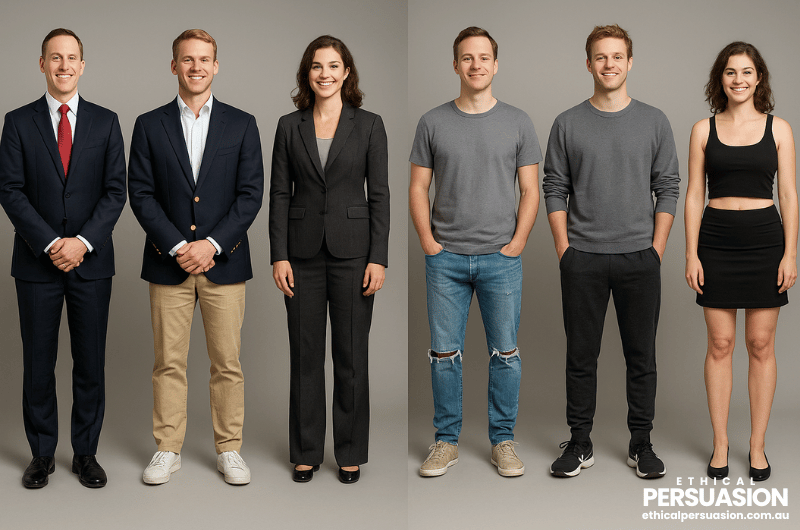
The same people, well-groomed and dressed professionally, can make us feel very different when dressed casually and not well-groomed.
What are Examples of Trappings?
The outward clues of success go far beyond just the clothes we wear. Attention to the details of your personal presentation can significantly impact how people perceive your credibility and authority. Here are some of the most common trappings people notice.
- Clothing and Shoes: The outfit you wear will communicate your expertise. While jeans and old runners may not send a message of authority, fashionable shoes, a business shirt, or a well-fitting suit tells people that you know your stuff.
- Grooming and Hygiene: This is the foundation of your appearance. A neat haircut is essential, as an overdue trim or messy hair detracts from your perceived authority. The same is true for your teeth; while it shouldn’t matter, it does, and a well-maintained smile is a significant asset. A pleasant or neutral scent and, for those who wear it, well-applied make-up complete a polished, professional look.
- Quality Accessories: Items like a classic watch or professional glasses complete the picture. They act as subtle but powerful signifiers of success and attention to detail, further reinforcing your professional image.
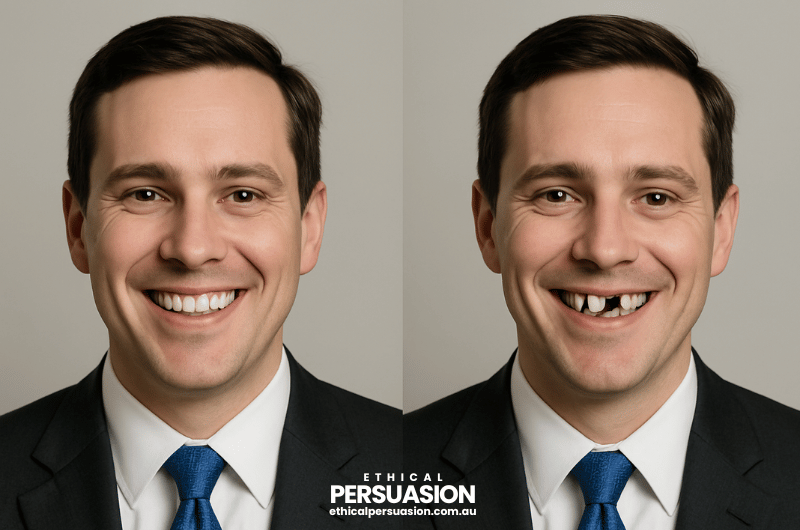
Imperfections in a person’s appearance have nothing to do with their mental capabilities, yet the perception of how professional and capable they are in the eyes of others can change.
The Trappings of Your Environment
Let’s widen our view from what we may wear on our person. The signals of authority extend far beyond your personal attire; your environment and the tools you use are constantly communicating your level of success and professionalism.
- Your Professional Assets: The quality of the tools you use speaks volumes. Ever seen an old economy car parked in the dedicated parking spot of a dentist? It doesn’t inspire confidence. Similarly, waving around a 50-cent pen or the free pens from the conference centre doesn’t signal you’re a professional. Your car, your pen, and even the quality of your business cards are all clues people use to assess your success.
- Your Physical Environment: Every detail of your office space is a ‘moment of truth’. From a prestigious street address and an impressive building exterior to a clean reception area and an organised desk, each step of a client’s physical journey with you either builds your credibility or damages it.
- Your Digital Environment: In the age of remote work, your video call presence is your new office. A messy background is the worst, followed closely by the generic ‘blurred’ background. Better is a professional virtual background, but often best is a clean, real-world environment. Investing in good lighting—even 3-point lighting and a better camera—further signals your professionalism.
- Your Support Systems: The presence or lack of a receptionist or an assistant is a powerful, non-verbal clue. It signals that your time is valuable and that you operate a successful, well-managed enterprise. A quiet office free from distracting background noise further reinforces that you are in control.
Does a Luxury Car Make You More Influential?
Research clearly shows that people perceive drivers of luxury cars as more successful and authoritative. This phenomenon is a powerful, real-world example of a cognitive bias at work, where symbols of wealth subconsciously influence our behaviour.

A luxury car not pulling away when the light turned green, and 50% of people never honked the horn
A classic experiment, often called “The Horn-Honking Study,” illustrates this perfectly. Researchers had a car fail to move for 15 seconds when a traffic light turned green.
- Scenario 1 (Economy Car): When the car was an older, economy model, nearly every driver behind it honked. Some even bumped its rear bumper in frustration.
- Scenario 2 (Luxury Car): When the car was a luxury model, drivers waited much longer to honk, and a full 50% of them never honked at all.
The Psychology Behind the Patience
What’s happening here is a direct demonstration of the Principle of Authority. The luxury car acts as a ‘trapping’ of success and high status. This triggers a mental heuristic, or shortcut, in the other drivers’ minds, leading them to show more deference. They subconsciously associate the car with someone important—a person of credibility and power—whose time is perhaps more valuable. This automatic judgment is a testament to the power of these non-verbal cues.
The most telling part is that when this situation was described to people, they consistently failed to predict this outcome, with most claiming they would honk at the luxury car sooner. This reveals a critical gap between our conscious beliefs and our subconscious actions. We consistently underestimate how much these symbols of authority shape our behaviour.
How to Use Trappings in Sales
“Dress to impress” is timeless advice, but what does it mean in practice? In business and sales, what we wear, how we’re groomed, and even our manners are a foundational part of establishing credibility. This is why it’s common for retail staff to be hired based on their grooming habits and why many sales teams receive specific dress code training. The key is to calibrate your appearance to your audience; the goal is to project authority without creating a disconnect.
A simple yet powerful guideline is the “One Step Better” Rule: aim to dress just one level more formally than the person you are meeting.
- If your client wears a t-shirt and jeans, you wear a collared shirt with smart trousers.
- If your client wears a business shirt and trousers, you wear a similar outfit but add a jacket.
Following this rule allows you to maintain a position of authority while still being relatable. Dressing too formally, like wearing a full suit to meet a client in a t-shirt, can make you seem out of touch and can damage rapport before your pitch even begins.
What to Do When Dressed Too Formally?
If you find yourself in a situation where you’re not sure what to expect in terms of how your audience will dress, the smartest strategy is to build flexibility into your outfit through what we can call “strategic layering.”
- Wearing a full suit and tie, but the room is business casual? You can always take your jacket off and hang it on the back of your chair to instantly appear more relaxed.
- Still feel overdressed? Depending on the setting, you can also discreetly remove your tie to ‘dress down’ another notch.
This approach ensures you can always align with the “One Step Better” rule, even when you have to make a decision in the moment.
Is It Ethical to Use Appearance to Persuade?
This brings us to a critical ethical question: since we know appearance is so influential, is it right to consciously use it?
In a perfect world, appearance shouldn’t matter. But in reality, ignoring its impact means knowingly putting yourself at a disadvantage. The ethical line is crossed, however, when presentation becomes deception.
Consider this scenario: an independent consultant is about to meet a major potential client. To project a higher level of success, they rent a luxury car for the day and wear a borrowed designer watch. They aren’t just dressing well; they are actively creating a false narrative about their financial status. The items are ‘imported into the situation’ purely to mislead. This is a fragile strategy because if the client were to discover the truth, credibility would be shattered.
The most ethical and effective guideline is to pursue authentic authority. This doesn’t mean inventing a character you are not. It means presenting the best, most professional version of your true self, using quality items you own and are comfortable with. The goal is to ensure your outward appearance is an honest reflection of the expertise and value you genuinely possess.
What to Do When You’re Dressed Too Formally?
If you’re unsure of a client’s dress code, the smartest strategy is to build flexibility into your outfit. Think in terms of layers you can easily remove to adjust your level of formality on the spot.
- Wearing a full suit, but the room is business casual? Simply remove your jacket and hang it on the back of your chair. This instantly makes your appearance more relaxed.
- Still feel overdressed? Depending on the setting, you can also discreetly loosen or remove your tie.
This “strategic layering” ensures you can always align with the “One Step Better” rule, even when you have to make a decision in the moment.
Gain Your Persuasive Edge: Learn the Science of Influence
The ability to persuade is no longer a soft skill—it’s an essential business function. The World Economic Forum ranks it as one of the top 3 most urgent skills for the workforce, and for good reason.
Research by Daniel Pink shows that most professionals spend 41% of their time—two full days a week—trying to influence others. For CEOs, this rises to over 80%. The problem is, without a scientific framework, much of this effort is based on guesswork, leading to predictably underperforming proposals and wasted resources.
Learning the science of ethical persuasion changes this. It isn’t about becoming a ‘master’ overnight; it’s about replacing guesswork with a proven process. It gives you the skills to build your arguments with more confidence, to better understand the motivations of your audience, and to gain a significant, sustainable advantage in your professional interactions. It is the highest-ROI investment you can make in your career effectiveness.
Choose Your Path towards Mastery
- Ready for Deep Expertise? Build application skill and confidence with our world-renowned programs.
- For Individuals: Take a leap forward towards mastery with Dr. Cialdini’s Flagship Certification Courses with live training sessions with your Cialdini Certified Trainer over 8 weeks, or take an economical and valuable first step by attending an online workshop for just a few hundred dollars.
- For Organisations: Safeguard your competitive edge with customised Keynotes, Consulting, and Workshops.
- Start Learning Today (For Free) Not ready for a full course? No problem. Head to our FREE resources page to:
- Download our e-booklet on the science of persuasion (no email required).
- Sign up for 7-Day Influence Lessons delivered directly to your inbox.
- Get Ongoing Insights Join many other professionals and subscribe to our newsletter. You’ll get a powerful, 7-minute insight on ethical persuasion delivered to you every two weeks.
We wish you an influential future.
Patrick van der Burght
Founding Member of the Cialdini Institute
Cialdini Institute Licensed Trainer
Author of the book ‘How to Hear YES More Often’
References/Research links:
^Voters Vote Beautiful – The Effect of Physical Appearance on a National Election – M.G. EFRAN, E.W.J. PATTERSON, 1974 – Link
*The relationship between teacher perceptions of pupil attractiveness and academic ability – K. Hansen 2016 – Link
** Lefkowitz, M., Blake, R. R., & Mouton, J. S. (1955). Status factors in pedestrian violation of traffic signals. Journal of Abnormal and Social Psychology, 51(3), 704–706. https://doi.org/10.1037/h0042000
*** Doob, A. N., & Gross, A. E. (1968). Status of frustration as an inhibitor of horn-honking responses. Journal of Social Psychology, 76(2), 213–218. – Also mentioned here.